The True Man of Nanhua
庄子
Zhuangzi
The True Man of Nanhua
庄子
The Butterfly Dream: He dreamed he was a butterfly, free and happy, forgetting he was Zhuangzi. Upon waking, he wondered: who was dreaming whom? This parable touches fundamental questions of identity and reality that have fascinated philosophers for millennia.
The Happiness of Fish: 'The minnows dart about — that is the happiness of fish.' 'You are not a fish. How do you know?' 'You are not me. How do you know I don't know?' — A timeless debate on the limits of knowledge.
The Owl and the Phoenix: When Huizi feared Zhuangzi wanted his prime ministership, Zhuangzi told of a phoenix that an owl threatened over its rotting rat — 'Are you trying to frighten me with your office?'
Drumming on the Pot: When his wife died, Zhuangzi drummed and sang. He explained: life and death are the gathering and dispersing of qi, as natural as seasons turning. To weep would show ignorance of fate.
昔者庄周梦为胡蝶,栩栩然胡蝶也……不知周之梦为胡蝶与,胡蝶之梦为周与?
"Once Zhuangzi dreamed he was a butterfly, flitting happily about… When he awoke, he did not know: was he Zhuangzi who had dreamed of being a butterfly, or a butterfly dreaming it was Zhuangzi?" — The boundary between self and other, dream and reality, dissolves.
天地与我并生,而万物与我为一。
"Heaven and Earth were born with me; the ten thousand things are one with me." — A declaration of cosmic unity that transcends the individual ego.
至人无己,神人无功,圣人无名。
"The perfect person has no self; the divine person has no achievement; the sage has no fame." — The three ideals of Daoist transcendence.
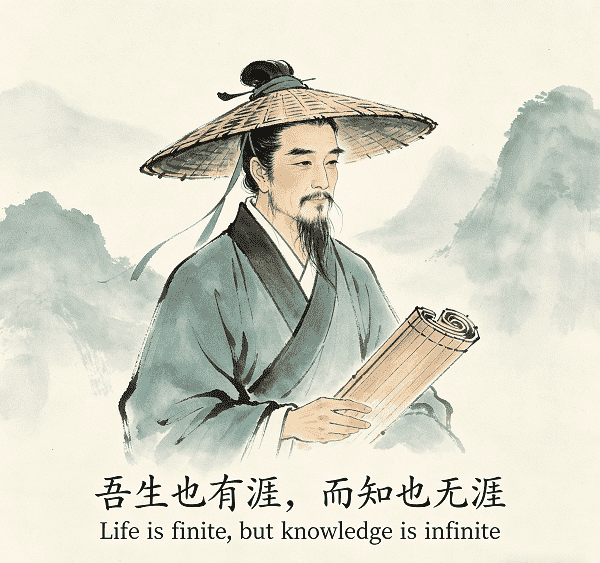
吾生也有涯,而知也无涯。以有涯随无涯,殆已。
"Life is finite, but knowledge is infinite. To pursue the infinite with the finite — that is perilous." — A warning against the exhausting chase for total knowledge.
相濡以沫,不如相忘于江湖。
"Rather than moistening each other with spit in a dried-up puddle, forget each other in the rivers and lakes." — Sometimes separation is kinder than clinging.
From the Dao's perspective, all things are equal. Big and small, beauty and ugliness, life and death — these are artificial distinctions. Transcending dualities reveals all things as manifestations of the Dao.
The highest state — not physical travel but spiritual freedom. The great Peng bird's wingspan of three thousand li illustrates scale, but true freedom is 'riding the true course of Heaven and Earth, to wander in the infinite.'
Everything is in constant transformation. Butterfly becomes Zhuangzi, Zhuangzi becomes butterfly. Don't cling to any fixed form — transformation is the essence of the universe.
A massive oak survived a thousand years because its wood was useless. 'Everyone knows the use of useful things, but no one knows the use of useless things.' Art, play, dreams — these 'useless' things give life true meaning.
Thirty-three chapters in three sections. Not only a philosophical pinnacle but a literary masterpiece — sweeping prose, vivid parables, and poetic imagination making it the model of pre-Qin literature.
Zhuangzi's thought offers modern people an inexhaustible treasury. His binary-transcending mindset helps reduce anxiety (aligning with modern 'decentering'). His unconventional thinking fuels creativity. His holistic cosmology supports environmental protection. And his 'use of uselessness' provides a refreshing antidote to relentless competition.