The Prince of Law
韩非子
Han Feizi
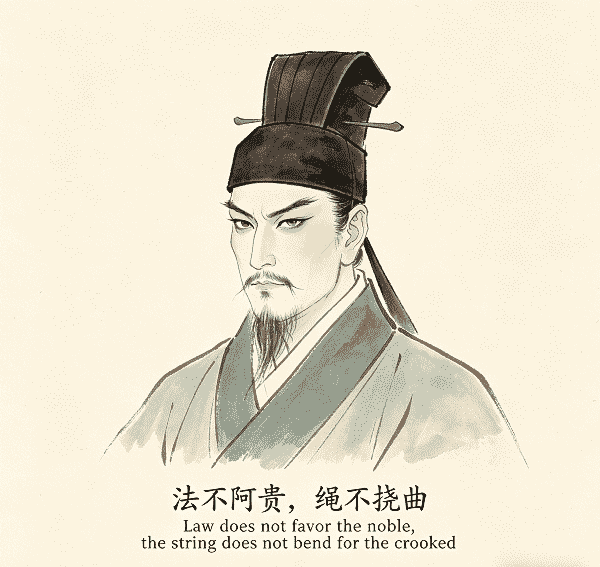
The Prince of Law
韩非子
Han Feizi, personal name Fei (非), was a prince of the State of Han — one of the weakest of the Seven Warring States, constantly under threat from its powerful neighbors. Born around 280 BCE into the declining royal house, Han Feizi witnessed firsthand how good intentions without effective systems fail to protect a nation.
Despite his royal birth, Han Feizi had a speech impediment — he stuttered badly. In an age when political success depended on eloquent persuasion, this was a devastating handicap. While his fellow student Li Si could charm kings with silver words, Han Feizi turned to the written word. His pen became his sword, and his writings would prove more powerful than any diplomat's tongue.
Han Feizi studied under Xunzi at the Jixia Academy, absorbing his teacher's rigorous analytical approach. But where Xunzi channeled his system toward Confucian ends — ritual, moral cultivation, education — Han Feizi pushed the logic of institutional control to its extreme, creating a comprehensive political science independent of moral ideals.
Han Feizi wrote repeatedly to the King of Han, pleading for reform. His warnings went unheeded. But his writings reached Qin Shi Huang (then King Zheng of Qin), who was so impressed that he declared: "If I can meet this man and befriend him, I can die without regret." Qin then attacked Han, and the terrified King of Han sent Han Feizi as an envoy to Qin — delivering his greatest thinker into the hands of his greatest enemy.
In Qin, Han Feizi was received but soon fell victim to court jealousy. His former classmate Li Si, now Chancellor of Qin, feared Han Feizi would overshadow him. Li Si poisoned Han Feizi in prison before he could meet the First Emperor. The man who wrote the most sophisticated analysis of political power in ancient China died powerless, betrayed by the very system he had described.
Study Under Xunzi: Han Feizi and Li Si studied together under the great Confucian Xunzi. Both were brilliant — but Li Si later recalled that Han Feizi was always the superior scholar. They absorbed Xunzi's belief that human nature needs external constraint, but drew opposite conclusions: Li Si chose raw power, while Han Feizi built a systematic philosophy.
Failed Reforms in Han: Han Feizi submitted multiple memorials to the King of Han, urging reform. He advocated strengthening the military, reforming the bureaucracy, and implementing clear laws. His proposals were ignored — the court preferred comfortable tradition to painful change. Han Feizi channeled his frustration into two of his most passionate essays: "Difficulties of Persuasion" (说难) and "Solitary Resentment" (孤愤).
Impressing the King of Qin: When King Zheng of Qin read Han Feizi's essays, he was thunderstruck. The writings articulated precisely what Qin needed — not moral idealism but a cold, practical system of governance. The famous anecdote says Zheng read Han Feizi's "Solvent Resentment" and "Five Vermin" and immediately ordered an attack on Han to obtain the author.
Death in Qin Prison: Li Si, now Qin's Chancellor, poisoned Han Feizi in prison out of jealousy. The First Emperor eventually regretted and sent a pardon, but it arrived too late. Han Feizi died in 233 BCE — and just nine years later, Li Si implemented Han Feizi's philosophy to help unify China under the Qin dynasty. The student used the master's ideas to build an empire.
法不阿贵。
"The law does not yield to the noble." — Justice must be impartial; the law applies equally to prince and commoner.
宰相必起于州部,猛将必发于卒伍。
"Prime ministers must rise from local offices; fierce generals must emerge from the ranks." — Promotion should come from proven experience, not birth or connections.
世异则事异,事异则备变。
"When the world changes, affairs change; when affairs change, preparations must change." — Governance must adapt to historical circumstances.
千里之堤,毁于蚁穴。
"A dike of a thousand li is destroyed by an ant hole." — Small corruptions, left unchecked, will bring down great institutions.
以法治国,则举措而已。
"Governing the state by law — that is all one needs." — Clear laws consistently enforced are the foundation of order.
Law must be public, clear, and consistently enforced. Everyone — from the highest minister to the lowest peasant — must know the rules and their consequences. Law is not an instrument of the ruler's whim but an impersonal system. Han Feizi emphasized that changing laws frequently destroys their authority; stability and predictability are paramount.
"Method" refers to the ruler's techniques of governance — how to appoint, evaluate, promote, and dismiss officials. The ruler must hold officials accountable by matching results to responsibilities. He should listen to both praise and criticism, checking them against reality. Shu is the art of governing men, distinct from governing by law alone.
"Positional power" — the authority inherent in the throne itself, independent of the ruler's personal virtue. Han Feizi argued that even an average ruler, seated on the throne with proper institutional support, can govern effectively. Conversely, even a sage without power cannot save a state. Position and institution matter more than individual talent.
Han Feizi inherited Xunzi's view that human nature is self-interested. But he went further: even the closest human bonds — parent-child, husband-wife — are ultimately driven by calculation. The ruler must design systems that channel self-interest toward public good, rather than relying on moral appeals or personal loyalty.
The collected works of Han Feizi, comprising fifty-five essays that together form the most comprehensive Legalist political philosophy in Chinese history. Major essays include "The Five Vermin" (五蠹), which attacks social parasites that weaken the state; "Solitary Resentment" (孤愤), a passionate cry from a misunderstood genius; "Difficulties of Persuasion" (说难), a brilliant psychological analysis of the art of political persuasion; and "The Ruler's Way" (主道), which outlines the ideal relationship between ruler and ministers. The text also contains Han Feizi's two famous commentaries on Laozi's Dao De Jing — notable for being the earliest known philosophical interpretation of Daoist thought through a Legalist lens.
Rule of Law: Han Feizi's insistence that law must be public, consistent, and impartial — applying equally to the powerful and the weak — anticipates modern legal principles. His vision of law as an impersonal system, not an instrument of personal power, resonates with contemporary debates about judicial independence and constitutional governance.
Institutional Design: Han Feizi's emphasis on systems over individuals is strikingly modern. He argued that a good system produces good outcomes regardless of who runs it — an insight that aligns with contemporary institutional economics and the design of bureaucratic systems.
Incentive Structures: His analysis of human self-interest and the need to design systems that channel it productively anticipates modern economics and public choice theory. The idea that good governance aligns private incentives with public welfare is essentially Adam Smith applied to politics.
Adaptive Governance: "When the world changes, affairs change" — Han Feizi's insistence on adapting governance to circumstances rather than clinging to tradition resonates with modern approaches to policy-making that emphasize evidence-based, context-sensitive solutions.