The God of War
孙子
Sun Tzu
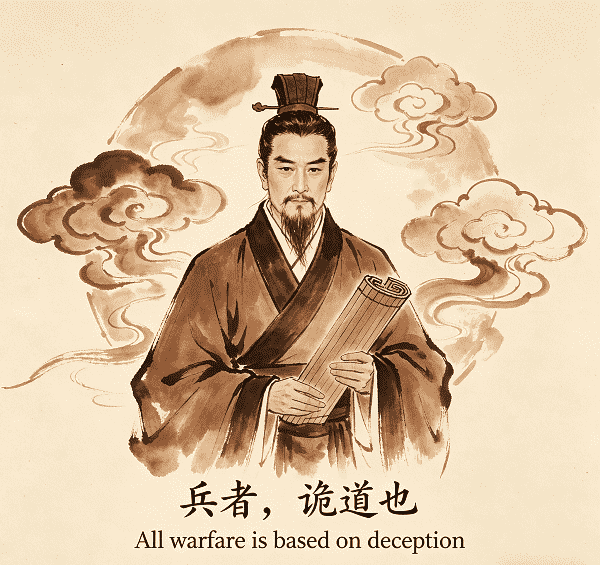
The God of War
孙子
Sun Tzu, personal name Wu (武), courtesy name Changqing (长卿), was a Chinese military strategist and philosopher who lived during the late Spring and Autumn period (approximately 544–496 BCE). He served King Helü (阖闾) of the State of Wu and is traditionally credited as the author of The Art of War (孙子兵法), the most influential treatise on strategy and warfare ever written.
According to the Records of the Grand Historian (史记) by Sima Qian, Sun Tzu was born in the State of Qi but migrated to Wu, where his talent for military strategy brought him to the attention of King Helü. The most famous anecdote about Sun Tzu illustrates the nature of his genius: to prove his methods to the skeptical king, Sun Tzu was given the king's palace concubines to train as soldiers.
When the women laughed and failed to follow orders, Sun Tzu ordered the king's two favorite concubines beheaded — despite the king's frantic protests. After the execution, the remaining women performed every drill with perfect precision. Sun Tzu told the king: "The soldiers are now trained. Your Majesty may use them as you wish." This ruthless demonstration of the absolute authority of military command became one of the most famous stories in Chinese history.
Under Sun Tzu's strategic guidance, the State of Wu rose from obscurity to become a major power. He led Wu's army to its greatest victory at the Battle of Boju (柏举之战) in 506 BCE, where a smaller Wu force decisively defeated the mighty State of Chu — one of the most celebrated military achievements of the entire Spring and Autumn period. After this victory, Sun Tzu seems to have withdrawn from public life. The details of his later years remain shrouded in mystery.
Training the Palace Women: When King Helü doubted Sun Tzu's abilities, Sun Tzu asked to demonstrate his methods using the king's harem of 180 concubines. Divided into two companies with the king's favorites as leaders, the women laughed at every command. Sun Tzu explained that if orders are clear and soldiers fail to follow, it is the officers' fault. When the women laughed again, he ordered the two favorites executed — despite the king's anguished pleas. With new officers appointed, the women drilled flawlessly. The lesson: in military affairs, command authority must be absolute.
The Battle of Boju (506 BCE): Sun Tzu's masterpiece. Wu's army, vastly outnumbered, faced the armies of Chu — one of the largest and most powerful states. Through brilliant strategic maneuvering, Sun Tzu achieved a deep penetration into Chu territory, won five consecutive battles, and captured the Chu capital of Ying (郢). This campaign demonstrated every principle from his treatise: speed, deception, exploiting the enemy's weaknesses, and attacking where they least expected.
Persuading King Helü: Before being granted command, Sun Tzu spent years studying and writing his treatise. When presented to King Helü, the king was skeptical — can theory really translate to practice? The concubine demonstration answered that question definitively. Sun Tzu proved that principles, rigorously applied, can transform any group into an effective force — even in the most unlikely circumstances.
Strategic Withdrawal: After the stunning victory over Chu, Sun Tzu reportedly advised King Helü against overextension. While the king's son and successor pursued further conquests, Sun Tzu faded from the historical record. Whether he retired, died, or was pushed aside is unknown. His withdrawal itself embodies his own principle: "Know when to fight and when not to fight."
知己知彼,百战不殆。
"Know yourself and know your enemy, and in a hundred battles you will never be in danger." — The most quoted line in military history: intelligence is the foundation of victory.
兵者,诡道也。
"War is the way of deception." — All warfare is based on misleading the enemy about your intentions, strength, and plans.
不战而屈人之兵,善之善者也。
"To subdue the enemy without fighting is the acme of skill." — The highest victory requires no battle at all; win through strategy, diplomacy, or psychological pressure.
兵无常势,水无常形。
"Military tactics are like water: water flows away from high places and toward low places." — Strategy must adapt to circumstances; rigidity leads to defeat.
上兵伐谋,其次伐交,其次伐兵,其下攻城。
"The supreme art of war is to subdue the enemy without fighting. Next best is to disrupt his alliances. Next is to attack his army. Worst of all is to besiege cities." — A hierarchy of strategic methods, from most to least efficient.
Sun Tzu's entire system rests on information. Before any action, a commander must thoroughly understand both his own capabilities and the enemy's. This requires spies, scouts, and constant analysis. The commander who acts without intelligence is "like a blind man trying to describe an elephant." Modern military intelligence, business competitive analysis, and even data-driven decision-making all trace their intellectual roots to this principle.
"All warfare is based on deception." Sun Tzu taught that appearing weak when strong, appearing far when near, appearing disordered when disciplined — these are the fundamentals of strategy. Deception is not dishonesty but the art of shaping the enemy's perception so they act in ways that serve your purposes. This principle extends far beyond the battlefield into negotiation, business strategy, and game theory.
"Shi" refers to the configuration of force — the positional advantage that multiplies the effectiveness of your resources. Like a boulder perched at the top of a mountain, the right configuration means even small forces can achieve decisive results. Sun Tzu emphasized building shi through preparation, positioning, and timing rather than relying on brute strength.
Sun Tzu's most radical insight: the greatest general wins without battle. Subduing the enemy through diplomacy, intimidation, cutting supply lines, or psychological warfare is superior to any engagement. War is costly — even victory drains resources. The ideal is to achieve objectives with minimal expenditure, preserving your strength for future challenges. This anti-war philosophy paradoxically makes The Art of War a guide to peace.
Thirteen chapters covering every aspect of military strategy: strategic assessment (计篇), waging war (作战篇), attack by stratagem (谋攻篇), tactical dispositions (形篇), force (势篇), weak points and strong (虚实篇), military maneuver (军争篇), variation in tactics (九变篇), army on the march (行军篇), terrain (地形篇), nine situations (九地篇), attack by fire (火攻篇), and the use of spies (用间篇). Despite its brevity — roughly 6,000 Chinese characters — it has influenced more readers across more cultures and centuries than any other work on strategy. Napoleon studied it; Japanese samurai adopted it; modern business schools teach it.
Business Strategy: The Art of War is the most widely read business strategy text in the world. Its principles — know your market, adapt to circumstances, build competitive advantages through positioning rather than brute force, and win without direct confrontation — have been applied by CEOs from Silicon Valley to Tokyo.
Negotiation and Diplomacy: Sun Tzu's insights into deception, information, and psychological pressure form the foundation of modern negotiation theory. His principle that "the supreme art is to subdue the enemy without fighting" directly informs contemporary diplomatic strategy and conflict resolution.
Competitive Intelligence: "Know yourself and know your enemy" is the philosophical basis of modern competitive intelligence. Market research, competitor analysis, SWOT analysis — all are applications of Sun Tzu's insistence on thorough information before action.
Adaptability: "Water flows away from high places and toward low places" — Sun Tzu's teaching on adaptability resonates in an era of rapid change. Agile methodology, design thinking, and adaptive leadership all echo his insistence that rigid plans fail and flexible strategies succeed.