Classical Chinese 原文古文原文
孫子曰:凡用兵之法,將受命于君,合軍聚眾,交和而舍,莫難於軍爭。軍爭之難者,以迂為直,以患為利。
sūn zǐ yuē: fán yòng bīng zhī fǎ, jiāng shòu mìng yú jūn, hé jūn jù zhòng, jiāo hé ér shè, mò nán yú jūn zhēng. jūn zhēng zhī nán zhě, yǐ yū wéi zhí, yǐ huàn wéi lì.
故迂其途,而誘之以利,後人發,先人至,此知迂直之計者也。
gù yū qí tú, ér yòu zhī yǐ lì, hòu rén fā, xiān rén zhì, cǐ zhī yū zhí zhī jì zhě yě.
軍爭為利,軍爭為危。舉軍而爭利則不及,委軍而爭利則輜重捐。
jūn zhēng wéi lì, jūn zhēng wéi wēi. jǔ jūn ér zhēng lì zé bù jí, wěi jūn ér zhēng lì zé zī zhòng juān.
是故卷甲而趨,日夜不處,倍道兼行,百里而爭利,則擒三將軍,勁者先,疲者後,其法十一而至。
shì gù juǎn jiǎ ér qū, rì yè bù chǔ, bèi dào jiān xíng, bǎi lǐ ér zhēng lì, zé qín sān jiāng jūn, jìn zhě xiān, pí zhě hòu, qí fǎ shí yī ér zhì.
五十里而爭利,則蹶上將軍,其法半至。三十里而爭利,則三分之二至。
wǔ shí lǐ ér zhēng lì, zé jué shàng jiāng jūn, qí fǎ bàn zhì. sān shí lǐ ér zhēng lì, zé sān fēn zhī èr zhì.
是故軍無輜重則亡,無糧食則亡,無委積則亡。
shì gù jūn wú zī zhòng zé wáng, wú liáng shí zé wáng, wú wěi jī zé wáng.
故不知諸侯之謀者,不能豫交;不知山林、險阻、沮澤之形者,不能行軍;不用鄉導者,不能得地利。
gù bù zhī zhū hóu zhī móu zhě, bù néng yù jiāo; bù zhī shān lín, xiǎn zǔ, jǔ zé zhī xíng zhě, bù néng xíng jūn; bù yòng xiāng dǎo zhě, bù néng dé dì lì.
故兵以詐立,以利動,以分合為變者也。故其疾如風,其徐如林,侵掠如火,不動如山,難知如陰,動如雷震。
gù bīng yǐ zhà lì, yǐ lì dòng, yǐ fēn hé wéi biàn zhě yě. gù qí jí rú fēng, qí xú rú lín, qīn lüè rú huǒ, bù dòng rú shān, nán zhī rú yīn, dòng rú léi zhèn.
Modern Chinese 今译现代汉语译文
孙子说:大凡用兵的法则,将帅接受国君的命令,从组织军队、聚集军需到开赴前线与敌对阵,没有比与敌人争夺主动权更困难的了。争夺主动权之所以困难,是要把迂回的道路变成直路,要把不利变为有利。
所以迂回绕道,并用小利引诱敌人,比敌人后出动而先到达战场,这就是懂得以迂为直计谋的人。
军争有利,军争也有危险。全军带着所有装备辎重去争利,就会因行动迟缓而赶不上;丢弃辎重去争利,辎重就会损失。
所以卷起铠甲急进,日夜不停,加倍行程赶路,走百里去争利,三军将领都可能被俘虏,强壮的先到,疲弱的掉队,结果只有十分之一的人能到达。
走五十里去争利,先头部队的将领会受挫,结果只有一半的人能到达。走三十里去争利,只有三分之二的人能到达。
所以军队没有辎重就会灭亡,没有粮食就会灭亡,没有物资储备就会灭亡。
所以不了解诸侯各国战略意图的,就不能与其结交;不熟悉山林、险阻、沼泽等地形的,就不能行军;不使用向导的,就不能得到地利。
所以用兵要靠诡诈来立身,根据有利情况来行动,以分散和集中作为变化的方式。所以军队行动迅速时像疾风,行动舒缓时像森林,攻击时像烈火,防御时像山岳,隐蔽时像阴天,冲锋时像雷霆。
English Translation
Sun Tzu said: In war, the general receives his commands from the sovereign, collects his army and concentrates his forces. When in difficult country, do not encamp. In country where high roads intersect, join hands with your allies. Do not linger in dangerously isolated positions. In hemmed-in situations, you must resort to stratagem. In a desperate position, you must fight.
We are not fit to lead an army on the march unless we are familiar with the face of the country — its mountains and forests, its pitfalls and precipices, its marshes and swamps. We shall be unable to turn natural features to account unless we make use of local guides. To detach the hampers from the baggage-train and make a forced march of a hundred li, snatching an advantage over the enemy, is the height of skill.
Hence, by making a detour and luring the enemy with bait, though you start after him, you arrive before him. This is the art of making the circuitous route the direct one.
Maneuvering for advantage is beneficial; maneuvering for advantage is also perilous. If you march with all your equipment to contest an advantage, you will fail to reach it in time. If you march leaving your equipment behind, your baggage and stores will be lost.
Therefore, if you roll up your armor and press on by forced march, traveling day and night without rest, covering double the distance to contest an advantage a hundred li away, the three commanders will be captured. The strong will arrive first, the exhausted will fall behind; as a rule, only one-tenth will arrive.
For an advance of fifty li to contest an advantage, the general of the van will be defeated; as a rule, only half the force will arrive. For an advance of thirty li, two-thirds of the force will arrive.
Hence, an army without its baggage train is lost; without provisions it is lost; without a base of supply it is lost.
We cannot enter into alliances until we are acquainted with the designs of our neighbors. We are not fit to lead an army on the march unless we are familiar with the face of the country — its mountains and forests, its pitfalls and precipices, its marshes and swamps. We shall be unable to turn natural features to account unless we make use of local guides.
War is based on deception. Move when it is advantageous; employ combinations of concentration and dispersion. Let your rapidity be that of the wind, your compactness that of the forest. In raiding and plundering be like fire, in immovability like a mountain. Let your plans be dark and impenetrable as night, and when you move, fall like a thunderbolt.
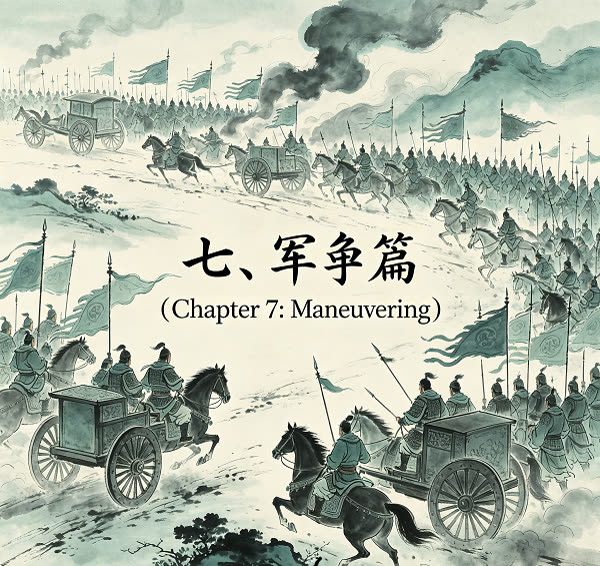


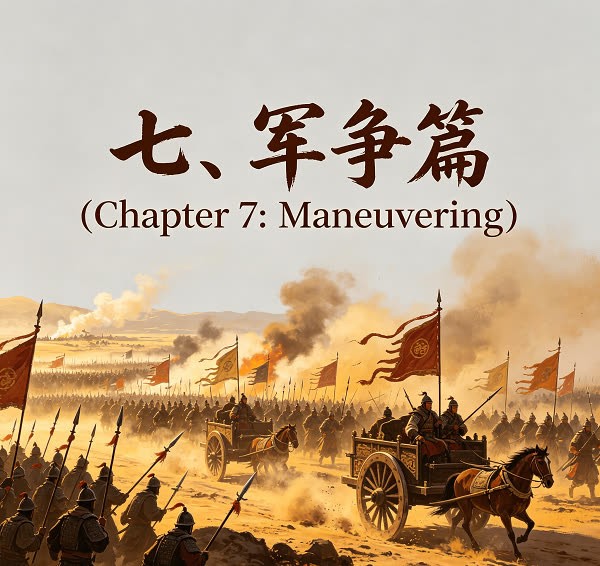
The core paradox of Chapter 7. 迂 means "circuitous, roundabout"; 直 means "direct." Together: the art of reaching your objective faster by going the apparently slower way. This is not mere flanking — it is the strategic insight that the obvious path is often the most costly, while the indirect path may arrive first. Modern parallels: guerrilla warfare, disruptive innovation, and market-entry strategies that avoid head-on competition.第七篇的核心悖论。"迂"义为迂回曲折;"直"义为径直直达。合起来:以看似更慢的路径更快到达目标。这不仅是侧翼迂回——而是认识到明显的路径往往代价最高,而间接路径可能先到。现代对照:游击战、颠覆式创新、避免正面竞争的市场进入策略。