Classical Chinese 原文古文原文
孫子曰:用兵之法,有散地,有輕地,有爭地,有交地,有衢地,有重地,有圮地,有圍地,有死地。
sūn zǐ yuē: yòng bīng zhī fǎ, yǒu sàn dì, yǒu qīng dì, yǒu zhēng dì, yǒu jiāo dì, yǒu qú dì, yǒu zhòng dì, yǒu pǐ dì, yǒu wéi dì, yǒu sǐ dì.
諸侯自戰其地者,為散地。
zhū hóu zì zhàn qí dì zhě, wéi sàn dì.
入人之地而不深者,為輕地。
rù rén zhī dì ér bù shēn zhě, wéi qīng dì.
我得則利,彼得亦利者,為爭地。
wǒ dé zé lì, bǐ dé yì lì zhě, wéi zhēng dì.
我可以往,彼可以來者,為交地。
wǒ kě yǐ wǎng, bǐ kě yǐ lái zhě, wéi jiāo dì.
諸侯之地三屬,先至而得天下之眾者,為衢地。
zhū hóu zhī dì sān shǔ, xiān zhì ér dé tiān xià zhī zhòng zhě, wéi qú dì.
入人之地深,背城邑多者,為重地。
rù rén zhī dì shēn, bèi chéng yì duō zhě, wéi zhòng dì.
行山林、險阻、沮澤,凡難行之道者,為圮地。
xíng shān lín, xiǎn zǔ, jù zé, fán nán xíng zhī dào zhě, wéi pǐ dì.
所由入者隘,所從歸者迂,彼寡可以擊吾之眾者,為圍地。
suǒ yóu rù zhě ài, suǒ cóng guī zhě yū, bǐ guǎ kě yǐ jī wú zhī zhòng zhě, wéi wéi dì.
疾戰則存,不疾戰則亡者,為死地。
jí zhàn zé cún, bù jí zhàn zé wáng zhě, wéi sǐ dì.
投之亡地然後存,陷之死地然後生。夫眾陷於害,然後能為勝敗。
tóu zhī wáng dì rán hòu cún, xiàn zhī sǐ dì rán hòu shēng. fū zhòng xiàn yú hài, rán hòu néng wéi shèng bài.
Modern Chinese 今译现代汉语译文
孙子说:按照用兵的原则,军事地理上可分为散地、轻地、争地、交地、衢地、重地、圮地、围地、死地九种。
诸侯在自己领土上作战的地区,叫做"散地"。
进入敌国领土不深的地区,叫做"轻地"。
我军占领有利,敌军占领也有利的地区,叫做"争地"。
我军可以去,敌军也可以来的地区,叫做"交地"。
诸侯之地与多国交界,先到者可以得到天下之众的地区,叫做"衢地"。
深入敌国领土,背后有许多敌方城邑的地区,叫做"重地"。
行军经过山林、险阻、沼泽等一切难以通行的地区,叫做"圮地"。
进入的道路狭窄,返回的道路迂远,敌人以少部兵力即可攻击我大军的地区,叫做"围地"。
奋勇速战就能生存,不奋勇速战就会灭亡的地区,叫做"死地"。
把军队投放在"亡地"上,然后才能保存;使士卒陷入"死地"中,然后才能活命。全军陷入危难之中,然后才能奋力争取胜利。
English Translation
Sun Tzu said: The art of war recognizes nine varieties of ground: (1) Dispersive ground; (2) Facile ground; (3) Contentious ground; (4) Open ground; (5) Ground of intersecting highways; (6) Serious ground; (7) Difficult ground; (8) Hemmed-in ground; (9) Desperate ground.
When a chieftain is fighting in his own territory, it is dispersive ground.
When he has penetrated into hostile territory, but to no great distance, it is facile ground.
Ground the possession of which imports great advantage to either side, is contentious ground.
Ground on which each side has liberty of movement is open ground.
Ground which forms the key to three contiguous states, so that he who first occupies it will have the support of all the allied states, is ground of intersecting highways.
When an army has penetrated into the heart of a hostile country, leaving a number of fortified cities in its rear, it is serious ground.
Mountain forests, rugged steeps, marshes and fens — all country that is hard to traverse — this is difficult ground.
Ground which is reached through narrow gorges, and from which we can only return by tortuous paths, so that a small number of the enemy would suffice to crush a large body of men — this is hemmed-in ground.
Ground on which each side has liberty of movement is open ground. Ground on which prompt action is necessary for survival is desperate ground.
Throw your soldiers into positions whence there is no escape, and they will prefer death to flight. If they will face death, there is nothing they may not achieve. Place them in desperate situations and they will survive; plunge them into death ground and they will live. For when the army is placed in such a position, it can then turn disaster into victory.
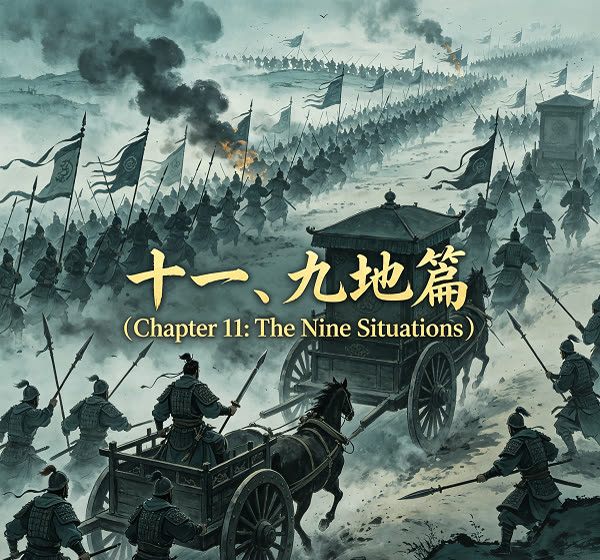


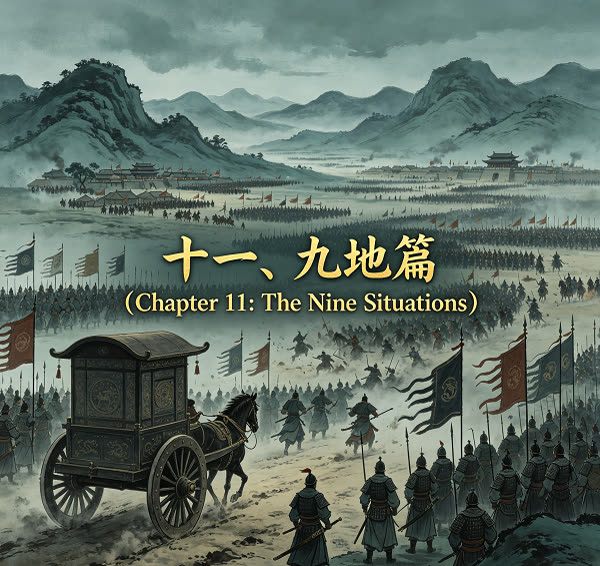
The central framework of this chapter — a classification system for military terrain based not merely on physical geography but on the psychological state of troops at each level of depth into enemy territory. As the army advances deeper, cohesion increases while supply lines become more vulnerable.本章的核心框架——一种基于心理状态(非纯地理)的军事态势分类体系。军队深入敌境越深,凝聚力增强,但补给线越脆弱。