Classical Chinese 原文古文原文
孫子曰:凡興師十萬,出征千里,百姓之費,公家之奉,日費千金。內外騷動,怠於道路,不得操事者,七十萬家。
sūn zǐ yuē: fán xīng shī shí wàn, chū zhēng qiān lǐ, bǎi xìng zhī fèi, gōng jiā zhī fèng, rì fèi qiān jīn...
相守數年,以爭一日之勝,而愛爵祿百金,不知敵之情者,不仁之至也。
xiāng shǒu shù nián, yǐ zhēng yī rì zhī shèng, ér ài jué lù bǎi jīn, bù zhī dí zhī qíng zhě, bù rén zhī zhì yě.
故明君賢將,所以動而勝人,成功出於眾者,先知也。先知者,不可取於鬼神,不可象於事,不可驗於度,必取於人,知敵之情者也。
gù míng jūn xián jiàng, suǒ yǐ dòng ér shèng rén, chéng gōng chū yú zhòng zhě, xiān zhī yě...
故用間有五:有因間,有內間,有反間,有死間,有生間。
gù yòng jiàn yǒu wǔ: yǒu yīn jiān, yǒu nèi jiān, yǒu fǎn jiān, yǒu sǐ jiān, yǒu shēng jiān.
因間者,因其鄉人而用之。內間者,因其官人而用之。反間者,因其敵間而用之。死間者,為誑事於外,令吾間知之,而傳於敵間也。生間者,反報也。
yīn jiān zhě, yīn qí xiāng rén ér yòng zhī. nèi jiān zhě, yīn qí guān rén ér yòng zhī...
故三軍之事,莫親於間,賞莫厚於間,事莫密於間。
gù sān jūn zhī shì, mò qīn yú jiān, shǎng mò hòu yú jiān, shì mò mì yú jiān.
非聖智不能用間,非仁義不能使間,非微妙不能得間之實。微哉!微哉!無所不用間也。
fēi shèng zhì bù néng yòng jiān, fēi rén yì bù néng shǐ jiān, fēi wēi miào bù néng dé jiān zhī shí. wēi zāi! wēi zāi! wú suǒ bù yòng jiān yě.
Modern Chinese 今译现代汉语译文
孙子说:凡是兴兵十万、出征千里,百姓的耗费、公室的开支,每天要花费千金。举国动荡,民众疲于运输而不能操持农务的,有七十万家之多。
敌我相持数年,就是为了争取最后一天的胜利。如果吝惜爵禄和金钱,不肯重用间谍,以致不了解敌情而失败,那就是最不仁慈的人了。
所以,英明的君主、贤良的将帅,之所以一出兵就能战胜敌人,功业超出众人之上,就在于事先掌握了敌情。要事先了解敌情,不可祈求鬼神,不可用相似的事物去类比推测,不可用星象度数去验证,必须从了解敌情的人那里去获取。
所以,使用间谍的方法有五种:有因间,有内间,有反间,有死间,有生间。
所谓"因间",就是利用敌国乡里的人做间谍。所谓"内间",就是利用敌方的官吏做间谍。所谓"反间",就是利用敌方的间谍为我所用。所谓"死间",就是故意散布假情报,让我方间谍知道,然后传给敌方间谍。所谓"生间",就是能回来报告敌情的间谍。
所以,军队中所有的事务,没有比间谍更亲密的,奖赏没有比间谍更优厚的,事情没有比间谍更机密的。
不是英明睿智的人不能使用间谍,不是仁慈义气的人不能指使间谍,不是精微奥妙的人不能得到间谍的真实情报。微妙啊!微妙啊!无时无处不可以使用间谍。
English Translation
Sun Tzu said: Raising a host of a hundred thousand men and marching them great distances entails heavy loss on the people and a drain on the resources of the State. The daily expenditure will amount to a thousand ounces of silver. There will be commotion at home and abroad, and men will drop out exhausted on the highways. As many as seven hundred thousand families will be affected.
Hostile armies may face each other for years, striving for the victory which may be decided in a single day. This being so, to remain in ignorance of the enemy's condition simply because one grudges the outlay of a hundred ounces of silver in honors and emoluments is the height of inhumanity.
Thus, what enables the wise sovereign and the good general to strike and conquer, and achieve things beyond the reach of ordinary men, is foreknowledge. Now this foreknowledge cannot be elicited from spirits; it cannot be obtained inductively from experience, nor by any deductive calculation. Knowledge of the enemy's dispositions can only be obtained from other men.
Hence the use of spies, of whom there are five classes: (1) Local spies; (2) Inward spies; (3) Converted spies; (4) Doomed spies; (5) Surviving spies.
Local spies are those from the enemy's country people whom we employ. Inward spies are enemy officials whom we employ. Converted spies are enemy spies whom we turn to our service. Doomed spies are those we deliberately allow the enemy to capture, feeding them false information. Surviving spies are those who return with intelligence.
When these five kinds of spy are all at work, none can discover the secret system. This is called "divine manipulation of the threads." It is the sovereign's most precious faculty. Of all those in the army close to none none should be more liberally rewarded than spies. In no other business should greater secrecy be preserved.
Spies cannot be usefully employed without a certain intuitive sagacity. They cannot be properly managed without benevolence and straightforwardness. Without subtle ingenuity of mind, one cannot make certain of the truth of their reports. Be subtle! Be subtle! And use your spies for every kind of business.
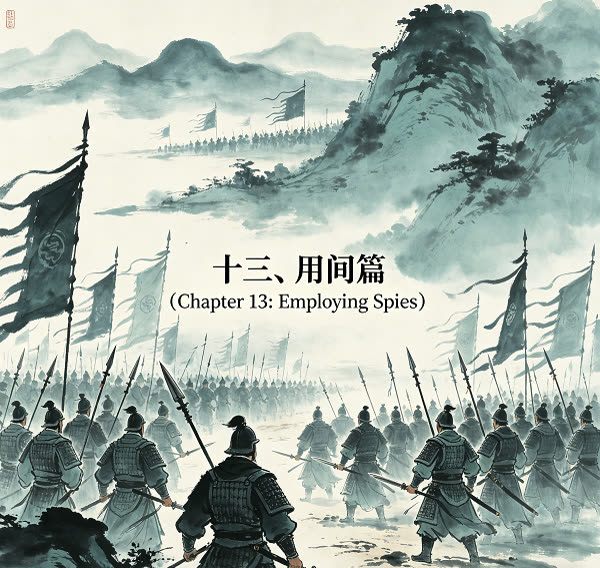

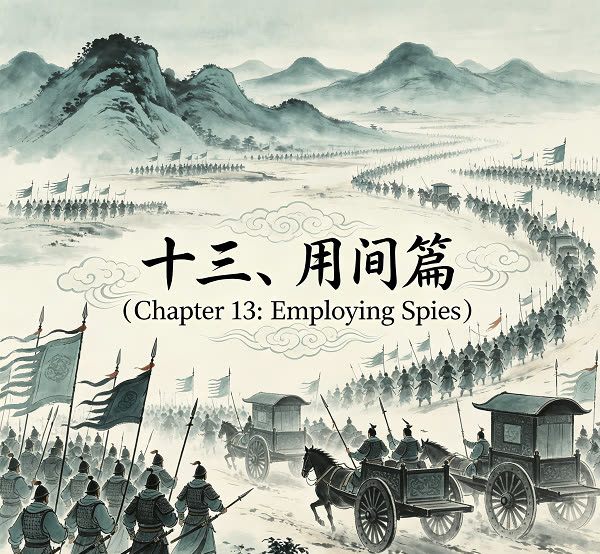
間 originally means "gap" or "interval" — by extension, one who inserts themselves into the gaps between enemy lines. The character carries a dual sense: both the spy and the act of espionage. Sun Tzu uses it as the capstone concept for the entire thirteen-chapter work: intelligence is the meta-strategy that enables all others."间"本义为缝隙——引申为插入敌方间隙中的人。此字兼具间谍与用间双重含义。孙武以此作为十三篇的收官概念:情报是使一切战略成为可能的元策略。