A Princess Lost
Emperor Yan — also known as Shennong, the Divine Farmer — was one of the founding ancestors of Chinese civilization. He tasted a hundred herbs to discover medicine and taught humanity agriculture. He had a beloved young daughter named Nüwa, a spirited girl filled with boundless curiosity about the sea.
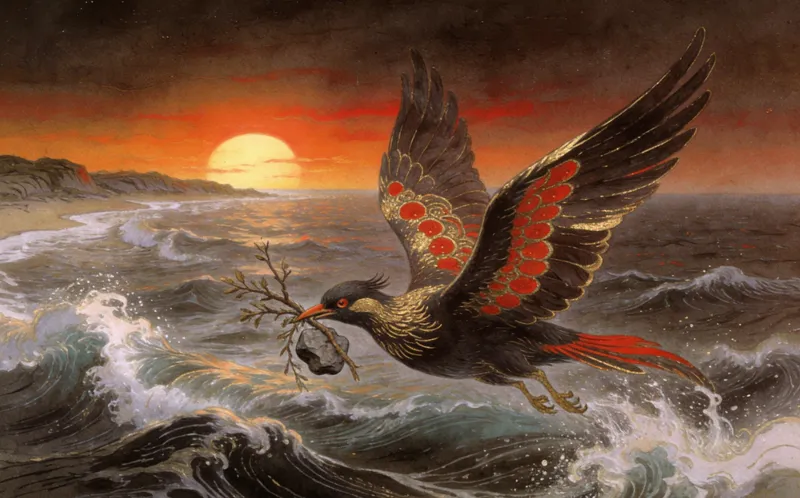
One day, Nüwa sailed alone into the sea for adventure. Without warning, a storm erupted — monstrous waves capsized her tiny boat, and she drowned in the boundless ocean. But her spirit refused to be silenced. She transformed into the Jingwei bird: a creature with a spotted head, a white beak, and red feet, burning with an unquenchable will.
Carrying Twigs to the Sea
“Nüwa went swimming in the Eastern Sea, drowned, and did not return. She became the Jingwei bird, constantly carrying twigs and stones from the Western Mountains to fill the Eastern Sea.”
— Shanhaijing, Běishān Jīng
Day after day, the Jingwei bird carried tiny branches and pebbles from the Western Mountains, flying a thousand miles to drop them into the Eastern Sea. The ocean laughed at her futility — how could such trifles fill the boundless deep? But Jingwei was unmoved. In her eyes, every pebble was a protest against fate, every twig a cry against injustice.
The Parable of Defiance
The story of Jingwei has endured for millennia because it touches a universal human question: in the face of an unbeatable force, does individual resistance have meaning?
Jingwei vs. Sisyphus
In the West, Sisyphus is condemned by the gods to push a boulder uphill forever. In the East, Jingwei freely chooses to fill the sea. One is punished; the other volunteers. This distinction reflects the Confucian spirit of acting despite knowing the impossibility and the Taoist faith that sincere will can open even metal and stone.
The Jin dynasty poet Tao Yuanming once wrote: 'Jingwei carries tiny twigs / to fill the vast sea. Xingtian dances with shield and axe / his fierce will forever unbroken.' To Tao Yuanming, Jingwei's spirit — like the headless warrior Xingtian — embodied undying ambition and eternal defiance.
Echoes in Culture
Today, 'Jingwei fills the sea' is one of the most frequently used idioms in Chinese, describing a spirit of determination and fearlessness in the face of hardship. In Chinese education, Jingwei's story inspires generation after generation: even against seemingly impossible challenges, every effort has intrinsic value when pursued with unwavering resolve.