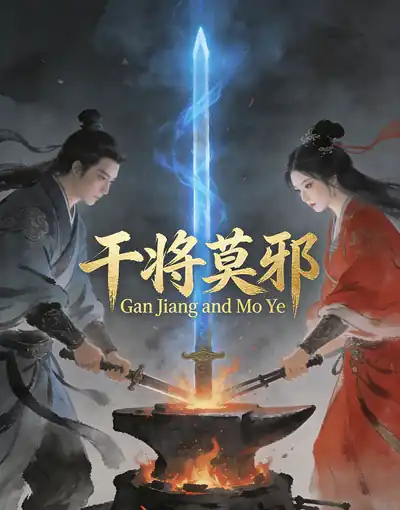
楚干将干将春秋时期著名铸剑师,与其妻莫邪并称。"干将莫邪"后来也成为名剑的代名词。、莫邪莫邪干将之妻,铸剑时以身投炉,铸成绝世名剑。后世常以"干将""莫邪"指代成对的宝剑。为楚王铸剑,三年乃成。王怒,欲杀之。剑有二,一雄一雌。
干将对其妻曰:「吾为王作剑,三年乃成。王怒,往必杀我。汝若生子是男,大,告之曰:『出户望南山,松生石上,剑在其背。』」
即将雌剑往见楚王。王大怒,使相之。剑有二,一雄一雌,雌来雄不来。王怒,即杀之。
Gan Jiang干将 Gan JiangA legendary swordsmith of the Spring and Autumn period. His name, together with his wife Mo Ye's, became synonymous with matched pairs of fine swords. and Mo Ye莫邪 Mo YeGan Jiang's wife, said to have cast herself into the furnace to complete a transcendent blade. Their names together evoke inseparable partnership., swordsmiths of Chu, spent three years forging a pair of swords for the King of Chu. When the work was done, the King, in his wrath, wished to kill them. The swords numbered two — one male, one female.
Gan Jiang said to his wife: "I have spent three years making the King's swords. His rage means death when I go to him. If you bear a son, when he is grown, tell him: 'Step outside and look toward the south mountain. Where the pine grows upon the stone, the sword lies behind it.'"
He took the female sword and went to see the King. The King, furious, ordered an inspection. There were two swords — one male, one female — and only the female had come. Enraged, the King put Gan Jiang to death.
莫邪子名赤,比后壮,乃问其母曰:「吾父所在?」母曰:「汝父为楚王作剑,三年乃成。王怒,杀之。去时嘱我:『语汝子,出户望南山,松生石上,剑在其背。』」
于是子出户南望,不见有山,但睹睹看见。古文常用"睹"代替"看",带有"目睹、亲见"的庄重意味。堂前松柱下,石低之上,即以斧破其背,得剑。日夜思欲报楚王。
王梦见一儿,眉间广尺,言:「欲报仇。」王即购之千金。
Mo Ye bore a son named Chi. When he had grown to manhood, he asked his mother: "Where is my father?" She replied: "Your father forged a sword for the King of Chu, a work that took three years. The King, in his anger, slew him. Before he left, he bade me tell you: 'Step outside and look toward the south mountain. Where the pine grows upon the stone, the sword lies behind it.'"
So the son went outside and looked southward. He saw no mountain — only the pine pillar before the hall, resting on its stone base. He took an axe and split open the back of the stone, and there found the sword. Day and night he thought only of vengeance against the King.
The King dreamed of a youth with a brow spanning a full chi尺An ancient Chinese unit of length, approximately 23 cm. "眉间广尺" (brow spanning one chi) is an exaggerated description of extraordinary appearance, suggesting the youth is marked by destiny., who said: "I come to avenge my father." The King immediately offered a thousand gold pieces for the boy's capture.
儿闻之,亡去。入山,行歌行歌边走边唱。古文中"行歌"常暗示人物处于悲愤或超脱的状态,如屈原"行吟泽畔"。。客有逢者,谓:「子年少,何哭之甚悲耶?」曰:「吾干将、莫邪子也。楚王杀吾父,吾欲报之。」
客曰:「闻王购子头千金,将子头与剑来,为子报之。」儿曰:「幸甚!」即自刎,两手捧头及剑奉之,立僵僵僵硬、僵立不动。此处指赤自刎后身体不倒,站立不动,体现其复仇意志之坚定。。客曰:「不负子也。」于是尸乃仆。
客持头往见楚王,王大喜。客曰:「此乃勇士头也,当于汤镬汤镬古代刑具,大锅中煮沸水,用于烹煮犯人。此处侠客建议以此处理头颅,实为陷阱。煮之。」王如其言。煮头三日三夕不烂。踔出汤中,瞋目大怒。
客曰:「此儿头不烂,愿王自往临视之,是必烂也。」王即临之。客以剑拟王,王头随堕汤中。客亦自拟己头,头复堕汤中。三首俱烂,不可识别。乃分其汤肉葬之,故通名「三王墓三王墓即"三头共葬"之墓。"三王"并非指三位王侯,而是对三颗头颅的尊称,表达了对壮烈牺牲者的敬意。」。
The boy, hearing of this, fled into the mountains, singing as he walked行歌 xíng gēSinging while walking. In classical Chinese literature, "walking and singing" often suggests a state of grief or transcendence — recall Qu Yuan "singing by the marsh" in exile.. A stranger met him on the road and said: "You are young — why do you weep so bitterly?" The boy replied: "I am the son of Gan Jiang and Mo Ye. The King of Chu killed my father. I would have my revenge."
The stranger said: "I hear the King offers a thousand gold pieces for your head. Give me your head and the sword, and I will avenge you for you." The boy said: "A great fortune!" And with that, he cut his own throat, and with both hands held out his head and the sword to the stranger, standing rigid僵 jiāngStiff, standing immovable. Chi's body does not fall after decapitation — his will for vengeance is so strong it holds him upright even in death.. The stranger said: "I shall not fail you." Only then did the body fall.
The stranger took the head before the King, who was greatly pleased. The stranger said: "This is the head of a brave man. It should be boiled in a cauldron汤镬 tāng huòAn ancient cauldron used for boiling condemned prisoners. The stranger's suggestion is, of course, a trap.." The King did as advised. Three days and three nights the head would not rot. It leapt from the boiling water, eyes glaring with fury.
The stranger said: "This boy's head will not rot. If Your Majesty would come and look upon it yourself, surely it must yield." The King approached the cauldron. The stranger struck with his sword, and the King's head fell into the water. Then the stranger cut off his own head, which also fell in. All three heads were boiled to pulp, beyond recognition. The flesh and broth were divided and buried together, and the grave was called the "Three Kings' Tomb三王墓The shared tomb of three heads. "Three Kings" does not mean three monarchs — it is an honorific for the three heads, expressing reverence for their heroic sacrifice.."
文学价值
《干将莫邪》是中国文学中最纯粹的复仇叙事之一。全文不足五百字,却完成了三代人的恩怨轮回:干将预见死亡→莫邪遗命→赤献首→侠客同归于尽。叙事节奏极为紧凑,没有任何多余的情节铺垫。
最令人震撼的是赤"自刎"后的"立僵"——头已断而身不倒,这是一种近乎超现实的意象,以身体的"不屈"来表达意志的"不灭"。它影响了后世无数文学和影视作品中"死而不倒"的英雄形象。
比较研究
与西方复仇叙事不同(如哈姆雷特的犹豫与道德困境),《干将莫邪》中的复仇是直接的、不犹豫的、不反思的。赤没有问"该不该报仇",侠客也没有考虑后果——复仇本身就是最高的道德行为。这种差异反映了中国古典文学中"血债血偿"的朴素正义观。
Literary Merit
"Gan Jiang and Mo Ye" is one of the purest revenge narratives in Chinese literature. In fewer than five hundred characters, it completes a cycle spanning three generations: Gan Jiang foresees death → Mo Ye bequeaths a mission → Chi offers his head → the stranger sacrifices himself. The narrative pace is relentless, without a single unnecessary scene.
Most striking is Chi's "standing rigid" after decapitation — head severed, body unbowed. This near-surreal image, using the body's "unyielding" posture to express will's "indestructibility," influenced countless heroic depictions in later literature and film.
Comparative Study
Unlike Western revenge narratives (Hamlet's hesitation and moral anguish), the vengeance in this tale is direct, unquestioning, and absolute. Chi never asks "should I revenge?" — the stranger never considers consequences. Revenge is the highest moral act. This reflects the uncomplicated justice of classical Chinese literature: blood debts demand blood payment.
据干宝《搜神记》记载,此墓在汝南北宜春县。"三王"并非指三位诸侯王,而是对三颗头颅的尊称——在古人看来,壮烈赴死者当受封"王"的尊号。这一命名本身即是一种民间正义的表达:死去的复仇者,比活着的暴君更值得被尊为"王"。
According to Gan Bao's In Search of the Supernatural, this tomb lies north of Runan in Yichun County. "Three Kings" does not refer to three feudal lords — it is an honorific bestowed upon three severed heads. In the folk imagination, those who die heroically deserve the title of "king." The very name is an expression of popular justice: the dead avenger is more worthy of kingship than the living tyrant.
东晋干宝所撰,中国志怪小说的开山之作。原书三十卷,已散佚,今本二十卷为后人辑录。干宝撰写此书的目的是"发明神道之不诬",即证明鬼神之事并非虚妄。《搜神记》收录了从上古到东晋的各类神异故事,是后世志怪文学的总源头。
Compiled by Gan Bao of the Eastern Jin dynasty, this is the foundational work of Chinese supernatural fiction. The original thirty volumes have been lost; the current twenty-volume edition was reconstructed by later scholars. Gan Bao's stated purpose was to "demonstrate that the ways of the spirits are not false." The collection spans tales from antiquity to the Eastern Jin and serves as the wellspring for all subsequent supernatural literature in China.