陈抟高卧
道家卧功之鼻祖,当推五代宋初之高道陈抟。陈抟字图南,自号扶摇子,隐居华山,以善睡闻名于世,人称"睡仙"。相传他一睡可达数月之久,所创之"蛰龙法"卧功,为道家睡功之正宗。
陈抟著有《睡歌》一首,颇为风趣:"臣爱睡,臣爱睡,不卧毡,不盖被。片石枕头,蓑衣铺地。震雷掣电鬼神惊,臣当其时正鼾睡。"由此可见,其所谓"睡",非寻常之睡眠,乃是一种高层次的修炼状态。
"至人本无梦,其梦乃游仙。真人亦无睡,睡则浮云烟。炉里长存药,壶中别有天。欲知睡梦里,人间第一玄。"
"The perfected one has no dreams — what seems a dream is roaming among immortals. The true person has no sleep — what seems like sleep is floating among clouds and mist. In the furnace, medicine is forever refined; in the gourd, another heaven awaits."
—— 陈抟《睡歌》
Chen Tuan (c. 871–989 CE), also known as Master Fuyao, was a legendary Daoist hermit who lived on Mount Hua during the chaotic Five Dynasties period. Famous for his ability to sleep for months at a time, he was called the "Immortal of Sleep." His practice, known as the Zhe Long Fa (蛰龙法, Method of the Dormant Dragon), became the orthodox lineage of Daoist sleeping qigong.
Yet his "sleep" was no ordinary rest — it was a profound meditative state achieved in the supine position, combining breathwork, visualization, and energy circulation.
卧功之理|The Principles of Reclining Practice (Wogong)
道家卧功之原理,在于借助卧姿使身体彻底放松,减少能量消耗,同时通过意念引导内气运行,达到调和阴阳、培补元气之效。
卧功之优势有三:其一,卧姿最利于全身放松,不受姿势紧张之干扰;其二,卧功可于临睡前或醒来后行之,不额外占用时间;其三,卧功对体弱多病者尤为适宜,不需起身即可修炼。
卧功之要点,在于"形松意不散"。身体虽躺卧不动,意识却保持清醒觉知。此即陈抟所谓"睡则浮云烟"——形体如云烟般松散无碍,而真意却如晴空般明澈不昧。
The underlying principle of Taoist Wogong (reclining practice) lies in utilizing the supine posture to achieve complete physical relaxation, minimize energy expenditure, and simultaneously guide the internal circulation of qi through mental intention—thereby harmonizing yin and yang and cultivating primordial vitality.
Three Advantages of Wogong
First, the reclining posture most readily facilitates total bodily relaxation, free from the tension and distraction of maintaining an upright position. Second, wogong may be practiced immediately before sleep or upon waking, requiring no additional time allocation. Third, it is especially suitable for those who are physically weak or chronically ill, allowing cultivation without the need to rise from bed. Essential Points
The crux of wogong lies in "relaxed form, undispersed intention" (xing song yi bu san). Though the body lies still and motionless, consciousness remains lucid and aware. This is what Chen Tuan meant by "in sleep, be as floating clouds and mist" (shui ze fu yun yan)—the physical form loose and unimpeded as drifting vapor, while the true intention remains as clear and unobscured as the open sky.
五式卧功
以下介绍五种经典道家卧功姿势与练法,由简入深,适合不同程度之修炼者。
- 仰卧于床上,全身放松,四肢自然伸展,两脚略宽于肩,双手掌心朝上置于体侧。
- 微闭双目,舌抵上腭(搭鹊桥),意守丹田。
- 行腹式呼吸:吸气时腹部隆起,意想清气从鼻入丹田;呼气时腹部内收,意想浊气从口出。
- 呼吸逐渐调至深、长、细、匀。每次练习十五至三十分钟。
- Lie supine on the bed, allowing the entire body to relax. The four limbs rest naturally extended, the feet slightly wider than shoulder-width apart, the palms facing upward at the sides of the body.
- Gently close the eyes, touch the tongue to the upper palate (forming the Magpie Bridge), and concentrate the mind on the dantian.
- Practice abdominal breathing: upon inhalation, the abdomen expands; visualize pure qi entering through the nose and descending to the dantian. Upon exhalation, the abdomen contracts inward; visualize turbid qi exiting through the mouth.
- Gradually regulate the breath until it becomes deep, long, fine, and even. Practice for fifteen to thirty minutes each session.
- 右侧卧于床上,右臂弯曲,右手托腮(或垫于右耳下)。左臂自然置于左腿上。
- 右腿伸直,左腿微屈,置于右腿前。
- 此式即陈抟"蛰龙法"之基本姿势。右侧卧有利于心脏不受压迫,胃内容物顺重力下流,最合养生之理。
- 呼吸调匀后,意想丹田中有温热之气,缓缓向四肢百骸扩散。
- Lie on the right side of the bed, bending the right arm and resting the right hand beneath the cheek (or padding it below the right ear). The left arm rests naturally upon the left leg.
- Extend the right leg straight, while the left leg is slightly bent and placed in front of the right leg.
- This posture constitutes the basic position of Chen Tuan's "Hibernating Dragon Method" (Zhelong Fa). Lying on the right side allows the heart to remain uncompressed and permits stomach contents to flow downward with gravity—most consonant with the principles of health cultivation.
- Once the breath is regulated and even, visualize a warm qi in the dantian gradually diffusing outward to the four limbs and hundred bones.。
- 仰卧放松,意守下丹田(脐下三寸)三分钟。
- 吸气时,意想气从下丹田下行至会阴,再沿督脉(脊柱后侧)上行至头顶百会。
- 呼气时,意想气从百会沿任脉(体前正中线)下行,经胸腹回到下丹田。
- 此即卧式小周天。初学者意念宜轻宜淡,"若存若亡",切忌用力导引。
- Lie supine and relax, concentrating the mind on the lower dantian (three cun below the navel) for three minutes.
- Upon inhalation, visualize qi descending from the lower dantian to the perineum (huiyin), then ascending along the Governing Vessel (dumai, posterior to the spine) to the crown of the head at baihui.
- Upon exhalation, visualize qi descending from baihui along the Conception Vessel (renmai, the anterior midline of the torso), passing through the chest and abdomen, and returning to the lower dantian.
- This is the supine version of the Small Heavenly Circuit (xiao zhoutian). For beginners, the mental intention should remain light and subtle—"as if present, as if absent" (ruo cun ruo wang)—strictly avoiding forceful guidance.
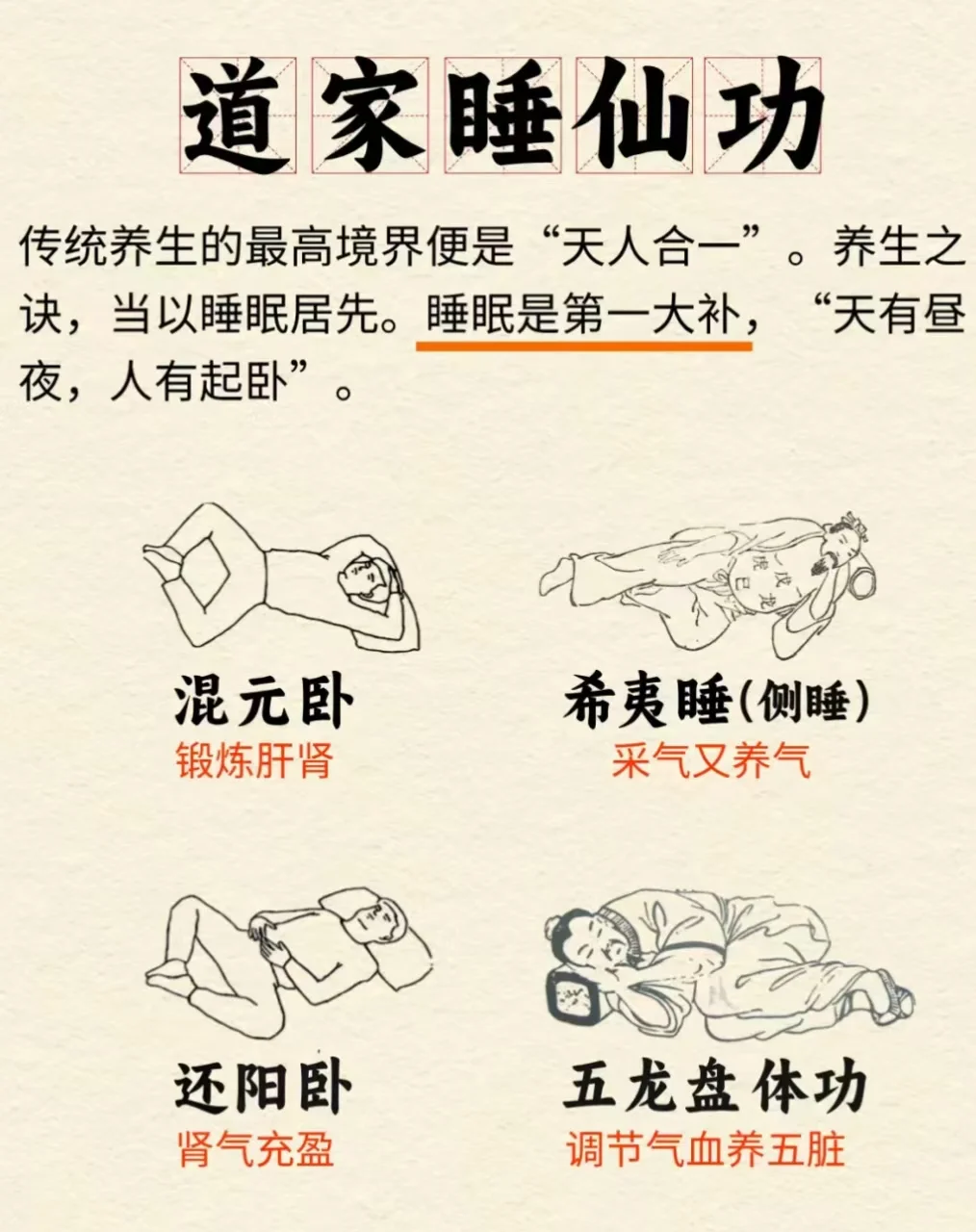
- 仰卧,两脚心(涌泉穴)相对,两膝向两侧打开,如蝴蝶展翅。此式古称"还阳卧"。
- 双手掌心向下,置于小腹丹田之上(男左手在下,女右手在下)。
- 此姿势能拉伸大腿内侧肝经、肾经,促进下肢气血回流。涌泉相对,使心肾之气相交,水火既济。
- 意守丹田,行自然呼吸。初练每次十五分钟,渐增至三十分钟。
- Lie supine with the soles of the feet (Yongquan points) facing each other, knees falling open to both sides like butterfly wings spreading. This posture was anciently termed the Reclining Yang Return (Huanyang Wo).。
- Place both palms downward upon the lower abdomen over the dantian (left hand below for men, right hand below for women).
- This position stretches the Liver and Kidney meridians along the inner thighs, promoting the return of blood and qi from the lower limbs. With Yongquan points opposed, the heart qi and kidney qi intersect, achieving the harmonious equilibrium of water and fire (shui huo ji ji).
- Concentrate the mind on the dantian, practicing natural breathing. Begin with fifteen minutes per session, gradually increasing to thirty minutes.
- 姿势同还阳卧,但双手改为十指交叉,掌心覆于头顶百会穴之上。
- 此式为还阳卧之进阶。手覆百会,能引气下行,使上焦之火下降温肾,心肾相交。
- 行此式时,意想周身之气如混沌未分之太极,混元一体,无内无外,无阴无阳。
- 此为卧功之高深境界,须有一定修炼基础后方可行之。
- The posture is identical to the Reclining Yang Return (Huanyang Wo), but the hands are modified: interlace the ten fingers and place the palms over the crown of the head at the Baihui point.
- This is the advanced progression of the Reclining Yang Return. Covering Baihui with the hands can draw qi downward, causing the fire of the upper burner to descend and warm the kidneys, thereby achieving the intersection of heart and kidney.
- When practicing this form, visualize the qi throughout the body as the Taiji in its undifferentiated, chaotic state—Hunyuan unity, without inner or outer, without yin or yang.
- This represents the profound realm of wogong, to be attempted only after establishing a certain foundation in cultivation.
注意事项
练习卧功,需注意以下几点:一、床铺宜硬中带软,过软则脊柱塌陷,过硬则肌肉紧张;二、练习前宜宽衣解带,去除束缚;三、室内宜通风良好,温度适宜;四、初学者宜从仰卧调息入手,渐次深入,切忌贪功冒进。
A few practical notes for practitioners: The bed should be firm yet comfortable — too soft collapses the spine, too hard tenses the muscles. Wear loose clothing; remove all constrictions. Ensure the room is well-ventilated at a comfortable temperature.
Beginners should start with the basic supine breathing and progress gradually through each posture. Patience is the foundation of all Daoist cultivation — rushing the process brings no benefit.
⚠️本文内容基于传统养生文献整理,仅供学习参考,不构成医疗建议。练习风险自负。
⚠️Content based on traditional health cultivation texts; for educational reference only, not medical advice. Practice at your own risk.
⚠️Special Populations Note:
Those with severe spinal conditions, vertigo, or GERD should consult a physician before practicing. Stop immediately if numbness or tingling occurs.