The Mind Philosopher
王阳明
Wang Yangming
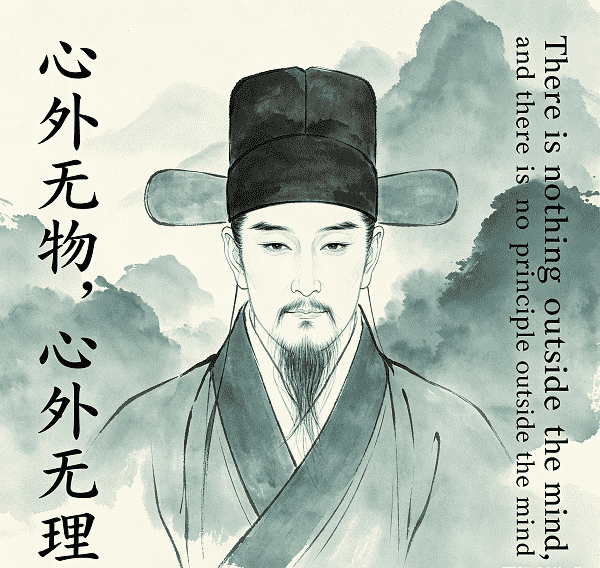
The Mind Philosopher
王阳明
Wang Yangming, personal name Shouren (守仁), courtesy name Bo'an (伯安), was born in 1472 in Yuyao, Zhejiang Province. He is widely regarded as the most important Chinese philosopher after Confucius and Mencius — and the only thinker in Chinese history to achieve Confucius's ideal of the "three immortalities" (三不朽): establishing virtue (立德), establishing achievement (立功), and establishing words (立言).
Born into a prominent scholarly family — his father Wang Hua was a top-ranking imperial examination candidate (状元) — young Wang Shouren showed an unusual temperament. At twelve, he told his teacher that "becoming a sage" was the highest aspiration, not passing exams. His father considered this impractical, but the boy never wavered.
After passing the imperial examinations and entering official service, Wang's career was marked by both brilliance and danger. He opposed the corrupt eunuch Liu Jin (刘瑾), one of the most powerful figures at court. For his outspoken criticism, Wang was beaten with forty strokes of the heavy paddle and exiled to the remote post of Longchang (龙场) in Guizhou — a frontier region infested with disease, where previous appointees had died.
It was in this hellish exile that Wang Yangming experienced his famous "Longchang Enlightenment" (龙场悟道). After meditating for years on the nature of mind and principle, he suddenly realized: "The mind itself is principle" (心即理). Truth is not found in external texts or rituals but within one's own heart-mind. This insight became the foundation of his entire philosophy.
After Liu Jin's fall, Wang was restored to power and proved himself not only a philosopher but a military genius. He suppressed the rebellion of Prince Ning of Zhu (宁王朱宸濠) with astonishing speed and efficiency, using deception, psychology, and strategic brilliance. He also pacified rebellions in southern Jiangxi and Guangxi. Wang Yangming died in 1529 while returning from a military campaign, reportedly murmuring: "This mind is bright and clear — what more is there to say?" (此心光明,亦复何言).
Opposing Eunuch Liu Jin: Wang Yangming submitted a memorial protesting the power of the eunuch Liu Jin, who effectively controlled the Ming government. For this act of moral courage, Wang was savagely beaten and exiled to Longchang post in Guizhou — essentially a death sentence in the disease-ridden frontier. His father was also demoted. Wang survived through sheer willpower and philosophical determination.
The Longchang Enlightenment (1508): In a stone coffin-like shelter in the Guizhou wilderness, Wang meditated night after night. One night, he suddenly leaped up in ecstatic realization: "The mind itself is principle!" External investigation was unnecessary; the moral law exists within every person's innate consciousness. This "enlightenment in the middle of the night" became the founding moment of the Yangming School of Mind (阳明心学), one of the most influential philosophical movements in East Asian history.
Suppressing Prince Ning's Rebellion (1519): Prince Ning of Zhu raised a massive army to overthrow the Ming emperor. Wang Yangming, then a relatively low-ranking official, organized an improvised defense force and defeated the rebellion in just forty-three days — using brilliant deception tactics that exploited the prince's psychological weaknesses. This was one of the most remarkable military achievements in Chinese history, accomplished by a philosopher with no formal military training.
The Taizhou School: Wang's philosophy inspired a radical student movement. His most famous follower, Wang Gen (王艮), founded the Taizhou School (泰州学派), which took Yangming's ideas to revolutionary conclusions — arguing that even common people without education could become sages through innate moral knowledge. This challenged the scholarly elite's monopoly on wisdom and had lasting social implications.
Deathbed Words: In 1529, returning from a military campaign in Guangxi, Wang Yangming fell gravely ill. When his students asked for final words, he said simply: "This mind is bright and clear — what more is there to say?" (此心光明,亦复何言). These seven characters became the most famous deathbed statement in Chinese philosophical history — a final, perfect expression of his belief that moral clarity lives within the mind itself.
知行合一。
"Knowledge and action are one." — True knowledge is inseparable from action. If you truly know something, you naturally do it. If you don't do it, you don't truly know it.
心即理。
"The mind itself is principle." — Moral truth is not external; it resides within every person's innate consciousness. You don't need to search the world — look within.
破山中贼易,破心中贼难。
"It is easier to defeat bandits in the mountains than to defeat the bandits in one's own mind." — Self-mastery is the greatest challenge. External enemies are nothing compared to inner desires, doubts, and fears.
致良知。
"Extend innate moral knowledge." — Every person possesses a natural moral compass (良知). The task of life is to remove the selfish desires that obscure it and let it shine forth.
此心光明,亦复何言。
"This mind is bright and clear — what more is there to say?" — Wang Yangming's final words, a perfect expression of a life lived with moral clarity.
Wang's most famous doctrine: knowledge and action are not two separate things. If you truly know something is right, you will naturally do it. If you don't do it, your knowledge is superficial — you don't truly understand. This challenges the common practice of studying philosophy without applying it. Wang insisted: "Knowledge is the beginning of action; action is the completion of knowledge."
Every person is born with "innate moral knowledge" (良知) — a natural sense of right and wrong. You don't need external education to know that harming others is wrong or that compassion is right. The problem is that selfish desires (私欲) cloud this innate knowledge, like dust on a mirror. The task of moral cultivation is to remove these obstructions and let the innate knowledge shine forth naturally.
Against Zhu Xi's (朱熹) Neo-Confucian approach of "investigating things" (格物致知) — studying external objects to understand principle — Wang argued that principle (理) already exists within the mind. You don't need to study every bamboo stalk in the world; you need to look inward. This inward turn made Wang's philosophy more accessible, more intuitive, and more democratic than the scholarly tradition it replaced.
Wang believed philosophical cultivation happens not in quiet meditation halls but in the thick of real life — dealing with bureaucracy, commanding soldiers, raising children. "Polish the mind through handling affairs" (事上磨). This insistence on practice over theory makes Wang's philosophy uniquely suited to people engaged in the world, not just contemplatives in retreat.
Recorded dialogues between Wang Yangming and his students, compiled by his disciples. The title literally means "Record of Transmission and Practice" — capturing Wang's insistence that philosophy must be transmitted from person to person and practiced in daily life. The text covers all major aspects of his philosophy through vivid conversations, practical examples, and Wang's direct answers to students' doubts. It is the primary source for understanding Yangming's thought and one of the most readable philosophical texts in the Chinese tradition.
Authenticity and Integrity: Wang's insistence that knowledge and action must be unified speaks directly to modern concerns about authenticity. In an age of performative virtue, his warning that "if you don't practice it, you don't truly know it" is a powerful challenge to superficial engagement with ethical ideas.
Ethical AI and Moral Agency: Wang's concept of innate moral knowledge (良知) raises profound questions about artificial intelligence. Can a machine possess moral intuition? Wang's philosophy suggests that true moral understanding requires an inner awareness that goes beyond rules — a challenge for any purely algorithmic approach to ethics.
Leadership: Wang Yangming — philosopher, military commander, administrator — embodies the Confucian ideal of the complete person. His ability to lead armies, govern provinces, and inspire students demonstrates that wisdom is not abstract but practical. Modern leadership theory increasingly emphasizes the integration of knowledge and action.
Mental Health and Inner Work: Wang's insight that "defeating the bandits in one's mind is harder than defeating those in the mountains" resonates with modern psychology's emphasis on inner work. His method of self-examination, removing selfish desires, and cultivating clarity parallels therapeutic practices for managing anxiety, addiction, and self-deception.