Keeper of the Royal Archives
Laozi served as Keeper of the Royal Archives for the Zhou dynasty — essentially the royal librarian. Confucius himself traveled to Luoyang to ask him about ritual, and returned saying: 'I know how birds fly, how fish swim — but the dragon! Today I have seen Laozi; he is like a dragon!'
Through Hangu Pass
As the Zhou dynasty declined, Laozi decided to go west into seclusion. At Hangu Pass, the gatekeeper Yin Xi recognized him and said: 'You are about to disappear. I beg you — write down your teachings for me.'
“The Tao that can be told is not the eternal Tao. The name that can be named is not the eternal name. The nameless is the origin of heaven and earth. The named is the mother of ten thousand things.”
— Tao Te Ching, Chapter 1
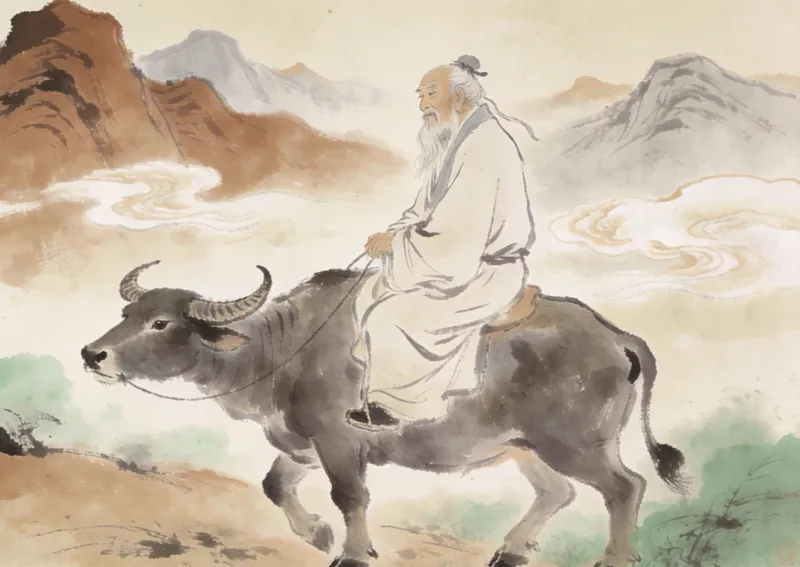
And so, Laozi composed over five thousand characters — two parts, eighty-one chapters. When he finished, he mounted his ox and rode west, never to be seen again. Those five thousand characters became the Tao Te Ching.
Core Teachings
The core ideas: Tao (fundamental law), Te (its manifestation), Wu Wei (effortless action), and Softness (overcoming hardness with gentleness). These shaped Chinese philosophy, art, martial arts, and health cultivation.
The Highest Good Is Like Water
'The highest good is like water.' — Chapter 8. Laozi used water as the supreme metaphor: soft, humble, nourishing all without claiming credit. This influenced East Asian leadership philosophy profoundly.
From Sage to Deity
In history, Laozi was a philosopher. In Daoism, he is 'Taishang Laojun' — one of the Three Pure Ones, the Tao personified. Legend says he descended to earth many times, appearing in different forms. The Tao Te Ching became the foundation for inner alchemy and immortality.
The Tao Te Ching is the most translated Chinese text in history, second only to the Bible — rendered into hundreds of languages since the 16th century.