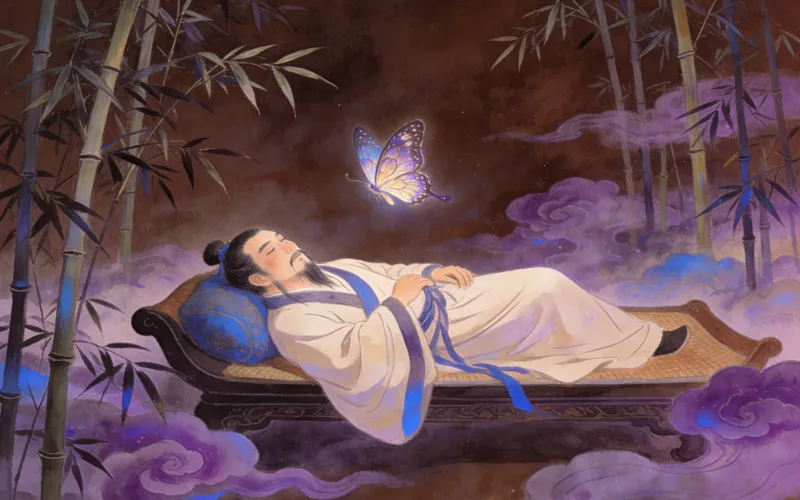
The Lacquer Garden Philosopher
Zhuangzi (c. 369–286 BCE) served as a minor official yet refused King Wei of Chu's offer of high office, preferring to 'wag his tail in the mud' like a turtle rather than be enshrined in a temple.
His work, the Zhuangzi, builds a labyrinth of thought from parables and philosophical puzzles. The most famous is the butterfly dream.
The Dream
“Once Zhuangzi dreamt he was a butterfly, fluttering happily, unaware of being Zhuangzi. Suddenly he awoke — solid and unmistakable Zhuangzi. But he did not know: was he Zhuangzi who had dreamt of being a butterfly, or a butterfly now dreaming it was Zhuangzi? This is called the Transformation of Things.”
— Zhuangzi, Qíwù Lùn
In these few dozen characters, Zhuangzi posed questions that philosophers have grappled with for over two millennia: How do we know we're not dreaming? Where is the boundary between dream and reality? Is identity fixed or fluid?
The Transformation of Things
Zhuangzi used wùhuà — 'transformation of things' — to summarize the parable. It is the recognition that all things have no essential distinction. Butterfly and Zhuangzi, dream and waking, life and death — at the level of Tao, these oppositions are themselves illusions.
Echoes with Descartes
Two millennia later, Descartes posed a similar question. But Descartes found certainty through 'I think, therefore I am,' while Zhuangzi chose not to answer — the uncertainty itself being the most honest answer.
The Butterfly's Legacy
The butterfly dream has become one of the deepest philosophical images in East Asian culture, inspiring poets, painters, and filmmakers. In modern physics, it's been used as a metaphor for the observer effect in quantum mechanics.