The Egg of Chaos
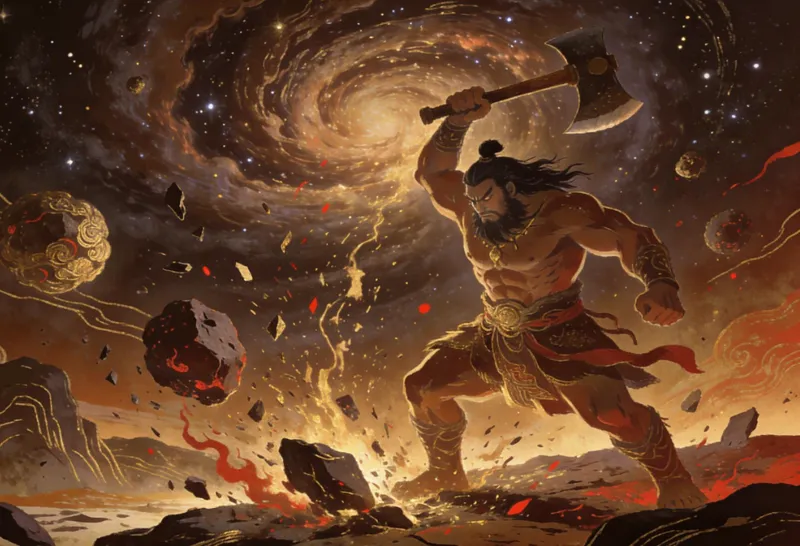
Before all things, before the birth of sun and moon, the entire cosmos was a formless mass of chaos — like a great cosmic egg, with yin and yang undifferentiated, light and heavy mixed together. Within this chaos, the first life of the universe gestated: Pangu.
“Heaven and earth were混沌 like an egg; Pangu was born within. After eighteen thousand years, heaven and earth opened: the clear and yang rose as sky, the turbid and heavy sank as earth. Pangu, between them, changed nine times a day — divine above, sacred below.”
— Sanwǔ Lìjì (Xú Zhěng, Three Kingdoms period)
Holding Up the Sky
When Pangu awoke, he found himself in darkness and confinement. He stretched his limbs, and heaven and earth began to separate — the light and pure slowly rising as sky, the heavy and dense sinking as earth. But the two threatened to collapse back together. So Pangu stood between them, head against the sky, feet upon the earth, holding the universe apart with his own body.
Each day, the sky rose one zhang higher, the earth grew one zhang thicker, and Pangu grew one zhang taller. This continued for eighteen thousand years — the sky became immeasurably high, the earth unfathomably thick, and Pangu grew into a titan of cosmic proportions.
Becoming the World
At last, Pangu fell. But he did not simply die — his body transformed into all things in the world. This is the most magnificent sacrifice narrative in Chinese mythology: one being giving everything of itself to create the entire world.
Pangu's Transformation
His breath → wind & clouds. His voice → thunder. Left eye → sun. Right eye → moon. Limbs → four poles. Blood → rivers. Veins → earth's contours. Muscles → fields. Hair → stars. Skin → vegetation. Teeth → metals. Marrow → jade. Sweat → rain.
Pangu's story reflects a profound cosmology: the world was not created by an external force, but grew organically from within. Creator and creation are different forms of the same being — a distinctly Eastern vision of universal oneness.
Comparative Perspectives
Pangu's legend finds fascinating parallels in creation myths worldwide. In Norse mythology, the giant Ymir's body becomes the world. In Hindu mythology, the sacrifice of Purusha creates the castes and nature. Across cultures, the ancients independently arrived at the idea of a giant's body becoming the world — suggesting a deep human intuition about the connection between life and the cosmos.