The Giant Who Ran
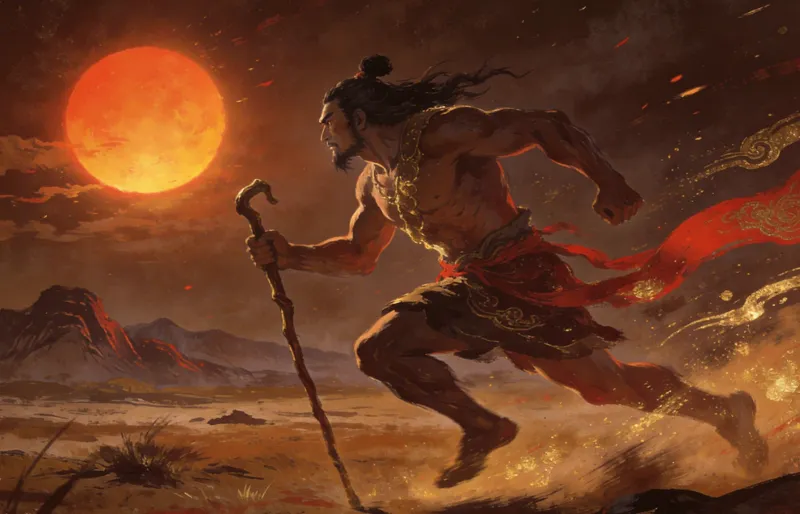
Kuafu was a descendant of the ancient race of giants. According to the Shanhaijing, he lived in the Great Wilderness of the north, with two yellow snakes threaded through his ears and two more in his grasp — a figure of raw, primal power.
“Kuafu raced the sun. He entered its light. Thirsty, he sought to drink — he drank the Yellow River and the Wei River. It was not enough. He turned north to drink the Great Marsh. Before he arrived, he died of thirst on the road. He cast away his staff, and it became the Deng Forest.”
— Shanhaijing, Hǎiwài Běi Jīng
Why Chase the Sun?
Why did Kuafu chase the sun? The texts give no clear motive — and this ambiguity is precisely what makes the story so compelling. It is an open parable, allowing each era to read its own meaning.
Three Interpretations
Three readings: Folly — blind arrogance (Legalist); Sublime — acting despite impossibility (Confucian); Exploration — humanity's thirst for knowledge (modern).
The Peach Forest
The image after Kuafu's death is equally profound. His fallen staff transformed into a vast peach forest stretching thousands of miles, providing shade and fruit for travelers who came after. This detail transforms Kuafu's 'failure' into a 'gift' — his death was not an end, but another form of life continuing.
Kuafu Chases the Sun and Jingwei Fills the Sea are the two most famous 'failed hero' narratives in Chinese mythology. Their shared theme: even if the goal can never be reached, the dignity and meaning of the pursuit itself are imperishable.