Founder of Daoism
老子
Laozi
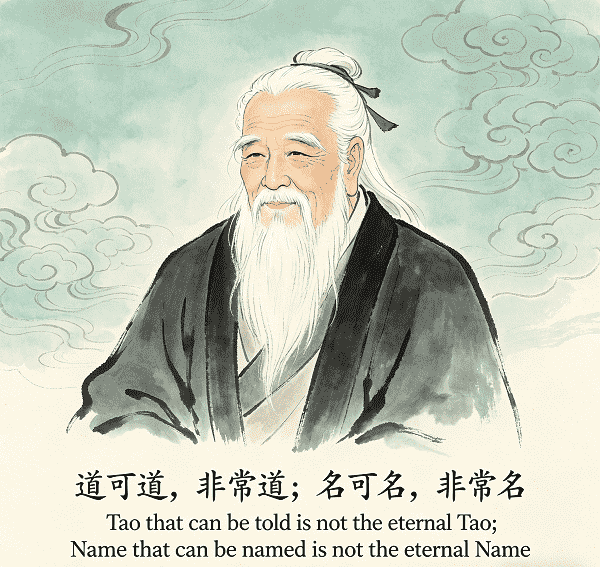
Founder of Daoism
老子
Keeper of the Archives: Laozi served as Keeper of the Archives at the Zhou court for decades, guarding a civilization's intellectual heritage. He witnessed the corruption of power firsthand, providing material for his philosophical vision.
Confucius Asks About Rites: Confucius traveled to the Zhou capital to consult Laozi. Laozi replied: 'The men you speak of — their bodies have decayed. Only their words remain.' He advised Confucius to rid himself of arrogance and desire.
Writing at Hangu Pass: Gatekeeper Yin Xi implored: 'You are about to withdraw. Write something for me.' Laozi composed the Tao Te Ching — two parts, eighty-one chapters, five thousand characters. One of the most consequential acts of writing in Chinese philosophy.
Passing Through the Gate: After completing his book, Laozi rode through the gate and vanished. The Records of the Historian claims he lived 160 or even 200 years. His vanishing was itself a philosophical act — embodying 'retiring when the work is done.'
道可道,非常道。名可名,非常名。
"The Way that can be spoken is not the eternal Way. The name that can be named is not the eternal name." — The opening lines of the Tao Te Ching, announcing the limits of language before saying a single word.
上善若水。水善利万物而不争。
"The highest good is like water. Water benefits all things and does not compete." — The supreme virtue is not forceful but yielding, not grasping but flowing.
千里之行,始于足下。
"A journey of a thousand miles begins with a single step." — Perhaps the most widely known Chinese proverb in the world, urging humble beginnings.
知人者智,自知者明。胜人者有力,自胜者强。
"Knowing others is wisdom; knowing yourself is enlightenment. Conquering others requires force; conquering yourself is true strength." — True mastery begins with the self.
天地不仁,以万物为刍狗。
"Heaven and Earth are not humane; they treat all things as straw dogs." — Nature operates without favoritism or sentiment. This is not cruelty but perfect impartiality.
Dao is both the origin of all things and the guide for human conduct. Formless and nameless, existing before Heaven and Earth, it is a living Way that can be experienced and followed, not merely theorized.
Not doing nothing, but not acting against nature. Like water, seemingly soft yet wearing through stone. The perfection is 'accomplishing all things through non-grasping.'
The Uncarved Block — the authentic, natural state. Laozi warned that civilization can distance us from our pure nature. He counseled: 'Embrace simplicity, reduce the self, diminish desire.'
'The softest thing overcomes the hardest.' Water, infants, the tongue — seemingly weak yet possessing the most enduring power. The strategic wisdom of overcoming hardness with gentleness.
Laozi's sole surviving work and the foundational scripture of Daoism. Eighty-one chapters in five thousand poetic characters. The most translated work in world literature after the Bible.
Laozi's thought remains profoundly relevant today. His ecological philosophy ('follow nature'), mental health wisdom (wu-wei aligns with modern mindfulness), leadership model ('the best leader is barely known'), and counsel for simple living ('less brings more') all speak directly to contemporary challenges.