The Second Sage
孟子
Mencius
The Second Sage
孟子
Mencius (372–289 BCE, State of Zou) inherited Confucius's doctrine from the grandson's disciples. Raised by his legendary Mother Meng, whose three moves and cloth-cutting lesson shaped his character, he later traveled the warring states advocating benevolent government. His dialogues with King Xuan of Qi are among the most celebrated exchanges in Chinese history. Though his ideas were not adopted in his lifetime, Zhu Xi later made the Mencius one of the Four Books, a cornerstone of Chinese education for eight centuries.
Mother Meng's Three Moves: Mother Meng moved three times — from near a cemetery, to a market, to a school — to create the right environment for her son's development.
Cutting the Loom: When Mencius came home early from school, his mother cut the cloth on her loom, saying his abandoning studies was like cutting the cloth. He was deeply moved and devoted himself to learning.
Debate with Gaozi: Gaozi argued human nature is neutral like water flowing any direction. Mencius countered: water always flows downward — human nature always tends toward goodness.
Dialogues with King Xuan: When the king could not bear to see an ox trembling at sacrifice, Mencius showed he had the seeds of benevolence. 'Such a heart is sufficient for kingship,' Mencius declared.
Famine Relief Advocacy: When Zou suffered famine, Mencius harshly criticized the duke for not providing relief, arguing that withholding grain reserves amounts to 'leading beasts to devour the people.'
人之初,性本善。
"Human nature is inherently good." — The opening declaration of the Three Character Classic, encapsulating Mencius's core philosophy.
天将降大任于斯人也,必先苦其心志,劳其筋骨,饿其体肤,空乏其身。
"When Heaven is about to bestow a great responsibility on a person, it first fills his mind with suffering, toils his muscles and bones, starves his body, and leaves him in destitution." — On the necessity of hardship in forging great character.
民为贵,社稷次之,君为轻。
"The people are the most important, the altars of grain and soil come second, and the ruler is the least important." — A revolutionary statement of popular sovereignty, 2,000 years before modern democracy.
富贵不能淫,贫贱不能移,威武不能屈,此之谓大丈夫。
"Wealth and rank cannot corrupt him, poverty and lowliness cannot sway him, force cannot bend him — this is the great man." — Mencius's definition of true moral courage.
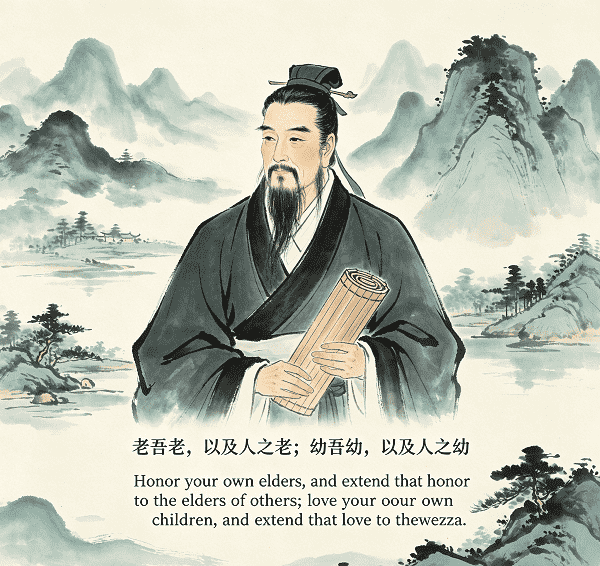
老吾老以及人之老,幼吾幼以及人之幼。
"Respect your own elders and extend it to others' elders; care for your own children and extend it to others' children." — The practical extension of benevolence from family to society.
Humans are born with innate moral sprouts — compassion, shame, deference, and sense of right and wrong. Evil arises when these sprouts are not cultivated.
Four innate moral beginnings that must be cultivated: compassion→benevolence, shame→righteousness, deference→ritual, discernment→wisdom.
Rulers should treat people as parents treat children: guarantee land, reduce taxes, educate the young. Only benevolent government can win hearts and unite the realm.
A tyrant is not a true ruler but a 'solitary fellow.' Killing one is not regicide but justice. This radical idea anticipated democratic theory by two millennia.
Seven chapters of dialogues recorded with his disciples. Distinguished by powerful rhetoric, it became one of the Four Books under Zhu Xi.
Mencius's assertion that 'the people are the most important' anticipated democratic theory by two millennia. His innate goodness doctrine provides a philosophical foundation for human rights. His advocacy for benevolent government aligns with modern social welfare, and his adversity-for-character teaching remains a powerful motivational framework.