The Supreme Sage and First Teacher
孔子
Confucius
The Supreme Sage and First Teacher
孔子
The events of Confucius's life are recorded in the Analects and the Records of the Historian. Here are the most significant episodes.
Childhood Love of Rites: As a young boy, Confucius would arrange ritual vessels and imitate ceremonial procedures. He traveled to the Zhou capital to ask Laozi about rites — a famous encounter in Chinese intellectual history.
The Jiagu Summit (500 BCE): Confucius served as master of ceremonies at a summit between Lu and Qi. Facing military threats, he used ritual propriety to compel Qi to return seized territories — the crowning achievement of his political career.
Starvation Between Chen and Cai: Trapped without food for seven days during his wanderings, Confucius continued to play his lute and teach. When asked if a gentleman could be so reduced, he replied: 'A gentleman remains steadfast in adversity; the petty person falls apart.'
Editing the Six Classics: In his later years, he selected 305 poems for the Book of Songs, compiled historical documents, wrote commentaries for the Book of Changes, and composed the Spring and Autumn Annals — making him the pivotal figure in Chinese cultural transmission.
Death of Yan Hui and Confucius's Passing: His beloved disciple Yan Hui died prematurely, and Confucius cried: 'Heaven has destroyed me!' His son soon followed. In 479 BCE, Confucius died at Qufu. His disciples mourned for three years.
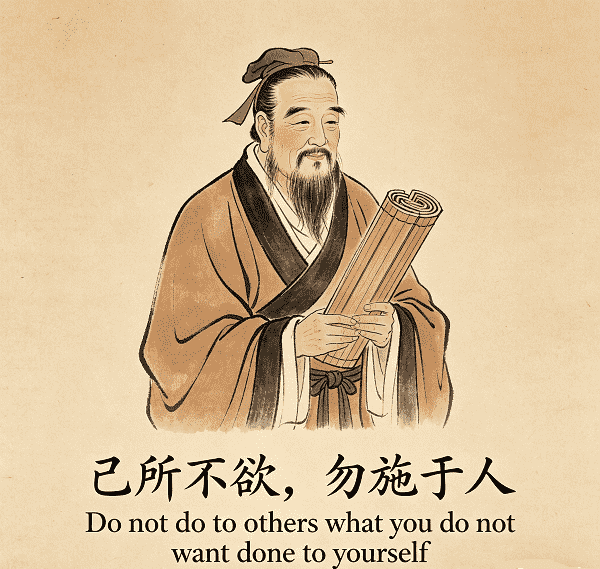
己所不欲,勿施于人。
"Do not impose on others what you do not wish for yourself." — The negative formulation of the Golden Rule, which Confucius stated five centuries before Christ.
学而时习之,不亦说乎?
"Is it not a joy to learn and regularly practice what you have learned?" — The opening line of the Analects, establishing learning as the foundation of human fulfillment.
三人行,必有我师焉。
"Among three walkers, one can surely be my teacher." — A testament to Confucius's humility and his belief that wisdom can be found everywhere.
知之为知之,不知为不知,是知也。
"To know what you know and to admit what you do not know — that is true wisdom." — Confucius on intellectual honesty as the beginning of all knowledge.
有教无类。
"In education, there are no class distinctions." — A revolutionary statement in an era when learning was the exclusive privilege of the aristocracy.
Ren (benevolence) is the core of Confucian thought — genuine love and compassion for others, manifested in daily human relationships. Confucius linked it to self-cultivation and ritual discipline.
Li encompasses the external norms of social order, from ceremonies to daily conduct. Confucius saw it not as empty form but as the outward expression of ren — teaching respect, restraint, and social responsibility.
The junzi (gentleman) is Confucius's ideal — defined not by social rank but by moral excellence. Guided by righteousness rather than profit, broad-minded and self-reflective.
The root of ren. Confucius argued that without devotion to parents, genuine benevolence toward others is impossible. True filial piety is spiritual reverence, not merely material support.
Confucius believed social chaos stemmed from disconnection between names and reality. 'Let the ruler be a ruler, the minister a minister, the father a father, the son a son.' Only when names match reality can order be restored.
A collection of Confucius's sayings and dialogues with disciples, recorded in twenty chapters. One of the most important texts in Chinese culture.
The earliest collection of Chinese poetry, 305 poems spanning five centuries. Confucius declared them summed up by: 'thoughts without depravity.'
A chronicle covering 242 years of Lu history. Through subtle word choices, Confucius conveyed moral judgments — the famous 'Spring and Autumn style.'
An ancient divination and philosophical text. Confucius studied it so intensely his leather bindings broke three times. He wrote the Ten Wings commentaries that gave it philosophical depth.
Confucius's thought shaped the spiritual core of Chinese civilization and profoundly influenced East Asia and the world. His emphasis on education without discrimination, leadership through virtue, social harmony through moral cultivation, and personal self-improvement remains strikingly relevant. His dictum 'If the leader is upright, all will follow without commands' remains a golden rule of management.