The Later Sage
荀子
Xunzi
The Later Sage
荀子
Xunzi, personal name Kuang (况), courtesy name Qing (卿), was the last and arguably the most systematic of the great pre-Qin Confucian philosophers. Born around 310 BCE in the State of Zhao during the tumultuous Warring States period, Xunzi dedicated his life to restoring the intellectual rigor of Confucianism against the rising tides of Mohism, Daoism, and Legalism.
Xunzi's career centered on the Jixia Academy (稷下学宫) in the State of Qi — the foremost intellectual center of the era. He served as its head, bearing the title "祭酒" (Libationer), an unprecedented honor for a scholar. He held this position three separate times, a testament to his towering reputation among contemporaries.
Beyond academia, Xunzi traveled extensively. He visited the State of Qin, where he observed its efficient Legalist governance with admiration and some reservation — an unusual openness for a Confucian. Later, he served under Lord Chunshen (春申君) in the State of Chu, eventually becoming magistrate of Lanling (兰陵令), where he implemented his philosophical ideas in actual governance.
Xunzi's most enduring legacy may be his students. He taught Han Feizi and Li Si — the two men who would become the chief architects of Legalism. Han Feizi synthesized Legalist theory, while Li Si, as Chancellor of Qin, helped unify China under the first emperor. That the Confucian "Later Sage" produced the two greatest Legalists of the age is one of history's most profound ironies.
Three Times Libationer of Jixia: Xunzi's appointment as head of the Jixia Academy — the greatest intellectual institution of the Warring States — placed him at the center of China's philosophical debates. He held this position three times, engaging with scholars from every school of thought and refining his own system against the strongest challenges.
Visit to the State of Qin: Unlike most Confucians who looked down on Qin's harsh Legalist governance, Xunzi traveled there and was genuinely impressed by its administrative efficiency and social order. Yet he also warned that Qin lacked the moral foundation of ritual and music (礼乐) that would sustain long-term rule — a prescient judgment that Qin would collapse just fifteen years after unification.
Serving Lord Chunshen: After political difficulties at Jixia, Xunzi moved south to Chu, where Lord Chunshen, one of the Four Lords of the Warring States, employed him. When jealous rivals spread rumors, Lord Chunshen initially dismissed Xunzi, but later reinstated him and appointed him magistrate of Lanling.
Training Han Feizi and Li Si: At Jixia, Xunzi's most brilliant students were Han Feizi and Li Si. Both absorbed his rigorous analytical approach but pushed it beyond Confucian boundaries into full Legalism. Li Si would later tell the First Emperor that Xunzi's emphasis on ritual and moral cultivation was inferior to law and punishment — the ultimate intellectual betrayal from a student to his master.
Debate with Mencius's Followers: Xunzi explicitly challenged Mencius's optimistic view that human nature is inherently good. This "性恶" vs. "性善" debate became the central fault line in Chinese philosophy of human nature, influencing thinkers from Dong Zhongshu to Wang Yangming and beyond.
人之性恶,其善者伪也。
"Human nature is evil; goodness is the product of conscious effort." — Xunzi's foundational thesis: goodness is not given but achieved through cultivation.
不积跬步,无以至千里。
"Without accumulating half-steps, one cannot travel a thousand miles." — A tribute to the transformative power of steady, patient effort.
青取之于蓝而青于蓝。
"Blue dye comes from the indigo plant, yet is bluer than the plant itself." — The student can surpass the master. Education elevates beyond nature.
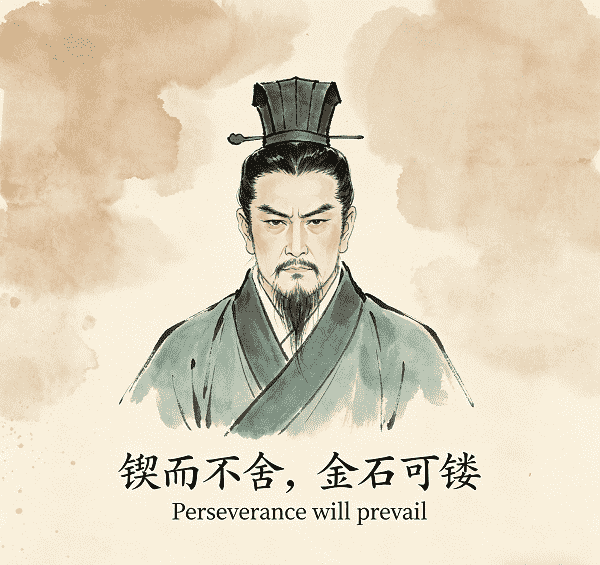
锲而不舍,金石可镂。
"If you carve without ceasing, even metal and stone can be engraved." — Perseverance can accomplish the seemingly impossible.
天行有常,不为尧存,不为桀亡。
"Heaven's course is constant — it does not exist for Yao nor perish for Jie." — Nature follows its own laws regardless of human virtue or vice.
Xunzi's most controversial claim: human nature is inherently inclined toward selfishness, envy, and desire. Left unchecked, these drives lead to chaos. But this is not pessimism — it is a call to action. Because goodness is "artificial" (伪, meaning "made through effort"), every person can become good through conscious cultivation. Xunzi compared human nature to a warped piece of wood: it must be steamed and straightened before it becomes useful.
For Xunzi, ritual (li) is not mere ceremony but the entire structure of civilized life — social norms, ethical standards, institutional design, and aesthetic refinement. Ritual is the sage-kings' great invention for channeling human desires into socially beneficial patterns. Without ritual, society degenerates into a war of all against all. With ritual, humans transcend their animal nature and become truly human.
If human nature is evil, then education becomes the most important social institution. Xunzi's essay "Exhortation to Learning" (劝学) is one of Chinese literature's most celebrated texts. Learning is a cumulative process — "not stopping" is the key. The environment matters: one should live among virtuous people, as ink absorbs into silk and perfume infuses one's body. Education literally reshapes human nature.
Xunzi stripped "Heaven" of its supernatural moral agency. Heaven is simply nature — it rains, the sun shines, seasons change — all according to impersonal laws, not moral intentions. Humans should understand natural patterns (天行有常) and work with them, not pray to Heaven for intervention. This naturalistic turn was revolutionary in Chinese thought, prefiguring modern secular attitudes.
The collected works of Xunzi, comprising thirty-two chapters covering every major philosophical topic: human nature, ritual, learning, governance, music, rhetoric, logic, and the nature of Heaven. The text is remarkable for its systematic structure — each chapter builds an argument from first principles, making it the most logically rigorous of all pre-Qin philosophical texts. Key chapters include "Exhortation to Learning" (劝学), "A Discussion of Heaven" (天论), "A Discussion of Ritual" (礼论), and "On the Rectification of Names" (正名).
Education and Social Mobility: Xunzi's insistence that goodness is achieved through effort, not inherited, is the philosophical foundation of meritocracy. His vision that anyone — regardless of birth — can become virtuous through learning resonates with modern democratic education and the belief that circumstances, not just innate talent, shape outcomes.
Institutional Design: Xunzi's emphasis on ritual as institutional structure — not empty ceremony — anticipates modern thinking about how institutions shape behavior. Good rules, well-designed social structures, and clear norms channel human self-interest toward collective good — much like modern constitutionalism and organizational theory.
Environmental Determinism: His insight that "near vermilion one becomes red, near ink one becomes black" (近朱者赤,近墨者黑) aligns with contemporary social science findings about peer effects, neighborhood influences, and the importance of positive environments for child development.
Secular Ethics: Xunzi's naturalistic "Heaven" — removing supernatural moral agency from nature — provides resources for building ethical systems without theological foundations. His approach to ethics through reason, institution-building, and education rather than divine command is strikingly modern.