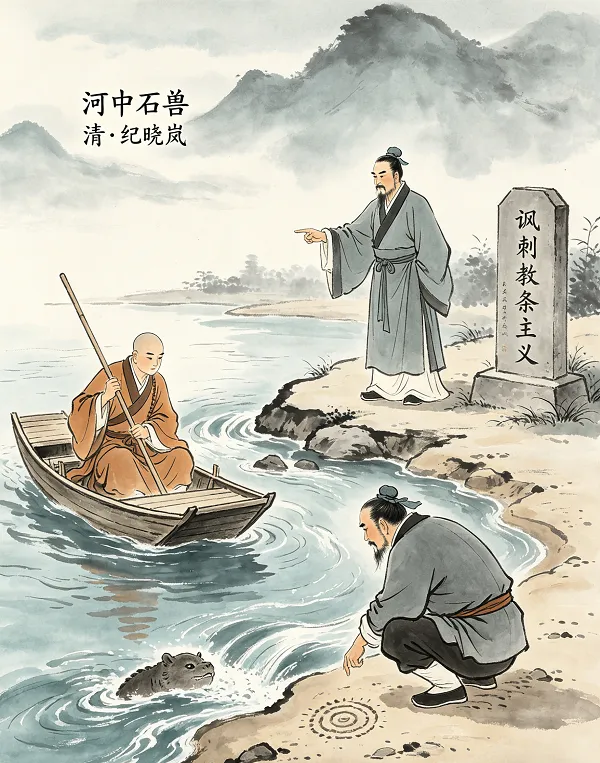
沧州南一寺临河干河干河岸、河边。"干"通"岸",是古汉语中表示水边的常用词。纪昀以此开篇,将故事场景设定在一条河边——石兽从河岸崩落入河,引出三方寻石的争论。,山门圮于河,二石兽并沉焉。阅十余岁,僧募金重修,求二石兽于水中,竟不可得。
以为顺流下矣,棹数小舟,曳铁钯,寻十余里无迹。
一讲学家讲学家以讲学为业的读书人,通常是理学(程朱理学)的拥护者。"讲学家"在纪昀笔下是一个带有讽刺意味的称呼——他们满口义理,但脱离实际。此处讲学家以"物理"推断石兽在下游沙中,看似有理,实则错了。设帐寺中,闻之笑曰:「尔辈不能究物理。是木杮木杮木屑、刨花。讲学家以木杮顺流而下为论据,推断石兽也应顺流而下——但石比水重,水流推不动石头,反而会冲走石头下面的沙子,使石头逆流滚动。讲学家的错误在于以轻物类比重物。,岂能为暴涨携之去?乃石性坚重,沙性松浮,湮于沙上,渐沉渐深耳。沿河求之,不亦颠乎?」众服为确论。
South of Cangzhou, a temple faced the riverbank河干 hé gānThe riverbank. "干" is interchangeable with "岸" (bank), a common classical term for the waterside. Ji Yun opens here, setting the scene beside a river — stone beasts collapse from the bank into the water, sparking a three-way debate over their location.. Its gate collapsed into the river, and two stone beasts sank with it. Over a decade later, the monks raised funds for reconstruction and searched the water for the two beasts, but could not find them.
Assuming they had been carried downstream, they rowed several small boats, dragging iron rakes for over ten li, finding no trace.
A lecturer讲学家 jiǎng xué jiāA scholar who lectures for a living, typically a proponent of Neo-Confucianism (Cheng-Zhu school). "Lecturer" carries an ironic tone in Ji Yun's writing — they mouth principles while being detached from reality. Here the lecturer deduces from "physics" that the beasts should be downstream in the sand; it sounds reasonable, but is wrong. who held classes at the temple heard this and laughed: "You people cannot investigate natural principles. Wooden shavings木杮 mù fèiWood shavings, wood chips. The lecturer uses wood shavings drifting downstream as evidence to deduce that stone beasts should also flow downstream — but stone is heavier than water; the current cannot push the stone, instead eroding sand beneath it, causing the stone to roll upstream. The lecturer's error is comparing a light object to a heavy one. may be carried away by floodwaters, but how could stone? Stone is hard and heavy; sand is loose and light. The beasts are buried in the sand, sinking deeper and deeper. To search downstream — is that not absurd?" The crowd accepted this as sound reasoning.
一老河兵老河兵在河堤上服役多年的老兵。"河兵"是清代负责河防的军人,常年与河水打交道,积累了丰富的实践经验。老河兵的答案基于经验而非理论,代表了"实践出真知"的立场。闻之,又笑曰:「凡河中失石,当求之于上流。盖石性坚重,沙性松浮,水不能冲石,其反激之力,必于石下迎水处啮沙为坎穴。渐激渐深,至石之半,石必倒掷坎穴中。如是再啮,石又再转。转转不已,遂反溯流逆上矣。」
求之下流,固颠;求之地中,不更颠乎?如其言,果得于数里外。然则天下之事,但知其一,不知其二者多矣,可据理臆断臆断凭主观臆测做出判断。"臆"指胸、内心,引申为主观。纪昀以此词作为全文的点睛之笔——无论是僧人的"顺流而下"还是讲学家的"渐沉渐深",都是脱离实际的臆断。唯有老河兵的经验判断才找到了真相。欤?
An old river soldier老河兵 lǎo hé bīngA veteran soldier who served on the riverbanks for many years. "River soldiers" were Qing-dynasty military men responsible for flood control, who accumulated rich practical experience through years of dealing with river currents. The old soldier's answer is based on experience rather than theory, representing the "truth comes from practice" standpoint. heard this and also laughed: "Whenever stones are lost in a river, one should search upstream. Stone is hard and heavy; sand is loose and light. Water cannot push stone directly. Its backwash current will scour sand into a hollow at the upstream face of the stone. This hollow grows deeper until it reaches halfway up the stone, at which point the stone topples into the hollow. The scouring continues, and the stone rolls again. Rolling endlessly, it eventually moves upstream against the current."
Searching downstream is certainly absurd; but searching in the earth — is that not more absurd still? Following the old soldier's words, the beasts were indeed found several li upstream. Thus it is with the affairs of the world: knowing one side but not the other is exceedingly common. Can one judge by conjecture臆断 yì duànTo judge based on subjective speculation. "臆" means the chest/heart, extended to mean subjective. Ji Yun uses this word as the crux of the entire essay — whether the monk's "flowing downstream" or the lecturer's "sinking deeper," both are conjectures detached from reality. Only the old soldier's experiential judgment found the truth.?
Three Laughs — The essay features three instances of "laughing": the monks at their failure, the lecturer mocking the monks' ignorance, and the old soldier mocking the lecturer's pedantry. The three laughs escalate progressively, forming a subtle satirical structure: the more confident, the more wrong; the more humble, the more right. Ji Yun wields "laughter" as a weapon of satire, sharper than direct criticism.
认识论的寓言
《河中石兽》是纪昀最著名的寓言之一,也是中学语文课本的经典篇目。故事表面讲的是寻找石兽,实质是对三种认识论立场的讽刺:僧人凭经验(顺流而下)、讲学家凭理论(渐沉渐深)、老河兵凭实践(逆流而上)。纪昀的结论是:天下之事"但知其一,不知其二者多矣"——真正的智慧不在于理论的完美,而在于对复杂现实的全面把握。
特别值得注意的是"讲学家"的塑造。纪昀并非反对读书,而是反对"读死书"——讲学家的错误不在于推理方法,而在于推理前提(以轻物类比重物)。这种"方法正确但前提错误"的陷阱,在今天的信息时代依然普遍。
笔记体的叙事艺术
纪昀用极简的笔法,在短短数百字中完成了三方的辩论和最终的揭示。没有铺垫,没有心理描写,纯粹以对话和行动推进叙事。这种"少即是多"的写法,是清代笔记文学的典范。
An Epistemological Parable
"The Stone Beast in the River" is one of Ji Yun's most famous parables and a classic of Chinese middle-school curricula. On the surface it concerns finding stone beasts; in substance, it satirizes three epistemological positions: the monk relying on experience (downstream), the lecturer relying on theory (deeper in sand), and the old soldier relying on practice (upstream). Ji Yun's conclusion: affairs of the world commonly show "knowing one side but not the other" — true wisdom lies not in theoretical perfection, but in comprehensive grasp of complex reality.
Notably, the "lecturer" is not opposed to reading but to "dead reading" — his error lies not in the method of reasoning but in the premise (comparing light objects to heavy). This trap of "correct method, wrong premise" remains ubiquitous in today's information age.
The Art of Notebook-Style Narrative
Ji Yun uses minimalist brushwork, completing a three-way debate and final revelation in barely hundreds of characters. No padding, no psychological description — pure dialogue and action driving the narrative. This "less is more" approach is the model of Qing-dynasty miscellanea literature.
"讲学家"是纪昀在《阅微草堂笔记》中反复出现的讽刺对象。他们通常是以讲授程朱理学为业的读书人,满口"天理""格物致知",但对实际事物一窍不通。纪昀并非反理学,而是反"伪理学"——那些只会背诵教条而不懂变通的书呆子。在《河中石兽》中,讲学家的推理表面上完全正确(石重沙轻,石应沉入沙中),却忽略了水流反激力的关键因素。
The "lecturing scholar" is a recurring satirical target in Ji Yun's Notes from the Yuewei Hermitage. Typically scholars who make their living teaching Cheng-Zhu Neo-Confucianism, they mouth "heavenly principle" and "investigating things to extend knowledge" while knowing nothing practical. Ji Yun opposes not Neo-Confucianism but "false Neo-Confucianism" — pedants who can only recite dogma without adaptability. In this tale, the lecturer's reasoning appears entirely correct (stone is heavy, sand is light, so stone should sink) yet overlooks the crucial factor of backwash current.
清代河防制度下的基层军人,负责巡视河堤、防汛抢险。老河兵没有读过多少书,但他在河边服役多年,对水流、沙石的运动规律了如指掌。纪昀以此人物代表"实践智慧"——与讲学家的"书本智慧"形成鲜明对比。老河兵的发言中包含了一个完整的物理学推理(水流反激→冲刷沙穴→石兽翻转→逆流滚动),这个推理后来被实验证实完全正确。
A low-ranking soldier of the Qing flood-control system, responsible for patrolling levees and emergency flood work. The old soldier was not well-read, but years of riverbank service gave him intimate knowledge of water currents and sediment dynamics. Ji Yun uses this figure to represent "practical wisdom" — in stark contrast with the lecturer's "bookish wisdom." The old soldier's speech contains a complete physics deduction (backwash → sand scouring → stone toppling → upstream rolling) later confirmed correct by experiment.