The Origin
Among the oldest narratives of Chinese civilization, Nüwa stands as the Mother of All Things — the great goddess who created humanity and repaired the broken sky. Her legend stretches back to pre-Qin texts, recorded in the Huainanzi, Classic of Mountains and Seas, and Fengsu Tongyi.
She is typically depicted as a divine being with a woman's upper body and a serpentine tail — a form that appears extensively in Han dynasty stone reliefs, making her one of the most ancient divine images in Chinese culture.
Key Sources
- Huainanzi — Lánmíng Xùn
- Shanhaijing — Dahuang Xī Jìng
- Fengsu Tongyi
- Chuci — Tiān Wèn
Gonggong's Fury
In ancient times, a great war erupted between Gonggong, the Water God, and Zhurong, the Fire God. Defeated and humiliated, Gonggong hurled himself against Mount Buzhou — the pillar that held up the northwestern sky. With a thunderous crack, the sky pillar shattered, and the earth tilted toward the southeast.
“In ancient times, the four pillars collapsed, the nine provinces split apart. The sky could no longer cover all things, the earth could no longer support them. Fires raged without ceasing, floods spread without end.”
— Huainanzi, Lánmíng Xùn
A massive hole opened in the heavens. Stars, sun, and moon lost their order. Celestial fire poured down, floodwaters surged from below. Savage beasts devoured the people, monstrous birds snatched the elderly and weak — the world plunged into catastrophe unlike anything before.
Smelting the Five-Colored Stones
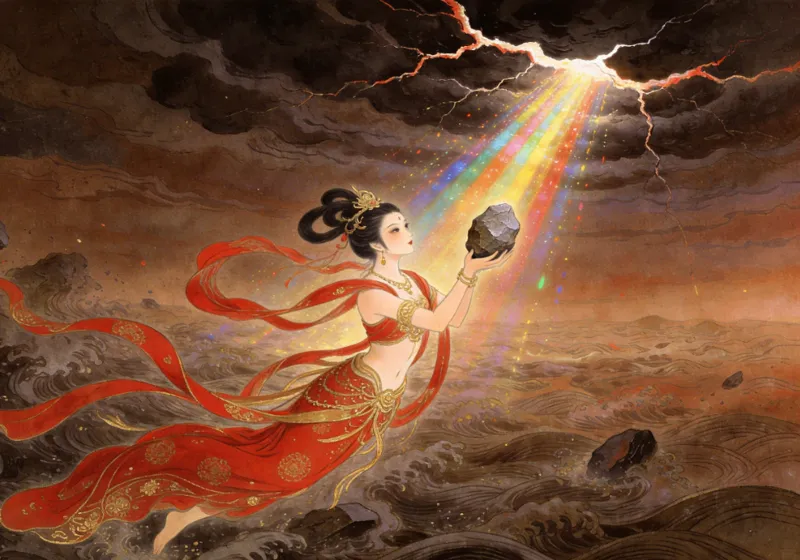
Faced with cosmic catastrophe, Nüwa did not turn away. She journeyed across mountains and rivers, gathering five sacred stones of blue, red, yellow, white, and black — corresponding to the Five Elements of wood, fire, earth, metal, and water.
Atop Mount Tiantai, she built a great fire and smelted the stones through long hardship. At last, she hurled the molten, glowing stone at the cracks in the heavens. Five-colored light blazed as the rifts slowly sealed, and the sun, moon, and stars returned to their proper places.
Symbolism of the Five Stones
The five stones represent not only the Five Elements but the totality of all color and matter in the universe. By using them to mend the sky, Nüwa restored cosmic order with the very essence of creation itself — a profound vision of universal harmony.
The Turtle's Sacrifice
Though the sky was mended, the four pillars that held heaven and earth had shattered. Nüwa then cut off the legs of a divine turtle — a colossal sea creature — and used them to prop up the four corners of the sky. From that time onward, the sky tilted northwest, so the sun, moon, and stars drift westward; the earth sank southeast, so rivers flow forever toward the east.
This detail echoes real Chinese geography even today — the terrain truly is higher in the northwest and lower in the southeast, with great rivers flowing eastward into the sea. The ancients wove natural phenomena into myth, giving the land itself narrative meaning.
Creating Humanity from Clay
Nüwa's other great deed was the creation of humanity. According to Fengsu Tongyi, she shaped figures from yellow clay mixed with water and breathed life into them. At first she carefully handcrafted each one, but finding it too slow, she swung a rope through the mud — and the splashing droplets also became people.
“It is said that when heaven and earth first opened, there were no people. Nüwa kneaded yellow clay to make humans. Overwhelmed by the task, she drew a rope through the mud and lifted it — each drop became a person.”
— Fengsu Tongyi
The handcrafted figures became nobles, while the rope-splashed droplets became common folk — a simple explanation for social hierarchy that reveals how the ancients embedded their worldview into myth.
Cultural Legacy
The legend of Nüwa is deeply woven into the fabric of Chinese culture. She is not only a creation goddess but a symbol of maternal power and selfless devotion. In Taoist thought, her act of mending heaven and earth represents the earliest expression of tian ren he yi — the unity of heaven and humanity — where harmony with nature is not passive acceptance but active stewardship.
The seventh day of the first lunar month is known as Rénrì — Human Day — believed to be the anniversary of Nüwa creating humanity. People wear flower ornaments and eat seven-vegetable soup to honor the great goddess who gave them life.