The Imperial Confucian
董仲舒
Dong Zhongshu
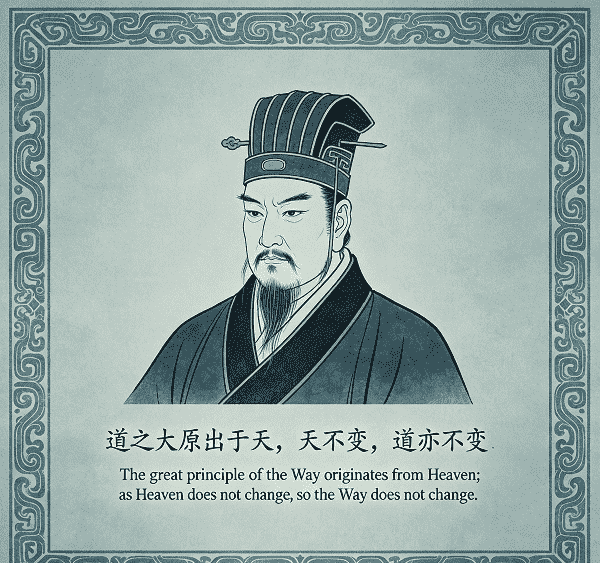
The Imperial Confucian
董仲舒
Dong Zhongshu, born around 179 BCE in Guangchuan (广川), present-day Hebei Province, was the architect of Confucianism's transformation from a philosophical school into the official state ideology of imperial China. His proposal to Emperor Wu of Han — "dismiss all other schools, revere only Confucianism" (罢黜百家,独尊儒术) — reshaped Chinese civilization for over two thousand years.
Dong Zhongshu's dedication to learning was legendary. He is said to have studied the Spring and Autumn Annals (春秋) with such obsessive focus that he did not look at his garden for three full years. His curtains were lowered, and he engaged with no visitors — only the classical text before him. This image of the utterly devoted scholar became a standard Chinese literary allusion for intellectual dedication.
His breakthrough came during the reign of Emperor Wu of Han (汉武帝, r. 141–87 BCE), one of the most powerful emperors in Chinese history. Dong presented his famous "Three Strategies of the Celestial Man" (天人三策) to the emperor — a comprehensive political-philosophical program arguing that Confucianism alone could provide the moral and cosmological foundation for a stable empire. Emperor Wu was convinced, and Dong's proposals became state policy.
As Chancellor of the Kingdom of Jiangdu (江都相) and later as Chancellor of Jiaoxi (胶西相), Dong put his theories into practice. He interpreted natural disasters as Heaven's warnings to the ruler — a double-edged sword. While this "Heaven-Man correspondence" gave Confucian scholars a powerful tool to criticize imperial excess, it also made Dong vulnerable. Accused of misinterpreting ominous portents to criticize the government, he was nearly executed and spent his later years in semi-retirement, focusing on writing. He died around 104 BCE.
Three Years Without Looking at the Garden: Dong Zhongshu's legendary dedication to studying the Spring and Autumn Annals — three years with curtains drawn, never glancing outside — became the model of scholarly devotion. This single-minded focus allowed him to develop his comprehensive interpretation of the classics, which would later reshape the entire Chinese intellectual tradition.
The Three Strategies (134 BCE): When Emperor Wu summoned scholars for policy advice, Dong Zhongshu presented three memorials arguing that Heaven, Earth, and humanity form a unified system. He proposed that the emperor should model governance on cosmic principles, establish Confucian academies, and elevate Confucian scholars to positions of authority. His recommendation to "dismiss all other schools and revere only Confucianism" was adopted, making Confucianism the exclusive state ideology.
Interpreting Omens: Dong applied his theory of Heaven-Man correspondence to real events. When a temple fire occurred or a comet appeared, he interpreted these as Heaven's displeasure with specific government policies. This gave Confucian scholars a powerful — and dangerous — tool. In 135 BCE, two imperial temples burned, and Dong attributed the fires to Heaven's anger. His political enemies used this to charge him with sedition, and he narrowly escaped execution.
Establishing the Imperial Academy: Building on Dong's proposals, Emperor Wu established the Imperial Academy (太学) in 124 BCE — China's first national university. It taught the Five Classics through Dong Zhongshu's interpretive framework, training generations of Confucian officials. This institution, and the examination system it eventually spawned, would select China's governing elite for the next two millennia.
Exile and Later Years: After his near-execution for omen interpretation, Dong Zhongshu retreated from political life. He served briefly as Chancellor of Jiaoxi but resigned after a few years, fearing further persecution. He spent his remaining years writing and teaching, producing the Chunqiu Fanlu (春秋繁露) — "Luxuriant Dew of the Spring and Autumn Annals" — the text that would secure his philosophical legacy.
道之大原出于天。
"The great origin of the Way is from Heaven." — The moral order that governs human society originates from the cosmic order of Heaven itself.
天人合一。
"Heaven and humanity are united as one." — The cosmos and human society form an integrated system; what affects one affects the other.
正其谊不谋其利,明其道不计其功。
"Rectify what is right without scheming for profit; clarify the Way without calculating results." — Moral action should be pursued for its own sake, not for personal gain.
罢黜百家,独尊儒术。
"Dismiss all other schools; revere only Confucianism." — Dong's famous proposal that made Confucianism the sole state ideology, ending the era of the Hundred Schools of Thought.
Dong's signature theory: Heaven and humanity are in constant interactive correspondence. When the ruler governs virtuously, Heaven rewards with good harvests and auspicious signs. When the ruler is corrupt or unjust, Heaven warns through floods, droughts, earthquakes, and eclipses. This gave Confucian scholars a permanent "check" on imperial power — the natural world itself became a moral watchdog.
Dong integrated the ancient Five Elements theory (wood, fire, earth, metal, water) into a comprehensive cosmological system that mapped onto seasons, directions, emotions, virtues, and political cycles. Each dynasty corresponded to one of the Five Elements in a perpetual cycle of replacement. This cosmological framework gave political legitimacy a metaphysical foundation — a dynasty's right to rule was written into the fabric of the cosmos.
Dong formalized the "Three Bonds" (ruler-subject, father-son, husband-wife) and "Five Constants" (benevolence, righteousness, ritual propriety, wisdom, trustworthiness) as the foundational ethics of society. These principles, rooted in cosmic order rather than mere convention, provided the moral infrastructure of Chinese society for over two thousand years.
Dong argued for political, intellectual, and moral unification under Confucian principles. Just as Heaven has one sun, the empire should have one ideology. This "Great Unity" concept justified both political centralization and cultural standardization, profoundly shaping the Chinese state's relationship with intellectual diversity.
Dong Zhongshu's masterwork — a systematic reinterpretation of the Spring and Autumn Annals through the lens of Heaven-Man correspondence, Five Elements cosmology, and Confucian political ethics. The text consists of eighty-two chapters (three lost) covering topics from cosmology and omen interpretation to ritual, governance, and human nature. It is the foundational text of Han dynasty Confucianism — the bridge between classical pre-Qin Confucianism and the imperial Confucian orthodoxy that would dominate Chinese civilization for two millennia.
State Ideology and Power: Dong Zhongshu's "dismiss all other schools, revere only Confucianism" is one of history's most consequential decisions about the relationship between ideas and power. It raises enduring questions: Should a state have an official ideology? What is lost when intellectual diversity is sacrificed for political unity? These questions remain relevant in debates about education, media, and national identity.
Environmental Ethics: Dong's Heaven-Man correspondence — the idea that human actions affect the natural world and vice versa — resonates with modern environmental thinking. While we no longer believe droughts punish corrupt emperors, the underlying insight that human society and the natural world form an interconnected system is remarkably prescient.
Social Ethics: The Three Bonds and Five Constants shaped East Asian society for millennia. While modern sensibilities rightly critique the hierarchical aspects (especially the subordination of women), the Five Constants — benevolence, righteousness, propriety, wisdom, and trustworthiness — remain powerful ethical ideals that continue to inform Confucian-influenced societies.
Cosmological Thinking: Dong's attempt to ground ethics in cosmic order — to make morality as fundamental as physics — anticipates modern attempts to find ethical implications in scientific discoveries, from ecology to evolutionary psychology. His project, while flawed in its methods, asked the right question: can we ground human values in something deeper than mere convention?