The Statecraft Scholar
顾炎武
Gu Yanwu
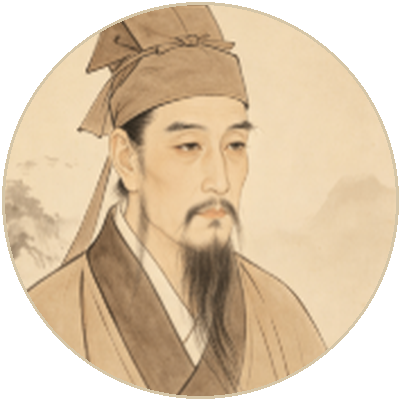
The Statecraft Scholar
顾炎武
Gu Yanwu's life reveals a scholar's profound commitment to his nation and civilization. Here are his most significant episodes.
His Mother's Martyrdom (1645): When Qing forces captured Kunshan, his adoptive mother Lady Wang starved herself to death, her final words urging him to never serve a foreign dynasty. These words became the spiritual anchor of his entire life.
Joining the Resistance (1645): Gu organized militia resistance in Kunshan with fellow scholars. The uprising failed and he escaped, beginning his long years of exile.
Twenty Years of Northern Travel: From 1657, Gu spent twenty-five years on horseback across northern China, meticulously investigating terrain, resources, and history — strategic reconnaissance for the Ming restoration cause.
Refusing the Imperial Examination (1678): When the Qing court summoned him through a special examination, Gu declared: 'Rope and blade are both here — do not hasten my death.' His defiance forced the court to withdraw.
天下兴亡,匹夫有责。
"Every person bears responsibility for the rise and fall of the world." — The most famous formulation of civic duty in Chinese thought, distinguishing the fall of a dynasty from the fall of civilization.
博学于文,行己有耻。
"Be broadly learned in culture, and have a sense of shame in your conduct." — Gu's guiding principle combining intellectual breadth with moral self-awareness.
保天下者,匹夫之贱与有责焉耳矣。
"As for protecting civilization, even the humblest person shares in this responsibility." — The original passage from which the famous dictum was distilled, emphasizing that moral order belongs to everyone.
文之不可绝于天地间者,曰明道也,纪政事也,察民隐也,乐道人之善也。
"Writing that cannot be severed from the world serves to illuminate the Way, record governance, observe the people's hardships, and speak well of others' virtues." — Gu's definition of what scholarship and writing should accomplish.
人之为学,不可自小,又不可自大。
"In learning, one must neither think too little of oneself nor too much." — A balance between humility and confidence that defined Gu's scholarly character.
The core of Gu's thought: scholarship must solve real problems. He criticized Neo-Confucians for replacing genuine governance with hollow talk, arguing this contributed to the Ming's fall. Scholars should study history, geography, institutions, and economics.
顾炎武区分了「亡国」与「亡天下」:亡国只是改朝换代,是君臣之事;亡天下则是道德沦丧、文明崩溃,这才是每个人的责任。他因此提出「天下兴亡,匹夫有责」,将社会责任从统治者扩展到每一个普通人,极大地提升了个体的道德主体性。
Gu distinguished the fall of a dynasty (the ruler's affair) from the fall of civilization (everyone's responsibility). His dictum extended social duty to every individual, elevating ordinary people's moral agency.
顾炎武开创了清代考据学的先河。他主张「采铜于山」——做学问要像到山里采铜矿一样,从原始材料出发,进行实地调查和严密考证,而不是依赖二手资料。他的《日知录》每一则都经过反复考证,引用大量文献证据,这种严谨的治学方法对清代学术产生了深远影响。
Gu pioneered evidential scholarship, advocating 'mining copper from the mountains' — research from primary sources and field investigation. His rigorous method profoundly shaped Qing scholarship.
顾炎武特别强调「耻」的重要性。他认为「博学于文,行己有耻」是做人的根本原则。一个学者不仅要有广博的知识,更要有道德上的羞耻感——知道什么可为、什么不可为。他批评当时许多士人寡廉鲜耻,投降清朝后不以为耻反以为荣,认为这种道德堕落比任何学术缺陷都更为致命。
Gu emphasized the sense of shame as fundamental: 'Be broadly learned, and have a sense of shame in conduct.' Moral degradation, he argued, was more fatal than any intellectual failing.
Gu's most important work, written over thirty years. Thirty-two volumes of meticulously documented entries covering classics, governance, customs, military affairs, and geography.
A monumental work from twenty years of field investigation, recording geography, resources, taxation, and military positions across China — a practical manual for governance.
Gu's groundbreaking contribution to Chinese phonology, systematically tracing sound changes from ancient to medieval Chinese. A milestone in the study of ancient pronunciation.
Gu's thought remains powerfully relevant. His 'every person bears responsibility for the world' is a core civic ideal. His evidential scholarship encourages truth-seeking from primary sources. His 'practical learning for governance' reminds us scholarship should serve society. His moral courage before power demonstrates the integrity every intellectual should possess.