The Democratic Pioneer
黄宗羲
Huang Zongxi
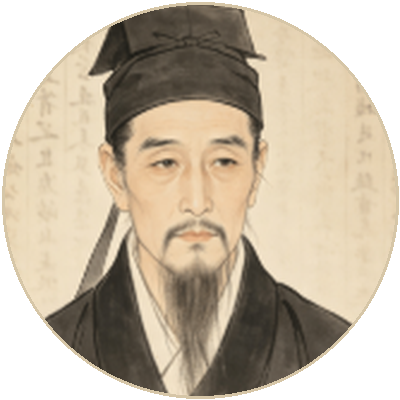
The Democratic Pioneer
黄宗羲
Huang Zongxi's life was filled with loyalty, courage, and resistance. Here are the most significant episodes.
Avenging His Father with an Iron Awl (1627): After his father was killed by eunuch faction agents, the nineteen-year-old Huang Zongxi traveled to Beijing. During the trial of the perpetrators, he produced an iron awl and stabbed the defendant in open court, then beat another conspirator. The emperor pardoned him, calling him 'a loyal minister's orphaned son.'
Organizing Resistance (1645–1650s): Huang sold his property and organized the 'Shizhong Camp' militia, following Prince Lu in nearly a decade of resistance against the Qing in eastern Zhejiang. Though the cause failed, his spirit became legendary.
Retirement and Scholarship: Hunted by the Qing, Huang retired to Yuyao and founded the Eastern Zhejiang School, producing over ten million characters across politics, philosophy, history, astronomy, and mathematics.
Refusing Qing Service: Huang repeatedly refused Qing court summons. When asked to help compile Ming dynasty history, he sent his son and disciple in his place — contributing to the project without ever personally serving the Qing.
天下为主,君为客。
"The world is the master; the ruler is but the guest." — A revolutionary redefinition of the relationship between ruler and people, reversing the traditional assumption that the emperor owns all under heaven.
天下之治乱,不在一姓之兴亡,而在万民之忧乐。
"The order or chaos of the realm does not depend on the rise or fall of a single dynasty, but on the sorrow or joy of the people." — A declaration that the welfare of the people, not dynastic power, is the true measure of governance.
学校所以养士也。然古之圣王,其意不仅此也,盖必使治天下之具皆出于学校。
"Schools exist to cultivate scholars. But the ancient sage-kings intended more: that the instruments of governance should all emerge from schools." — Huang's vision of schools as political forums, not merely educational institutions.
我之出而仕也,为天下,非为君也;为万民,非为一姓也。
"When I enter public service, it is for the world, not for the ruler; for all the people, not for one family." — A clear statement that public service is a duty to humanity, not to a dynastic house.
工商皆本。
"Both artisan production and commerce are fundamental." — A challenge to the traditional Confucian hierarchy that ranked agriculture above all other occupations.
Huang's most revolutionary idea: the realm belongs to the people, not the emperor. The ruler is merely a delegate entrusted with governance. Authority derives from the people's mandate, not heaven — a thunderous insight in seventeenth-century China.
Huang envisioned schools as public forums for political discussion and imperial oversight. The head of the Imperial Academy could review and critique the emperor's edicts — a concept resembling modern parliamentary systems.
Huang critiqued autocracy since the Qin, arguing rulers mistook 'their own selfish interests for the public good.' He distinguished ancient laws made for all from later laws serving a single family — mere 'private laws,' not true public law.
黄宗羲继承了浙东学派的传统,强调学术必须「经世致用」——学问的最终目的是解决现实社会问题,而不是空谈义理。他反对当时理学末流的空疏学风,主张研究历史、制度、经济、军事等实际学问,通过深入研究古代制度来为当代改革提供借鉴。
Huang championed practical learning for governance, insisting scholarship must address real-world problems. He opposed empty philosophical speculation, advocating the study of history, institutions, economics, and military affairs as guides for reform.
Huang's most important political treatise (1663). Through chapters on rulers, ministers, law, and schools, it critiques imperial autocracy and proposes limiting monarchical power and establishing schools as political forums — with proto-democratic overtones.
China's first comprehensive intellectual history (62 volumes), systematically tracing every major Ming Confucian school. Huang pioneered the 'case study' format for intellectual history, critically analyzing each school.
Huang's unfinished work, completed by his son and the scholar Quan Zuwang (100 volumes). It traces Song and Yuan intellectual traditions and remains essential for studying that era's thought.
Huang's ideas were far ahead of their time. His concept of 'the world is master, the ruler is guest' preceded Western democratic theory by half a century. His vision of schools as political forums anticipated the modern public sphere. His advocacy of 'practical learning for governance' remains a vital scholarly ideal. He is one of the most visionary thinkers in Chinese intellectual history.