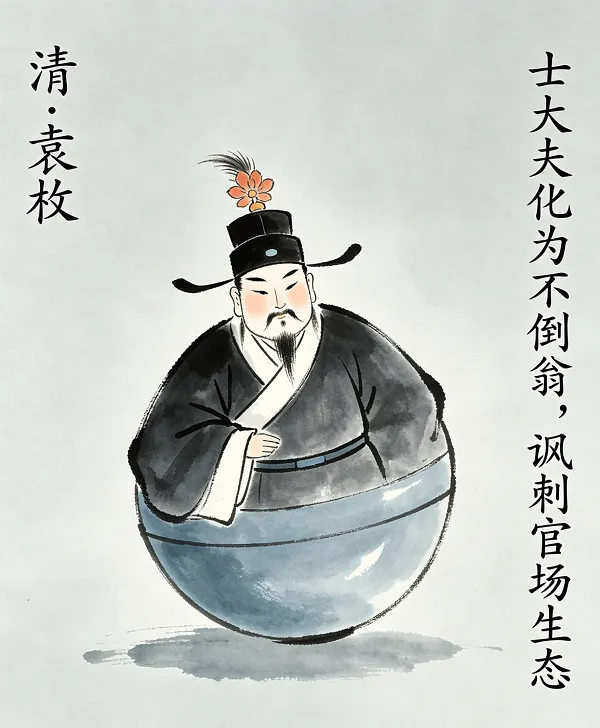
某士大夫士大夫古代中国的官僚阶层和知识分子的统称。"士"指读书人,"大夫"指官员。此处的士大夫是袁枚讽刺的核心对象——一生周旋于官场,见风使舵,左右逢源。,历仕三朝,宦海沉浮数十年。为人圆滑,善揣摩上意,从不得罪人。同僚戏之曰:"此公一生如不倒翁,推之不倒。"
士大夫卒后,其家人夜见一物,形如不倒翁不倒翁中国传统玩具——底部为半球形,重心极低,推倒后自动立起。不倒翁的核心特征是"怎么推都不倒",袁枚以此比喻官场中那些"怎么都不得罪人"的圆滑之人。,圆头大腹,满面笑容,立于堂中。推之则摇,放手即正。家人惊惧,知为士大夫之魂所化。
有好事者以墨涂其面,翌日复白;以针刺其腹,不痛不叫。问之曰:「汝究竟是何物?」但笑不答。居数月,忽失所在。
A certain scholar-official士大夫 shì dà fūThe ruling class and intellectual stratum of ancient China. "士" means literati; "大夫" means officials. This scholar-official is Yuan Mei's satirical target — a lifetime of navigating bureaucracy, reading the winds, never offending anyone. served three dynasties, floating and sinking through decades of officialdom. He was smooth and calculating, adept at reading his superiors' moods, never offending a soul. Colleagues joked: "This gentleman's whole life is like a roly-poly — push him and he won't fall."
After his death, his family saw something at night: shaped like a roly-poly不倒翁 bù dǎo wēngA traditional Chinese toy with a hemispherical base and extremely low center of gravity — it rights itself after being pushed over. The core trait is "never falling no matter how you push." Yuan Mei uses this to satirize those in officialdom who "never offend anyone.", round-headed and pot-bellied, grinning broadly, standing in the main hall. Push it and it sways; let go and it rights itself. The family, terrified, knew it was the scholar's transformed spirit.
A wag painted its face with ink; the next day it was white again. Someone pricked its belly with a needle — no pain, no cry. Asked "What on earth are you?" it merely smiled without answering. After several months, it suddenly vanished.
官场生存术的寓言
《不倒翁》是袁枚对官场生态最辛辣的讽刺。不倒翁的核心特征——圆头(没有棱角)、大腹(贪吃贪拿)、满面笑容(从不翻脸)、推之不倒(谁也扳不倒)——正是清代官僚的完美写照。袁枚自己做过官,深知官场之险恶,这个故事既是讽刺,也是自嘲。
"以墨涂其面,翌日复白"这个细节极为精妙——墨象征污名、罪名,但不倒翁第二天就恢复了洁白。这是对官场"洗白"能力的讽刺:无论做过什么,过了一夜就清白了。"以针刺其腹,不痛不叫"则暗示这些人的脸皮和肚皮都已经厚到了没有知觉的程度。
袁枚的自嘲精神
袁枚自己就是一位成功"全身而退"的官员——他在33岁辞官归隐,避开了官场的倾轧。但他并不以"清高"自居,而是用不倒翁的形象承认:在官场中生存,不可能不圆滑。这种不装清高的坦率,是袁枚最可贵的品质。
A Fable of Bureaucratic Survival
"The Tumbler" is Yuan Mei's most biting satire of officialdom. The roly-poly's core traits — round head (no edges), pot belly (greedy), permanent grin (never changes face), never falls (can't be toppled) — are a perfect portrait of the Qing bureaucrat. Having served as an official himself, Yuan Mei knew the dangers firsthand; this story is both satire and self-mockery.
"Painting its face with ink, white again the next day" is exquisitely pointed — ink symbolizes stigma, charges, but the roly-poly is spotless by morning. This satirizes the "whitewashing" ability of officials: no matter what they've done, they're clean by the next day. "Pricking its belly with a needle — no pain, no cry" implies their skin has thickened beyond sensation.
Yuan Mei's Spirit of Self-Mockery
Yuan Mei himself was an official who "retreated intact" — resigning at 33 to avoid bureaucratic intrigue. But he doesn't pose as "pure and lofty"; through the tumbler, he acknowledges that surviving in officialdom requires smoothness. This honesty without pretension is Yuan Mei's most admirable quality.
中国传统玩具,底部为半球形,重心极低,推倒后自动立起。"不倒翁"的比喻在中国文化中通常带贬义——形容那些见风使舵、圆滑世故、谁也扳不倒的官僚。袁枚将这个日常玩具升华为一个死后"灵魂具象化"的意象:一个官员生前活得像不倒翁,死后灵魂真的变成了不倒翁——生前的面具,死后的本质。
A traditional Chinese toy with a hemispherical base, extremely low center of gravity, that rights itself after being pushed over. In Chinese culture, "roly-poly" usually carries a negative connotation — describing smooth, opportunistic bureaucrats who can't be toppled. Yuan Mei elevates this everyday toy into a "soul materialization" image: an official who lived like a roly-poly has his soul literally become one — the mask in life, the essence in death.