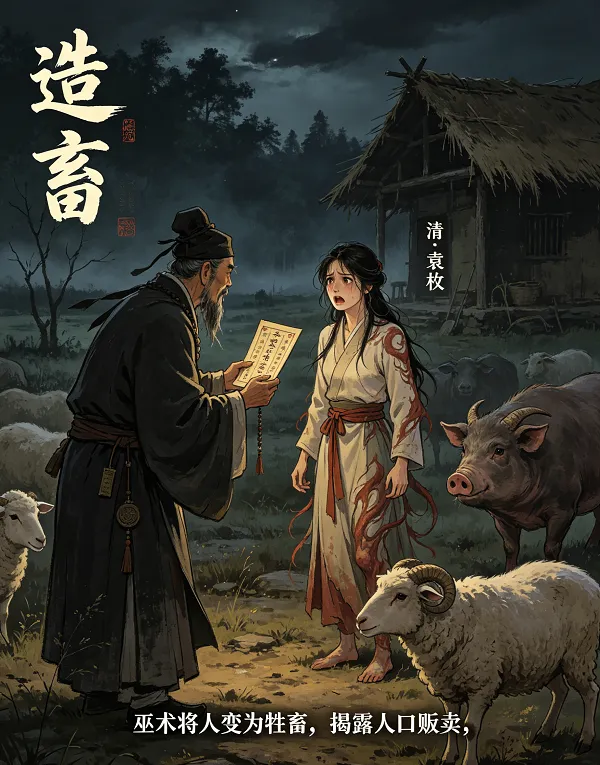
有江湖术士江湖术士行走江湖、以方术谋生的人。"江湖"指社会底层的流动空间,"术士"指掌握各种技艺(包括骗术)的人。清代江湖术士是社会的灰色地带——他们中既有真有本事的,也有纯粹的骗子。,善"造畜"之术。能以符水令活人化为驴、羊等牲畜,牵至市上售卖。买者不知其为人,以为真畜。
一日,有人买驴归。驴忽能言,泣曰:「我乃某县人,为术士所害。求君放我!」买者大惊。以水灌之,驴化为人。遍体鳞伤,被符水符水画了符咒的水。道教法术中,符水是最基本的工具——将符烧化于水中饮下,据说可以治病、驱邪。但袁枚笔下的术士用符水做坏事——将人变成牲畜。这种"法术黑化"的想象,反映了民间对江湖术士的恐惧。所迷,三日方醒。
买者报官。官府捕术士,得实。然术士笑曰:「天下造畜者众矣,独捕我何为?」言毕,忽化为青烟而去。官吏莫能追。
There was a wandering sorcerer江湖术士 jiāng hú shù shìOne who roams the jianghu (social underworld) making a living through arts and tricks. "Jianghu" refers to the fluid space of society's underclass; "sorcerer" means one who commands various skills (including fraud). Qing-dynasty wandering sorcerers occupied society's gray zone — some genuinely skilled, others pure charlatans. skilled in the art of "beast-making." He could use charmed water to transform living people into donkeys, sheep, and other livestock, then lead them to market for sale. Buyers, unaware they were human, believed them genuine animals.
One day, a man bought a donkey and took it home. The donkey suddenly spoke, weeping: "I am a man from Such-and-such County — the sorcerer did this to me. Please set me free!" The buyer was shocked. He poured water over it; the donkey transformed back into a human. Covered in wounds, he had been dazed by charmed water符水 fú shuǐWater infused with talismanic power. In Daoist practice, charmed water is a basic tool — burning a talisman into water to drink, said to cure illness and expel evil. But Yuan Mei's sorcerer uses it for evil — transforming people into livestock. This "dark magic" imagination reflects common fears of wandering sorcerers. and took three days to awaken.
The buyer reported it to the authorities. The officials arrested the sorcerer and confirmed the truth. But the sorcerer laughed: "Beast-makers abound in this world — why arrest only me?" Having spoken, he transformed into green smoke and vanished. The officials could not pursue him.
超自然外壳下的社会现实
《造畜》是袁枚社会批判中最沉重的篇章。表面上讲的是"巫术变人",实质上揭露的是清代的人口贩卖——江湖骗子用迷药将人迷倒,当作牲畜贩卖。"造畜"不过是"迷拐人口"的超自然化表述。袁枚以此超自然外壳,包裹了一个人间最黑暗的现实。
术士最后说"天下造畜者众矣"——这句台词将故事从个案提升为社会批判。袁枚暗示:人口贩卖不是个别现象,而是遍布天下的系统性罪恶。术士化为青烟而去、"莫能追",则暗示了官府对此类犯罪的无力——不是不能追,而是不想追。
"人变畜"的隐喻深度
"人变畜"这个意象有三重含义:第一层是字面的——人口贩卖使人失去自由,沦为"牲畜";第二层是社会的——底层百姓在权力者眼中本就与牲畜无异;第三层是哲学的——当一个人失去自主意识(被符水迷晕),他就不再是"人",而成了可以买卖的"物"。袁枚用一个超自然故事,触及了"人何以为人"的终极问题。
Social Reality Beneath a Supernatural Shell
"Beast-Making" is the heaviest piece in Yuan Mei's social criticism. On the surface it describes "sorcery transforming people"; in substance, it exposes Qing-dynasty human trafficking — con artists drugging people unconscious and selling them as livestock. "Beast-making" is merely a supernaturalized description of "drugging and kidnapping."
The sorcerer's final line — "Beast-makers abound in this world" — elevates the tale from case study to social critique. Yuan Mei implies human trafficking isn't isolated but a systemic evil. The sorcerer vanishing as green smoke, "unpursuable," suggests official complicity — not that they can't pursue, but that they won't.
The Metaphorical Depth of "Human into Beast"
The image of "human into beast" carries three layers: literal — trafficking strips freedom, reducing people to livestock; social — the lower classes are already beasts in rulers' eyes; philosophical — when one loses autonomous consciousness (drugged), one ceases to be "human" and becomes a tradable "object." Through a supernatural tale, Yuan Mei touches the ultimate question: what makes one human?
"造畜"字面意义是"制造牲畜"——将活人变成牲畜。这个概念在中国志怪文学中有悠久的传统(如《搜神记》中的"化虎"故事),但袁枚将其与人口贩卖联系起来,赋予了古老母题以全新的社会批判功能。"造畜"的本质是"将人降格为物"——剥夺人格、消除意识、使之可以买卖。这是一种比杀戮更恐怖的暴力。
"Beast-making" literally means "manufacturing livestock" — transforming living humans into animals. This concept has a long tradition in Chinese supernatural literature (e.g., "transformation into tigers" in In Search of the Supernatural), but Yuan Mei connects it to human trafficking, endowing the ancient motif with new social-critical function. "Beast-making" is fundamentally "degrading humans to objects" — stripping personality, eliminating consciousness, making them tradeable. This is a violence more terrifying than killing.