某地有巨富,为人贪鄙贪鄙贪婪而卑鄙。"贪"指贪得无厌,"鄙"指见识短浅、行为猥琐。袁枚以此二字概括这类人物的核心特征——不仅是贪财,更是为贪而失人格。。平生以盘剥为业,夺人田产,欺压佃户,无所不为。乡人恨之入骨,然畏其财势,莫敢言。
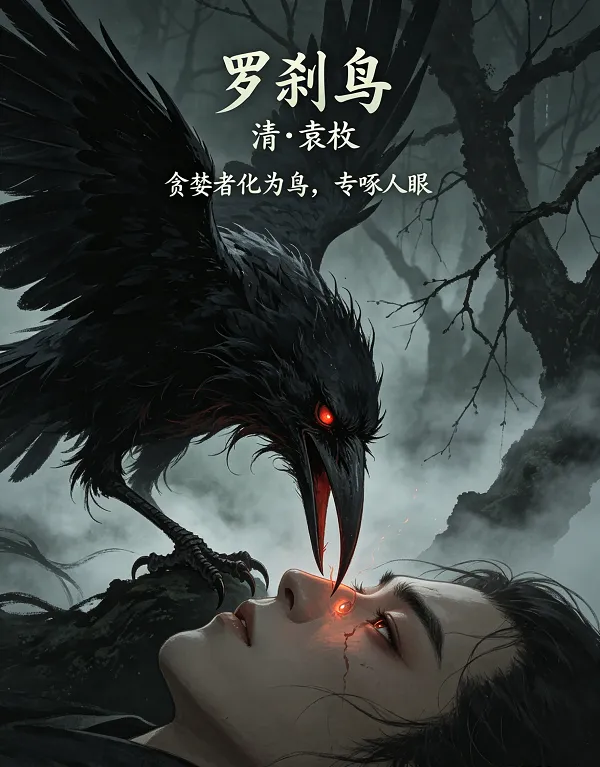
一日暴卒。死后忽化为巨鸟巨鸟巨大的鸟类。"罗刹鸟"是袁枚的创造——将佛教中的"罗刹"(恶鬼)与"鸟"结合,创造出一种专门啄人眼睛的怪物。眼睛象征"贪婪的目光",被啄去双眼正是对其生前"见利眼开"的惩罚。,翅展丈余,目赤如火。专飞至富户门首,啄人双目。被啄者目盲,家道遂衰。
乡人相告曰:「此乃罗刹鸟罗刹鸟袁枚创造的合成词——"罗刹"(佛教恶鬼)+"鸟"。贪婪者死后化为恶鸟,专门啄食其他贪婪之人的眼睛。这是一个精巧的因果循环:以贪始者,以贪终;啄人目者,因目而贪。也,贪者化鸟,专啄贪者之目。」自后富户多有闭目藏金以防之者。
In a certain region lived a man of great wealth who was greedy and base贪鄙 tān bǐAvaricious and despicable. "贪" means insatiably greedy; "鄙" means narrow-minded and vulgar. Yuan Mei uses these two characters to define such figures — not merely money-grubbing, but willing to lose their humanity for gain.. His entire life was devoted to exploitation — seizing others' lands, oppressing tenants, stopping at nothing. The villagers loathed him to the bone, but fearing his wealth and power, none dared speak.
One day he died suddenly. After death, he transformed into a giant bird巨鸟 jù niǎoA massive bird. The "Raksha Bird" is Yuan Mei's invention — combining the Buddhist "Raksha" (demon) with "bird" to create a monster that specifically pecks out human eyes. Eyes symbolize "greedy gazes"; losing them is punishment for one's lifetime of "eyes lighting up at profit." with a wingspan of over ten feet and eyes red as fire. It flew exclusively to wealthy households' gates and pecked out their eyes. Those blinded saw their family fortunes decline.
The villagers told each other: "This is the Raksha Bird罗刹鸟 luó chā niǎoA compound coined by Yuan Mei — "Raksha" (Buddhist demon) + "bird." The greedy, after death, become monstrous birds that peck out the eyes of other greedy people. A karmic loop: those who begin with greed end with greed; those who peck eyes were blinded by eyes to begin with. — the greedy become birds that feast on the eyes of the greedy." From then on, many wealthy households kept their eyes shut while hiding their gold.
袁枚的因果美学
《罗刹鸟》是袁枚因果报应叙事中最精巧的篇章。"啄人目"这一行为本身就是一个完美的隐喻——贪婪者以"眼"看利益("见利眼开"),死后化为鸟啄去他人之"眼"。袁枚不是简单地说"善有善报",而是用一个视觉化的意象(鸟啄眼),将抽象的因果报应变成了一幅恐怖的画面。
结尾"闭目藏金"四字极为讽刺——富户们为了防鸟啄眼而闭上眼睛,但仍然舍不得放下金子。这种"闭着眼睛数钱"的画面,是对"死不悔改"的终极讽刺:即使面对惩罚,贪婪者的第一反应仍然是保护财产,而非反省过错。
"子不语"的反题
书名《子不语》取自《论语》"子不语怪力乱神"——孔子不谈论怪异、暴力、悖乱、鬼神。袁枚以此为名,恰恰是要做孔子不做的事:用"怪力乱神"来针砭时弊。罗刹鸟的故事不是迷信,而是一则以超自然外壳包裹的社会批判。
Yuan Mei's Aesthetics of Karma
"The Raksha Bird" is the most ingenious karmic tale in Yuan Mei's collection. The act of "pecking eyes" is itself a perfect metaphor — the greedy see profit with their "eyes" (eyes light up at gain), and after death become birds that pluck out others' "eyes." Yuan Mei doesn't simply say "good begets good"; he uses a visual image to transform abstract karma into a terrifying picture.
The ending — "shut eyes while hiding gold" — is bitterly ironic. Wealthy households close their eyes against the bird but cannot release their gold. This image of "counting money with eyes shut" is the ultimate satire of "refusing to repent": even facing punishment, the greedy's first instinct is protecting property, not reflecting on their faults.
The Antithesis of "The Master Does Not Speak"
The title Zibuyu derives from the Analerta: "The Master did not speak of prodigies, feats of strength, disorders, or spirits." Yuan Mei uses this title to do precisely what Confucius would not: use "prodigies and spirits" to critique contemporary society. The Raksha Bird is not superstition but social criticism wrapped in a supernatural shell.
梵语 Rākṣasa 的音译,佛教中的恶鬼族类,以食人著称。"罗刹鸟"是袁枚将佛教概念本土化后的创造——贪婪者不是下地狱,而是变成一只以同类为食的鸟。这种"变身为怪物"的报应方式,比佛教的六道轮回更加直观和恐怖。
Transliteration of Sanskrit Rākṣasa — a class of Buddhist demons known for devouring humans. The "Raksha Bird" is Yuan Mei's localized creation: the greedy don't descend to hell but transform into birds that feed on their own kind. This "transformation into monster" is more visceral and terrifying than the Buddhist six realms of rebirth.