宋康王康王即宋王偃,战国时宋国末代君主。历史上以暴虐著称,在位期间穷兵黩武,最终宋国为齐国所灭。舍人韩凭韩凭宋康王的门客(舍人),因妻子何氏貌美而遭康王觊觎,被夺妻囚禁,最终自杀殉情。,娶妻何氏,美。康王夺之,囚韩凭。妻密遗凭书,缪其辞曰:「其雨淫淫,河大水深,日出当心。」
凭以书呈王,王以示左右,左右莫能解。臣苏贺苏贺宋康王的大臣,是唯一能解读何氏密诗的人,揭示了诗中暗藏的求死之意。对曰:「其雨淫淫,言愁且思也。河大水深,不得往来也。日出当心,心有死志也。」
A retainer舍人 shè rénA personal attendant or household retainer to a noble. Han Ping served as a retainer to Kang Wang, the King of Song. of Kang Wang康王 Kāng WángKing Yan of Song, the last ruler of the state of Song during the Warring States period. Known historically for his tyranny, he launched aggressive campaigns until Song was conquered by Qi. of Song, Han Ping韩凭 Hán PíngA retainer of Kang Wang whose beautiful wife He was coveted by the king. Imprisoned and bereft, he took his own life., had a wife named He, renowned for her beauty. Kang Wang seized her and imprisoned Han Ping. The wife secretly sent a letter to Han Ping, its words veiled in metaphor: "The rain falls ceaselessly; the river is vast and deep; when the sun rises, look to the heart."
Han Ping presented the letter to the King, who showed it to his attendants. None could decipher it. Only the minister Su He苏贺 Sū HèA minister of Kang Wang, the only one who could decode the hidden poem, revealing the wife's death wish. answered: "'The rain falls ceaselessly' means sorrow and longing. 'The river is vast and deep' means they cannot cross to each other. 'When the sun rises, look to the heart' — her heart has turned to death."
宋康王之舍人舍人门下食客,类似后世之幕僚。战国时期贵族豢养门客之风盛行,舍人与主人关系密切。韩凭,娶妻何氏,美。康王闻之,召见,果美。王大悦,遂夺之,囚韩凭于城旦城旦古代一种苦役刑罚,犯人须在黎明时分起来修筑城墙。此处指韩凭被罚作苦工。。
何氏贞洁,不为所动。日夜思念韩凭,忧愁不能自已。乃密修书一封,以隐语隐语暗语、隐晦的言辞。古人在不能直言时常用隐语传达心意,类似后世之暗号或密码。抒怀,托人带给韩凭。诗曰:「其雨淫淫,河大水深,日出当心。」
韩凭得书,不解其意,以为妻子已忘旧情。愤而呈书于王。王亦不解,遍示左右。群臣面面相觑,唯苏贺一人曰:「此绝命之辞也。」
Han Ping, a retainer舍人 shè rénA household follower or private secretary. During the Warring States period, it was fashionable for nobles to maintain large retinues of educated men. of King Kang of Song, had taken a wife named He, whose beauty was renowned. The King, hearing of her, summoned her to court and found her as lovely as reported. Greatly pleased, he seized her for himself and cast Han Ping into hard labor城旦 chéng dànA form of penal servitude in ancient China, where prisoners were forced to build city walls at dawn. Here it means Han Ping was sentenced to grueling physical labor..
He remained chaste and unyielding. Day and night she thought of Han Ping, consumed by a sorrow she could not escape. She secretly composed a letter in coded language隐语 yǐn yǔVeiled or coded speech. When direct words were impossible, the ancients used hidden metaphors to convey their true meaning — an early form of cipher. and entrusted it to someone who would bring it to him. The poem read: "The rain falls ceaselessly; the river is vast and deep; when the sun rises, look to the heart."
Han Ping received the letter but could not decipher its meaning. He believed his wife had forgotten their love. Bitter and resentful, he presented the letter to the King. The King too could not understand it and showed it to all his attendants. The ministers looked at one another in confusion — only Su He spoke: "These are words of a final farewell."
苏贺解曰:「其雨淫淫,言愁且思也。河大水深,不得往来也。日出当心,心有死志也。」王览其辞,不以为意,以为妇人之言不足挂齿。
俄而韩凭自杀。何氏闻之,阴腐阴腐暗中将衣裳腐蚀弄坏。何氏提前将衣服弄脆弱,以便从高台跳下时衣服不能兜风,确保必死。其衣。王与之登台台高台,古代宫殿中常见的高大建筑,用于观景、祭祀或宴饮。此处何氏从台上跃下自杀。,何氏因自投台下。左右揽之,衣不中手而死。
何氏之衣带有书,曰:「王利其生,妾利其死。愿以尸骨尸骨死后的遗体和骸骨。何氏请求与韩凭合葬,这是她最后的愿望。,赐凭合葬。」王怒,不听。
Su He decoded it: "'The rain falls ceaselessly' speaks of sorrow and longing. 'The river is vast and deep' means they can no longer reach each other. 'When the sun rises, look to the heart' — her heart has resolved on death." The King read the explanation and dismissed it, thinking a woman's words were beneath his concern.
Before long, Han Ping took his own life. When He heard the news, she secretly weakened阴腐 yīn fǔSecretly rotting or weakening. He had beforehand made her garments fragile so that when she leapt from the tower, her clothes would not catch the wind — ensuring her death. her garments. The King took her up to a tower台 táiAn elevated terrace or tower, common in ancient palace architecture for viewing landscapes, rituals, or banquets. He threw herself from such a tower., and there she cast herself down. The attendants tried to seize her, but her clothes tore in their hands, and she fell to her death.
Within the folds of her garments was a letter that read: "The King desires that I live; I desire only to die. I ask that my mortal remains尸骨 shī gǔThe body and bones of the dead. He's last wish was to be buried together with Han Ping. be granted to rest beside Han Ping." The King, in his fury, refused.
王乃使人埋之,冢冢坟墓。此处指康王故意将韩凭夫妇分别埋葬在两处,使他们死后也不能相聚。相望也。王曰:「尔夫妇相爱不已,若能使冢合,则吾不阻也。」
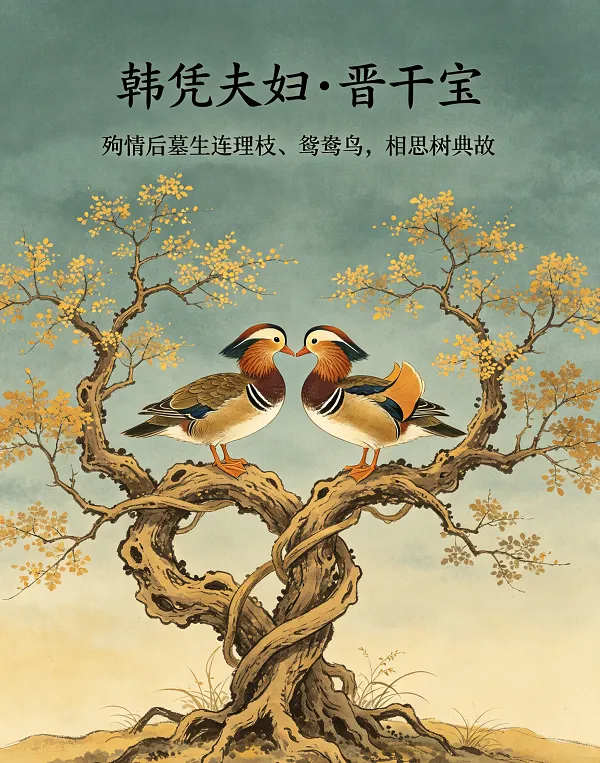
宿昔之间,便有大梓木大梓木高大的梓树。梓树在古代被视为百木之长,象征高贵和思念。从两座坟上各生一株,根枝相交。生于二冢之端,旬日而大盈抱。屈体相就,根交于下,枝错于上。又有鸳鸯鸳鸯即鸳鸯鸟,古称"匹鸟",因其雌雄成对、终生不离,被视为忠贞爱情的象征。,雌雄各一,恒栖树上,晨夕不去,交颈悲鸣,音声感人。
宋人哀之,号其木曰「相思树相思树即"互相思念之树"。此名后世广为流传,成为中文中表达爱情思念的经典意象。鸳鸯栖于其上,更添忠贞之意。」。相思之名,起于此也。南人谓此禽即韩凭夫妇之精魂。
The King ordered them buried in separate graves冢 zhǒngA burial mound or tomb. Here Kang Wang deliberately buried Han Ping and his wife apart, ensuring they could not be together even in death., within sight of each other. He said: "If your love truly knows no end, let the graves join as one — I shall not prevent it."
Within a single night, great catalpa trees大梓木 dà zǐ mùTowering catalpa trees. The catalpa was considered the noblest of trees, symbolizing dignity and longing. One sprouted from each grave, their roots and branches intertwining. sprouted from both tombs. In ten days their trunks were thick as an embrace. The bodies of the trees bent toward each other, roots entwined below, branches interlaced above. And there came mandarin ducks鸳鸯 yuān yāngMandarin ducks, called "matched birds" in ancient texts because they mate for life and never separate — the quintessential symbol of faithful love in Chinese culture., one male and one female, dwelling always in the trees. At dawn and dusk they never departed, neck to neck they cried in mourning, their song moving all who heard it.
The people of Song, grieving, named these trees the "Trees of Longing相思树 xiāng sī shù"Trees of mutual longing." This name became one of the most enduring expressions of lovesickness in Chinese. The mandarin ducks nesting above added the meaning of eternal fidelity.." It is from this tale that the phrase "lovesickness" takes its arboreal form. The southerners say that these birds are the very souls of Han Ping and his wife.
文学价值
《韩凭夫妇》是《搜神记》中最凄美的殉情故事。它以极其精炼的笔法,写出了一个完整的悲剧弧线:夺妻→囚禁→密诗→殉死→分葬→化树→鸳鸯。每一个转折都带着不可抗拒的命运感。
何氏的"隐语"是全篇的点睛之笔。三句十二字,句句含悲,却以自然意象包裹——雨是愁,河是隔,日出是死。这不是简单的暗号,而是将死亡升华为一种诗意的选择。何氏赴死前"阴腐其衣"的细节更是冷峻至极——她清醒地、有计划地走向死亡,没有任何犹豫。
比较研究
与《罗密欧与朱丽叶》相比,韩凭夫妇的故事更早约一千五百年,却在结构上惊人地相似:恋人被权力阻隔→双双殉情→死亡令权力低头。但莎士比亚让两个家族因死亡而和解,而《搜神记》则以"化树"的意象超越了人间的和解——韩凭夫妇不需要任何人的原谅,他们以自然之力重新结合,比生前更不可分离。
"相思"二字在此获得了双重含义:既是深切的爱恋,也是无尽的哀愁。后世诗词中"相思"成为最常用的爱情意象,其源头即在此。
Literary Merit
"Han Ping and His Wife" is the most poignant love-tragedy in In Search of the Supernatural. In remarkably compressed prose, it traces a complete tragic arc: seizure → imprisonment → coded poem → suicide → separate burial → trees springing forth → mandarin ducks. Each turn carries the weight of inexorable fate.
He's coded poem is the story's masterstroke. Three lines, twelve characters — each line laden with grief, yet wrapped in natural imagery. Rain is sorrow, the river is separation, sunrise is death. This is no simple cipher; it elevates dying into a poetic choice. Even more chilling is the detail that He "secretly weakened her garments" — she walked toward death with clear-eyed, deliberate planning, without hesitation.
Comparative Study
Compared to Romeo and Juliet, the tale of Han Ping predates Shakespeare by roughly fifteen hundred years, yet the structure is astonishingly similar: lovers separated by power → mutual death → death humbles the powerful. But where Shakespeare allows the two families to reconcile through tragedy, In Search of the Supernatural transcends human reconciliation entirely — through the image of trees growing from the graves. Han Ping and his wife need no one's forgiveness. They reunite through the forces of nature, more inseparable in death than they ever were in life.
The word "相思" (xiāngsī, mutual longing) acquires a double meaning here: both profound love and endless sorrow. This became the most enduring image of romantic yearning in Chinese poetry, and its source lies in this very tale.
相思树的意象在中国文学中影响深远。"相思"本义为互相思念,后专指男女之间刻骨铭心的爱情。李商隐"春蚕到死丝方尽,蜡炬成灰泪始干"中的"丝"与"思"谐音双关,其精神源头即在此处。鸳鸯栖于相思树上,更是将"忠贞不渝"与"生死相依"融为一体。
The image of the "Trees of Longing" exerted profound influence on Chinese literature. The word "相思" (xiāngsī) originally meant mutual longing, later becoming specifically associated with romantic love. Li Shangyin's famous line about the silkworm spinning silk until death plays on the homophony of "silk" (丝) and "longing" (思) — a spiritual descendant of this tale. The mandarin ducks nesting in the trees fuse "eternal fidelity" with "together in life and death" into a single image.
连理枝指两棵不同树木的枝条生长在一起,自古被视为夫妻恩爱的最高象征。白居易《长恨歌》中"在天愿作比翼鸟,在地愿为连理枝",直接化用了韩凭夫妇的意象。此典故与"比翼鸟""比目鱼"并列为爱情三大经典比喻。
"Intertwined branches" refers to branches from two separate trees growing together — since antiquity, the supreme symbol of conjugal love. Bai Juyi's "Song of Everlasting Sorrow" directly borrows this image: "In heaven, we wish to be birds flying wing to wing; on earth, we wish to be trees with intertwined branches." Together with "pair-winged birds" and "pair-eyed fish," it forms the classical triad of love metaphors.
东晋干宝所撰,中国志怪小说的开山之作。原书三十卷,已散佚,今本二十卷为后人辑录。干宝撰写此书的目的是"发明神道之不诬",即证明鬼神之事并非虚妄。《搜神记》收录了从上古到东晋的各类神异故事,是后世志怪文学的总源头。
Compiled by Gan Bao of the Eastern Jin dynasty, this is the foundational work of Chinese supernatural fiction. The original thirty volumes have been lost; the current twenty-volume edition was reconstructed by later scholars. Gan Bao's stated purpose was to "demonstrate that the ways of the spirits are not false." The collection spans tales from antiquity to the Eastern Jin and serves as the wellspring for all subsequent supernatural literature in China.