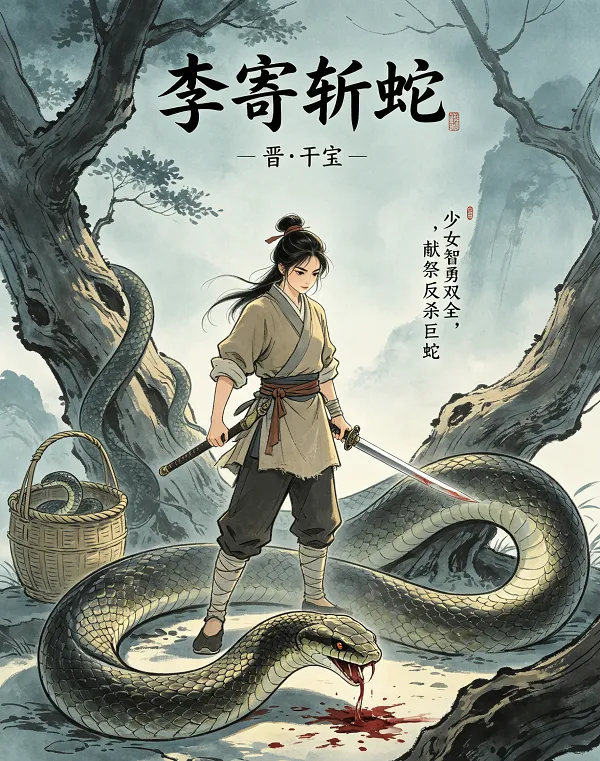
闽中有大蛇,名曰庸岭庸岭闽中地区的一座山岭(今福建境内),传说有巨蛇穴居其中,为害一方。之下穴中。长七八丈,大十余围。土俗常惧,以牛羊祭之。岁岁不绝。
后蛇与人梦,求祭以十二三岁童女童女未成年少女。蛇神化后在梦中向人索求活人祭祀,以少女为牺牲。。都尉、令长共患之,然气厉不息。共请求人家生婢子,及有罪家女,以八月祭之。
In the land of Min (modern Fujian) there dwelt a great serpent蛇 shéA giant snake — here elevated to the status of a deity demanding human sacrifice. In ancient Chinese folk belief, powerful animals could become local gods requiring appeasement. in a cave beneath Yong Ridge庸岭 Yōng LǐngA mountain ridge in the Min region (modern Fujian), said to harbor a giant serpent that terrorized the surrounding area.. It was seven or eight zhang long and more than ten arm-spans in girth. The locals lived in constant terror and offered oxen and sheep to appease it, year after year without end.
Later the serpent appeared in dreams, demanding a maiden of twelve or thirteen童女 tóng nǚAn underage girl. Having achieved the status of a local deity through fear, the serpent began demanding living human sacrifices — young girls as offerings. as its offering. The military commanders and magistrates were tormented, for the plague of evil did not cease. Together they procured daughters born to household slaves and girls from condemned families, sacrificing them each August.
闽中有大蛇,穴于庸岭之下。长七八丈,大十余围。土俗常惧,以牛羊祭之。后蛇与人梦,求以十二三岁童女祭之。都尉、令长共患之,然气厉不息。共请求人家生婢子,及有罪家女,以八月八月农历八月,即蛇神祭祀之期。古代八月秋收之际举行祭祀,蛇亦在此时出没最频繁。祭送蛇穴。
蛇辄吞啮吞啮吞食咬噬。此处描写蛇吞食祭品少女的残忍场景。,累年如此。已用九女。岁时祭祀,都不敢养女。有女者皆以女为患,或弃之,或溺之。
民间惶惶,重男轻女之风益甚。盖养女徒以饲蛇,不如弃之。乡里之悲,莫此为甚。然官府无能为力,唯以百姓之女充牺牲牺牲祭祀用的牲畜或人。此处以少女为牺牲品,暗示官府对蛇的恐惧甚于对百姓的关心。,苟安一时。
In the land of Min, a great serpent dwelt in a cave beneath Yong Ridge. Seven or eight zhang in length, its girth exceeding ten arm-spans, it terrified the region. The locals offered cattle and sheep to appease it. Then the serpent appeared in dreams, demanding a maiden of twelve or thirteen. The officials were helpless, for the evil influence never ceased. They procured slave-born daughters and girls from criminal families, sacrificing them each August八月 bā yuèThe eighth lunar month, the season of the serpent-god sacrifice. In ancient times, autumn harvest season was when such offerings were made, and when serpents were most active. at the serpent's cave.
The serpent devoured them whole吞啮 tūn nièTo swallow and devour. Here it describes the horrific scene of the serpent consuming the sacrificial maidens., year after year. Nine girls had already been consumed. At each season's sacrifice, no one dared to raise daughters. Those who had girls considered them a burden — some abandoned them, some drowned them.
The people lived in constant dread, and the preference for sons over daughters grew ever harsher. Why raise a daughter only to feed a serpent? Better to cast her away. No sorrow in the village was greater than this. Yet the officials could do nothing but offer the people's daughters as sacrifice牺牲 xī shēngRitual victims — animals or humans offered to a deity. Here, young girls served as sacrificial offerings, implying the officials feared the serpent more than they cared for the people., buying temporary peace at the cost of innocent lives.
将乐县李诞家,有六女,无男。其小女名寄寄李寄,李诞家的小女儿。"寄"有寄托、寄望之意,或许父母本寄望于子,却得一女,因以为名。,应募欲行。父母不听。
寄曰:「父母无相,惟生六女,无有一男。虽有如无。女无缇萦缇萦淳于缇萦,西汉少女,为救父而上书汉文帝,感动文帝废除肉刑。此处李寄以缇萦自比,表明虽为女子亦可有大作为。之益,有济父母之名。既不能供养,徒费衣食。生无所益,不如早死。卖寄之身,可得少钱,以供父母。岂不善哉?」
父母慈怜,终不听去。寄自潜行,不可禁止。乃行,请好剑及咋蛇犬咋蛇犬善于咬蛇的猎犬。李寄特意求取此犬,作为对付巨蛇的武器之一。。
In the county of Lele lived a man named Li Deng with six daughters and no sons. The youngest was named Ji寄 JìLi Ji, the youngest daughter of Li Deng. The character "寄" means "to entrust" — perhaps the parents had hoped for a son and received a daughter instead, naming her with that sense of deferred hope.. When the call for sacrificial candidates went out, she volunteered. Her parents would not allow it.
Ji said: "Father and mother are unfortunate — six daughters and not a son. Though you have children, it is as if you had none. I lack Ti Ying's缇萦 Tí YíngChunyu Tiying, a Western Han maiden who petitioned Emperor Wen to save her father from punishment, moving him to abolish mutilating penalties. Li Ji compares herself to Tiying, declaring that even a woman can achieve great things. talent to save a father, yet I have a daughter's duty to aid my parents. Unable to support you, I only waste your food and clothes. A life that brings no benefit — better to end it early. If you sell my body, you will gain a little money for your keep. Is this not a good plan?"
Her parents, loving and grieved, would not hear of it. But Ji went in secret, and they could not stop her. She went forth and obtained a fine sword and a serpent-hunting dog咋蛇犬 zhà shé quǎnA hunting dog trained to attack serpents. Li Ji specifically requested this dog as one of her weapons against the giant snake..
至八月朝祭,便诣庙中坐。先以数石米餈餈糯米做的糕饼,即糍粑。李寄用大量米糕做饵,其中暗藏利剑,是智取之策。,用蜜麨麨炒米粉,拌蜜后香甜可口,用以吸引蛇来吞食。灌之,置于穴口。蛇便出,头大如囷囷圆形的粮仓。此处形容蛇头之大,犹如一座圆形粮仓。,目如二尺镜。
先啖餈,犬便咋之。寄从后斫斫砍、劈。李寄从蛇身后挥剑劈砍要害。数创。蛇因踊出,至庭而死。寄入穴中,得其九女髑髅,悉举出。咤言曰:「汝曹怯弱,为蛇所食,甚可哀愍!」
于是寄缓步而归。越王闻之,聘以为后后王后。越王被李寄的勇武所感,娶她为王后。这是中国文学中"以功封后"的最早范例之一。。拜其父为将乐令,母及姊皆有赐赏。由是郡无复有蛇患。
On the morning of the August sacrifice, she went to the temple and sat in waiting. She had first placed several shi of rice cakes餈 cíGlutinous rice cakes (zongzi or cifan). Li Ji used a large quantity as bait, hiding her sharp sword within — a strategy of cunning over brute force. soaked in honeyed flour麨 chǎoFried rice flour mixed with honey, sweet and aromatic — irresistible bait for the serpent. at the mouth of the cave. The serpent emerged, its head as large as a granary囷 qūnA round granary. Here it describes the serpent's head as enormous as a circular grain storehouse., its eyes like mirrors two feet across.
It first devoured the rice cakes, whereupon the dog attacked. Li Ji hacked斫 zhuóTo chop or slash. Li Ji struck the serpent's vital points from behind with her sword. it from behind, dealing several grievous wounds. The serpent writhed and burst from the cave, dying in the courtyard. Li Ji entered the cave and found the skulls of the nine previous victims. She carried them all out and cried: "You were weak and timid, devoured by a serpent — how pitiable you were!"
Then she walked home at a measured pace. The King of Yue heard of her deed and took her as his queen后 hòuQueen or empress. The King of Yue, moved by Li Ji's valor, married her. This is one of the earliest examples in Chinese literature of a woman ennobled through heroic deed.. Her father was appointed magistrate of Lele, and her mother and sisters all received rewards. From that time on, the commandery was free of serpents.
文学价值
《李寄斩蛇》是中国文学中最早的少女英雄叙事之一。与后世常见的"女侠"形象不同,李寄的力量不在于武艺超群,而在于智谋过人。她以蜜餈诱蛇、以猎犬牵制、以利剑致命,每一步都是精心计算的结果。这是一种以智取胜的英雄模式,远比单纯的武力更值得称道。
尤为值得注意的是李寄面对死亡时的冷静。她不是被迫赴死,而是主动请缨——甚至在父母拒绝后"自潜行"。她的请缨辞以缇萦自比,显示了极高的自我意识:她知道自己是女子,但也知道自己可以改变命运。
比较研究
这个故事可与西方的圣乔治屠龙传说相比较。两者都是英雄斩杀巨兽拯救一方,但李寄的故事更多了一层社会批判的意味:官府无能、重男轻女、以人祭蛇——这些社会弊病才是真正的"蛇"。李寄斩的不仅是山中的蟒蛇,更是这些根深蒂固的偏见。
Literary Merit
"Li Ji Slays the Serpent" is one of the earliest female hero narratives in Chinese literature. Unlike the later "swordswoman" archetype, Li Ji's strength lies not in martial prowess but in strategic intelligence. She lures the serpent with honeyed rice cakes, pins it with a hunting dog, and delivers the killing blow with a hidden sword — every step carefully calculated. This is a hero model that values wit over brute force, far more admirable than mere physical power.
Most remarkable is Li Ji's composure in the face of death. She is not compelled but volunteers — even going in secret after her parents refuse. Her speech invoking Ti Ying shows extraordinary self-awareness: she knows she is a girl, and she knows she can change her fate.
Comparative Study
This tale invites comparison with the Western legend of St. George and the Dragon. Both feature a hero slaying a monstrous beast to save the people. But Li Ji's story carries an additional layer of social critique: incompetent officials, the devaluation of daughters, human sacrifice to a serpent — these social ills are the true serpent. Li Ji slays not just a snake in the mountains but the deep-rooted prejudices that fed it.
李寄是中国文学中最早以"智勇双全"闻名的少女英雄。她的形象与后世的花木兰(替父从军)、穆桂英(挂帅出征)一脉相承,但更为原始和直接。李寄的力量不来自家传武艺或神仙庇佑,而来自她自身的智慧和决断。她是中国女性叙事从"被拯救者"到"拯救者"转变的关键节点。
Li Ji is the earliest female hero in Chinese literature celebrated for "both wisdom and courage." Her image is the ancestor of Hua Mulan (who took her father's place in war) and Mu Guiying (who led armies into battle), but more primal and direct. Li Ji's power comes not from martial training or divine protection but from her own intelligence and resolve. She marks a pivotal shift in Chinese female narrative from "the saved" to "the savior."
在古代中国,少女(十二三岁)被视为最脆弱的群体之一,也是最容易被牺牲的对象。李寄的故事反转了这一预期:最"脆弱"的人反而成了最强大的英雄。这种"以弱胜强"的叙事在中国文化中具有特殊的意义,它挑战了力量与年龄、性别之间的固有联系。
In ancient China, a young maiden (twelve or thirteen) was considered among the most vulnerable — and the most readily sacrificed. Li Ji's story inverts this expectation: the "weakest" person becomes the strongest hero. This "triumph of the weak" narrative carries special significance in Chinese culture, challenging the assumed link between power and age or gender.
东晋干宝所撰,中国志怪小说的开山之作。原书三十卷,已散佚,今本二十卷为后人辑录。干宝撰写此书的目的是"发明神道之不诬",即证明鬼神之事并非虚妄。《搜神记》收录了从上古到东晋的各类神异故事,是后世志怪文学的总源头。
Compiled by Gan Bao of the Eastern Jin dynasty, this is the foundational work of Chinese supernatural fiction. The original thirty volumes have been lost; the current twenty-volume edition was reconstructed by later scholars. Gan Bao's stated purpose was to "demonstrate that the ways of the spirits are not false." The collection spans tales from antiquity to the Eastern Jin and serves as the wellspring for all subsequent supernatural literature in China.