The Perfected of the Literary Beginning
关尹子
Guanyinzi
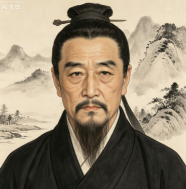
The Perfected of the Literary Beginning
关尹子
Receiving the Dao De Jing: As Laozi approached Hangu Pass on his ox, Guan Yin Xi saw purple clouds (紫气东来) heralding a great sage's arrival. He warmly received Laozi and implored him to record his teachings. Laozi wrote the Dao De Jing in two parts — Dao Jing (道经) and De Jing (德经) — totaling five thousand characters. This moment is one of the most celebrated encounters in Chinese philosophical history.
Purple Clouds from the East: Before Laozi's arrival, Guan Yin Xi observed auspicious purple clouds moving from the east. This phrase (紫气东来) became a Chinese idiom meaning an omen of good fortune or the arrival of something noble.
Master of Liezi: Guan Yin Xi is recorded as the teacher of Liezi (列子). He guided Liezi beyond superficial abilities (like riding the wind) toward true understanding of the Dao — teaching that even supernatural powers are not the ultimate goal.
The Wenshi Tradition: Guan Yin Xi's lineage became known as the Wenshi (文始) school of Daoism, emphasizing direct transmission of esoteric knowledge and the unity of all teachings.
在己无居,形物自著。
"When the self has no fixed abode, forms reveal themselves naturally." — Non-attachment allows true perception.
道不可传,传而非也。道不可受,受而非也。
"The Dao cannot be transmitted; what is transmitted is not the Dao. The Dao cannot be received; what is received is not the Dao." — True understanding transcends language.
圣人不以一己治天下,而以天下治天下。
"The sage does not govern the world through the self, but lets the world govern itself." — The highest governance is non-interference.
浑乎洋乎,游太初乎。
"Vast and boundless, wandering in the Great Beginning." — The sage returns to the primordial state.
以仁为恩,以义为理,以礼为行,以乐为和。
"With benevolence as kindness, righteousness as principle, ritual as conduct, and music as harmony." — Even within Daoism, the virtues have their place.
The ultimate reality that cannot be captured in words. Guan Yin Xi's philosophy centers on the ineffable nature of the Dao — it can only be pointed to, never defined.
The sage cultivates a mind free from fixed positions. Only through emptiness can one receive the Dao. This echoes Laozi's teaching of "emptiness of mind" (虚其心).
The fundamental substance of all existence. Understanding qi leads to understanding the transformations of all things.
All apparent multiplicity returns to the One. The sage sees unity where others see division.
Also known as the Wenshi Zhenjing (文始真经). A text attributed to Guan Yin Xi, composed of nine chapters covering Daoist cosmology, cultivation, and philosophy. It emphasizes the unity of the Dao, the emptiness of the self, and the naturalness of all phenomena.