Master Lianxi
周敦颐
Zhou Dunyi
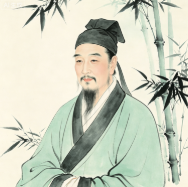
Master Lianxi
周敦颐
Writing the Taijitu Shuo: Zhou Dunyi composed the Taijitu Shuo (太极图说, "Explanation of the Taiji Diagram"), a short but revolutionary text that synthesized Daoist cosmology with Confucian ethics. It explains how the Supreme Ultimate (太极) generates yin and yang, the five phases, and all things — providing Neo-Confucianism with a complete cosmological framework.
The Ai Lian Shuo: Zhou Dunyi's famous essay "On the Love of the Lotus" (爱莲说) is one of the most beloved prose pieces in Chinese literature. He wrote: "I love the lotus because, while growing from mud, it is unstained." This became a metaphor for the morally upright person who remains pure amid worldly corruption.
Mentoring the Cheng Brothers: Zhou Dunyi taught the young Cheng Hao and Cheng Yi, passing on his cosmological vision. These two students would develop his ideas into the mature Neo-Confucian system that dominated Chinese thought for seven centuries.
Simplicity in Governance: As a local official, Zhou Dunyi was known for his just and efficient governance. He once released a prisoner who had been unjustly detained, choosing justice over career advancement.
出淤泥而不染,濯清涟而不妖。
"Growing from mud yet unstained, bathed in clear water yet not seductive." — The lotus as the ideal of moral purity.
无极而太极。
"From the Limitless comes the Supreme Ultimate." — The opening line of the Taijitu Shuo, describing the genesis of the cosmos.
太极动而生阳,动极而静,静而生阴。
"The Supreme Ultimate in movement generates yang; at its limit it becomes still. In stillness it generates yin." — The fundamental rhythm of cosmic change.
圣人定之以中正仁义而主静,立人极焉。
"The sage establishes centrality, uprightness, benevolence, and righteousness, and takes stillness as the master — thus setting the standard for humanity." — Ethics grounded in cosmology.
菊之爱,陶后鲜有闻。莲之爱,同予者何人?
"After Tao's love of chrysanthemums, few have been heard of. Who shares my love of the lotus?" — A poignant question about moral solitude.
The cosmic principle that generates all phenomena through the interplay of yin and yang. It is the foundation of Zhou Dunyi's cosmology.
The moral principle at the heart of the cosmos. Sincerity is not just a human virtue but the very nature of Heaven and Earth. The sage embodies this cosmic sincerity.
The method of moral cultivation. By returning to stillness, one aligns with the fundamental nature of the cosmos and achieves genuine virtue.
The ethical principles derived from cosmic order. Zhou Dunyi grounded Confucian ethics in his cosmological framework, giving them metaphysical depth.
A cosmological treatise explaining the generation of the universe from the Limitless through the Supreme Ultimate.
A prose essay using the lotus as a metaphor for moral purity.
A philosophical work elaborating on the Yijing and the relationship between sincerity, stillness, and cosmic principle.
Zhou Dunyi's lotus metaphor remains powerfully relevant. In an age of moral compromise and corruption, his insistence on rising pure from the mud speaks to anyone striving for integrity. His cosmological synthesis — bridging nature and ethics — offers a model for integrating scientific understanding with moral purpose. The "love of the lotus" continues to inspire Chinese art, literature, and ethical reflection.