The Perfected of Empty Harmony
列子
Liezi
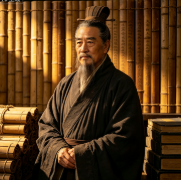
The Perfected of Empty Harmony
列子
Riding the Wind: Liezi's most famous ability. The Zhuangzi records that he could ride upon the wind and travel freely, returning only after fifteen days. Yet his teacher Guanyinzi pointed out that even this was not true freedom — true freedom means riding the transformations of heaven and earth itself.
Seeking the Dao from Guanyinzi: Liezi studied under Guanyinzi, who taught him to look beyond external appearances and cultivate inner emptiness. Under this guidance, Liezi learned to see the unity behind all things.
The Debate on Fate: In the Liezi text, there is a famous dialogue between 'Power' (力) and 'Fate' (命), exploring whether human effort or cosmic destiny governs life. Liezi's answer embraces both — effort within the framework of natural order.
Encounter with the Shaman: A story where a fortune-teller named Ji Xian could predict life and death. Liezi's teacher Guanyinzi showed that true mastery lies beyond such tricks, in the realm of the Dao itself.
天地无全功,圣人无全能,万物无全用。
"Heaven and Earth do not have complete achievement; sages do not have complete ability; the ten thousand things do not have complete function." — Imperfection is the natural order.
生者,理之必终者也。终者不得不终,亦如生者之不得不生。
"Those who are born must inevitably end. Those who end must end, just as those who are born must be born." — Life and death as natural necessities.
至游者不知所适,至观者不知所视。
"The ultimate traveler does not know where they go; the ultimate observer does not know what they see." — True experience transcends conscious direction.
形之不形,声之不声,化之不化。
"Form that is not form, sound that is not sound, transformation that is not transformation." — The deepest reality lies beyond sensory categories.
可以生而生,天福也;可以死而死,天福也。
"To live when one may live is heaven's blessing; to die when one may die is heaven's blessing." — Accepting both life and death as gifts.
The sage cultivates inner emptiness, free from fixed ideas and desires. Only in emptiness can the Dao reside.
Like the wind that moves without intention, the sage acts without forcing. Liezi's riding the wind symbolizes harmony with natural forces.
Understanding the limits of human control. Liezi's philosophy embraces the cosmic order without resignation — one acts fully within one's nature while accepting what cannot be changed.
All things are in constant flux. The sage flows with transformation rather than resisting it.
Also known as the Chongxu Zhenjing (冲虚真经, "True Classic of Empty Harmony"). Eight chapters attributed to Lie Yukou, though compiled and edited over centuries. Rich in parables and cosmological speculation, covering themes of emptiness, transformation, fate, and the relativity of human experience.
Liezi's thought offers wisdom for the modern age. His emphasis on emptiness and letting go resonates with mindfulness practices. The idea of "riding the wind" — acting in harmony with circumstances rather than forcing outcomes — provides a model for navigating uncertainty. His stories about the relativity of perspective anticipate modern discussions about cognitive bias and the limits of perception.