The Principle Philosopher
程颐
Cheng Yi
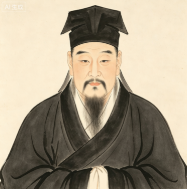
The Principle Philosopher
程颐
The events of Cheng Yi's life are recorded in the History of Song and the Collected Works of the Two Chengs.
Memorial to Emperor Renzong: At eighteen, as a commoner, Cheng Yi submitted a memorial urging the emperor to govern through the kingly way. Though not adopted, it demonstrated his courage and foreshadowed his later career.
Tutoring Emperor Zhezong: Cheng Yi taught the young emperor with strict devotion. When the emperor broke a willow branch, Cheng Yi admonished: 'In spring, all things come to life — do not destroy them without cause.' He insisted the emperor correct even his sitting posture.
洛蜀之争:程颐在朝廷任职期间,与以苏轼为首的蜀党发生了激烈的思想冲突。苏轼性格洒脱豪放,不拘小节;程颐则严肃刻板,注重礼法。两派的矛盾不仅是个人性格的冲突,更反映了宋代理学与文学两种文化取向的根本分歧。这场争论最终导致程颐被贬出朝廷,但也深刻影响了宋代士人文化的发展方向。
The Luo-Song Conflict: During his time at court, Cheng Yi clashed fiercely with the Shu faction led by Su Shi. Su Shi was free-spirited and unrestrained; Cheng Yi was rigid and propriety-obsessed. Their conflict was not merely personal but reflected a fundamental divide between the Neo-Confucian and literary cultural orientations of the Song dynasty. This dispute eventually led to Cheng Yi's dismissal from court, but it also profoundly shaped the direction of Song literati culture.
晚年流放:绍圣年间,新党重新执政后,程颐被列为「奸党」,遭到严厉的政治迫害。他的学说被禁止传播,著作被销毁,弟子被监视。他被迫离开洛阳,流放到涪州(今重庆涪陵)。在流放期间,程颐完成了他的重要著作《伊川易传》。据说他在极端困难的条件下,每天坚持研读《易经》和著述,将自己对天理的思考融入了这部巨著之中。
Exile in Later Years: During the Shaosheng era, when the reformist faction regained power, Cheng Yi was listed among the 'treacherous party' and suffered severe persecution. His teachings were banned, writings destroyed, and students surveilled. He was forced to leave Luoyang and exiled to Fuzhou (present-day Fuling, Chongqing). During exile, he completed his masterwork, the Yichuan Commentary on the Book of Changes. Under extreme hardship, he persisted daily in studying the Yi and writing, infusing this great work with his reflections on heavenly principle.
性即理也。
"Nature is principle." — Cheng Yi's foundational philosophical statement, identifying human nature with the universal principle that governs all things.
涵养须用敬,进学在致知。
"Nourishment of the self requires reverence; advancement in learning lies in extending knowledge." — Cheng Yi's two-pronged approach to self-cultivation: moral discipline and intellectual inquiry.
今日格一物,明日格一物,积习既多,然后脱然自有贯通处。
"Today investigate one thing, tomorrow investigate another. After accumulated practice, there will suddenly be a place of comprehensive penetration." — On the method of gradually extending knowledge through the investigation of individual things.
饿死事小,失节事大。
"Starving to death is a small matter; losing one's integrity is a great matter." — A statement about the primacy of moral principle over physical survival, though later controversially applied to widow chastity.
学者须先识仁。仁者浑然与物同体,义、礼、知、信皆仁也。
"The student must first know ren. The benevolent person is seamlessly one with all things; righteousness, ritual, wisdom, and trustworthiness are all ren." — From the famous 'Essay on Knowing Ren' (识仁篇).
程颐哲学的核心命题是「性即理」——人的本性就是宇宙的根本法则(理)。这一命题将人性论与宇宙论统一起来:天理既是万物运行的客观规律,也是人心本有的道德本性。每个人天生就具有完整的天理,但被后天的私欲所遮蔽。修养的目标就是去除私欲的蒙蔽,恢复天理的本来面目。这一思想为朱熹的理学体系奠定了理论基础。
The core proposition of Cheng Yi's philosophy is 'nature is principle' (性即理) — human nature is the fundamental principle (理) of the cosmos. This proposition unifies the theory of human nature with cosmology: heavenly principle is both the objective law governing all things and the innate moral nature within every human heart-mind. Everyone is born with complete heavenly principle, but it becomes obscured by acquired selfish desire. The goal of self-cultivation is to remove this obscuration and restore the original face of heavenly principle. This laid the theoretical foundation for Zhu Xi's philosophical system.
程颐对《大学》中「格物致知」的诠释,成为宋明理学认识论的基石。他将「格」解释为「至」(到达),将「格物」理解为「到达事物之理」——通过深入研究具体事物来认识其中蕴含的天理。他强调这是一个渐进的过程:今天研究一件事物,明天研究另一件,日积月累,最终豁然贯通,认识到万事万物之理归根结底都是同一个天理的不同表现。
Cheng Yi's interpretation of 'investigating things to extend knowledge' (格物致知) from the Great Learning became the cornerstone of Neo-Confucian epistemology. He interpreted 'investigate' (格) as 'reach' — to reach the principle within things through deep study of concrete phenomena. He emphasized this as a gradual process: today investigate one thing, tomorrow another, and through accumulated practice, eventually achieve comprehensive penetration — realizing that the principle of all things is ultimately the same heavenly principle manifesting differently.
程颐提出「涵养须用敬,进学在致知」,将自我修养分为两个相辅相成的方面。敬(reverence)是一种内心的专注和敬畏状态,是道德修养的基础功夫。程颐认为,敬不是简单的严肃拘谨,而是一种「主一无适」的精神状态——心专注于一处,不被外物分散。通过持敬的功夫,人可以保持天理的清明,防止私欲的侵扰。这一思想对后来的修养论产生了深远影响。
Cheng Yi proposed that 'nourishment of the self requires reverence; advancement in learning lies in extending knowledge,' dividing self-cultivation into two complementary aspects. Reverence (敬) is a state of inner attentiveness and awe — the fundamental practice of moral cultivation. Cheng Yi held that reverence is not mere rigidity but a state of 'focused unity without distraction' — the mind concentrated in one place, undisturbed by external things. Through the practice of reverence, one maintains the clarity of heavenly principle and prevents the intrusion of selfish desire. This profoundly influenced later theories of self-cultivation.
程颐是中国哲学史上最早系统论述理气关系的思想家之一。他认为宇宙由理(形而上的法则)和气(形而下的质料)构成。理是永恒不变的,是万物之所以然的根据;气是不断变化的,是万物之所以然的条件。理气不离不杂——理不能离开气而独立存在,气也不能脱离理而自行运动。这一理气二元论为朱熹的「理在气先」学说提供了理论框架。
Cheng Yi was among the first Chinese philosophers to systematically论述 the relationship between principle (理) and vital force (气). He held that the cosmos consists of principle (the metaphysical law) and qi (the physical material). Principle is eternal and unchanging — the ground of why things are as they are; qi is constantly changing — the condition through which things manifest. Principle and qi are neither separable nor confused — principle cannot exist independently of qi, and qi cannot move without principle. This dualism provided the theoretical framework for Zhu Xi's doctrine of 'principle prior to qi.'
程颐对「克己复礼为仁」的诠释与兄长有所不同。他更强调「克己」——克服私欲——的功夫。在他看来,仁的实现不是自然而然的,而是需要持续不断的自我约束和道德努力。他将天理与人欲对立起来,主张「存天理,灭人欲」——保存天理,消除人欲。虽然这一表述在后世引起了一些争议,但程颐的本意是去除过度的私欲,回归天理的自然状态,而非压制一切正常的人性需求。
Cheng Yi's interpretation of 'to restrain oneself and return to ritual propriety is ren' differed from his brother's. He placed greater emphasis on the discipline of 'restraining oneself' — overcoming selfish desire. In his view, the realization of ren is not spontaneous but requires continuous self-restraint and moral effort. He opposed heavenly principle to human desire, advocating 'preserve heavenly principle, eliminate human desire.' While this formulation proved controversial in later ages, Cheng Yi's original intent was to remove excessive selfish desire and return to the natural state of heavenly principle — not to suppress all normal human needs.
Cheng Yi's masterwork, finalized during exile. Unlike Han dynasty numerology, he interpreted the Yi through philosophical principle, elevating it to a philosophical classic. Decades in the making.
《经说》是程颐对儒家经典的注释和解说,涵盖《诗》《书》《礼》《春秋》等多部经典。这些注释体现了程颐以理学解经的方法论——不拘泥于文字训诂,而是着重阐发经典中的义理和天理。这种方法对朱熹的经学研究产生了直接的影响,也成为宋明理学解经的基本范式。" data-en="The Classical Interpretations are Cheng Yi's commentaries on the Confucian classics, covering the Book of Songs, Book of Documents, Book of Rites, Spring and Autumn Annals, and others. These commentaries exemplify his Neo-Confucian hermeneutic method — focusing on philosophical meaning rather than philological detail. This approach directly influenced Zhu Xi's classical scholarship and became the standard paradigm for Neo-Confucian interpretation.">Cheng Yi's commentaries on the Confucian classics, exemplifying his Neo-Confucian hermeneutic — focusing on philosophical meaning rather than philological detail. This approach directly influenced Zhu Xi.
程颐的大量语录、书信和短文收录在《二程集》中,包括《河南程氏遗书》《河南程氏外书》《伊川文集》等。这些文献是研究程颐思想的重要第一手资料,记录了他与弟子的对话、对时政的评论以及对学术问题的深入探讨。程颐的语录以其严谨深刻著称,常常一语中的,发人深省。" data-en="A vast collection of Cheng Yi's recorded sayings, letters, and essays is preserved in the Collected Works of the Two Chengs, including the Surviving Books of the Chengs of Henan, the Outer Books, and the Collected Writings of Master Yichuan. These are vital primary sources for studying Cheng Yi's thought, recording his dialogues with students, political commentary, and scholarly discussions. His sayings are known for their precision and depth.">Cheng Yi's vast recorded sayings, letters, and essays preserved in the Collected Works. Known for precision and depth, they are vital primary sources for his thought.
Cheng Yi's thought offers insights for today: his 'investigating things' parallels modern scientific method; his 'reverence' resonates with mindfulness practice; his emphasis on uniting knowledge with action reminds us learning must become action; and his insistence on teaching the emperor with integrity embodies the independence of knowledge from power.