The Logic Master
惠施
Hui Shi
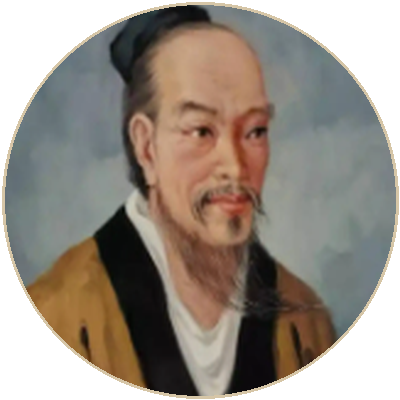
The Logic Master
惠施
Hui Shi (c.380–305 BCE), also known as Huizi, was a native of the State of Song during the Warring States period. A leading figure of the School of Names (名家, Mingjia), he was one of the most brilliant logicians and debaters of his era. He also served as Prime Minister of the State of Wei, leaving a deep mark on both politics and scholarship.
Hui Shi's career centered on the State of Wei. He was a contemporary and close friend of Zhuangzi — though their intellectual temperaments were utterly different. Zhuangzi championed natural spontaneity and non-action; Hui Shi was passionate about logical debate. Yet this difference did not prevent them from becoming the closest of friends. Their debates and friendship became one of the most moving stories in Chinese intellectual history.
As Prime Minister of Wei, Hui Shi advocated the 'vertical alliance' strategy (合纵), uniting the six eastern states against Qin's expansion. He helped forge alliances between Wei, Qi, and Chu, achieving notable diplomatic successes. But his political career was not smooth — he faced repeated exclusion and attack from political rivals.
Hui Shi's greatest intellectual contribution was his 'Ten Theses on Things' (历物十题) — ten propositions about the nature of reality, touching on fundamental philosophical questions of space, time, motion, identity, and difference. Though dismissed as sophistry in his day, these theses have profound epistemological and methodological significance from the perspective of modern logic and philosophy.
Hui Shi's writings have been lost, and his thought survives primarily through the Zhuangzi, Xunzi, Lüshi Chunqiu, and other texts. The 'Under Heaven' (天下) chapter of the Zhuangzi records his Ten Theses and twenty-one paradoxes of the dialecticians in detail — the most important source for studying the School of Names. After Hui Shi's death, Zhuangzi lamented: 'Since the Master's death, I have no one to use as a whetstone, no one to talk to.'
">Hui Shi (c.380–305 BCE), also known as Huizi, was a leading figure of the School of Names (名家) and one of the most brilliant logicians of the Warring States era. He served as Prime Minister of Wei and advocated alliances against Qin's expansion. His close friendship with Zhuangzi — despite their radically different temperaments — is one of Chinese philosophy's most celebrated relationships. His 'Ten Theses on Things' explored space, time, motion, and identity. His works are lost; his thought survives through the Zhuangzi and other texts.The events of Hui Shi's life are recorded across several classical texts. Here are the most significant episodes.
The Bridge Debate: On the Hao River bridge, Zhuangzi claimed to know fish were happy. Hui Shi challenged: 'You're not a fish — how do you know?' Zhuangzi: 'You're not me — how do you know I don't know?' This famous exchange reveals their contrasting approaches — intuition versus logic.
Zhuangzi at Hui Shi's Tomb: After Hui Shi's death, Zhuangzi told the story of a master carpenter who could swing his axe to remove a speck of clay from a man's nose without touching the skin — but refused to perform without his partner. 'Since the Master's death, I have no one to use as a whetstone, no one to talk to.'
The Ten Theses on Things: Preserved in the Zhuangzi, these include: 'The infinitely great has nothing outside it — the Great One; the infinitely small has nothing inside it — the Small One'; 'The south is both infinite and finite.' These challenged common-sense understanding of space, time, and motion.
Prime Minister of Wei: A capable statesman who advocated alliances against Qin and helped forge a Wei-Qi-Chu coalition. His rival Zhang Yi, who favored alignment with Qin, eventually prevailed, forcing Hui Shi to leave Wei.
Zhuangzi's Assessment: The Zhuangzi criticized Hui Shi's doctrines as 'heterogeneous' and his words as 'missing the mark,' yet acknowledged his books 'filled five carts' — a testament to his vast learning.
卵有毛。
"An egg has feathers." — A paradox about potentiality: since a chick with feathers emerges from an egg, the egg must somehow contain the potential for feathers. This challenges the boundary between potentiality and actuality.
鸡三足。
"A chicken has three legs." — A paradox about abstraction: if you count 'chicken-leg' as a concept in addition to the two physical legs, there are three. This explores the relationship between concepts and physical objects.
飞鸟之影未尝动也。
"The shadow of a flying bird never moves." — A paradox about motion and perception: at each instant, the bird's shadow occupies a fixed position. Motion is a series of still frames. This anticipates Zeno's paradoxes and modern discussions of space-time.
至大无外,谓之大一;至小无内,谓之小一。
"The infinitely great has nothing outside it — call it the Great One. The infinitely small has nothing inside it — call it the Small One." — A meditation on the nature of infinity and the limits of conceptual division.
南方无穷而有穷。
"The south is both infinite and finite." — A paradox about the relativity of spatial concepts: from any point, the south extends infinitely, yet in a finite world it must have limits.
合同异是惠施最核心的哲学主张。他认为,从万物的共性来看,一切事物都是相同的;从万物的个性来看,一切事物都是不同的。同与异不是绝对的,而是相对的、可以互相转化的。这就像从太空看地球,所有的人都是同一个物种;但从近处看,每个人都完全不同。惠施通过这一思想,揭示了概念的相对性和认识的多层性。" data-en="'Uniting sameness and difference' (he-tong-yi) is Hui Shi's most fundamental philosophical proposition. He held that from the perspective of commonality, all things are the same; from the perspective of individuality, all things are different. Sameness and difference are not absolute but relative and mutually transformable. It is like viewing the Earth from space — all humans are one species — but up close, every individual is utterly different. Through this insight, Hui Shi revealed the relativity of concepts and the multi-layered nature of knowledge.">Hui Shi's fundamental insight: from the perspective of commonality, all things are the same; from individuality, all are different. Sameness and difference are not absolute but relative and mutually transformable. This reveals the relativity of concepts and multi-layered nature of knowledge.
惠施的「历物十题」是其哲学方法的集中体现。他通过一系列看似荒谬的命题,挑战人们对世界的基本假设。这些命题不是简单的诡辩,而是通过极端的逻辑推演,揭示日常概念中的矛盾和局限。这种方法类似于现代分析哲学中的思想实验——通过构造极端案例来检验概念的有效性。" data-en="Hui Shi's 'Ten Theses on Things' are the concentrated expression of his philosophical method. Through a series of seemingly absurd propositions, he challenged people's basic assumptions about the world. These are not mere sophistry but logical thought experiments that reveal contradictions and limitations in everyday concepts. His method resembles the thought experiments of modern analytic philosophy — constructing extreme cases to test the validity of concepts.">Hui Shi's ten theses are not mere sophistry but logical thought experiments challenging basic assumptions about the world. His method resembles modern analytic philosophy's thought experiments — constructing extreme cases to test conceptual validity.
惠施是中国古代辩证思维的先驱。他善于通过对话和辩论来揭示真理,认为只有在不同观点的碰撞中,才能接近事物的本质。他的辩论不是为了战胜对手,而是为了探索概念的边界。庄子说惠施「以反人为实而欲以胜人为名」,批评他过于追求辩论的胜利,但也承认他的思辨能力无人能及。" data-en="Hui Shi was a pioneer of dialectical thinking in ancient China. He excelled at revealing truth through dialogue and debate, believing that the nature of things can only be approached through the collision of opposing viewpoints. His debates were not about defeating opponents but about exploring the boundaries of concepts. Zhuangzi criticized him for 'taking contrariness as truth and seeking victory over others,' but acknowledged that his speculative abilities were unmatched.">A pioneer of dialectical thinking, Hui Shi believed truth emerges through the collision of opposing viewpoints. His debates explored conceptual boundaries rather than seeking victory. Zhuangzi acknowledged his unmatched speculative abilities.
作为名家的代表人物,惠施关注的核心问题是名(概念、语言)与实(现实、事物)之间的关系。他认为,人们通过语言和概念来认识世界,但语言和概念本身是有局限的——它们可能遮蔽事物的真实面貌。因此,需要不断地反思和批判我们的概念框架,以更接近事物的本质。这一思想对后来的语言哲学和认识论产生了深远影响。" data-en="As a leading figure of the School of Names, Hui Shi's central concern was the relationship between names (concepts, language) and reality (things, the world). He believed that people know the world through language and concepts, but these are inherently limited — they may obscure the true face of reality. Therefore, we must constantly reflect upon and critique our conceptual frameworks to approach the essence of things. This thinking profoundly influenced later philosophy of language and epistemology.">Hui Shi's central concern was the relationship between names and reality. Language and concepts are inherently limited — they may obscure reality's true face. We must constantly critique our conceptual frameworks to approach essence. This influenced later philosophy of language and epistemology.
惠施善于运用悖论和反转来揭示思维中的盲点。他的「卵有毛」「鸡三足」「飞鸟之影未尝动也」等命题,都是通过违反常识的陈述来迫使人们重新审视自己的认知。这种方法不是无意义的文字游戏,而是一种深刻的哲学策略——通过极端的逻辑推演来暴露日常思维中的隐藏假设和内在矛盾。" data-en="Hui Shi excelled at using paradox and reversal to reveal blind spots in thinking. His propositions — 'an egg has feathers,' 'a chicken has three legs,' 'the shadow of a flying bird never moves' — force people to re-examine their assumptions through counter-intuitive statements. This is not meaningless wordplay but a profound philosophical strategy: using extreme logical reasoning to expose hidden assumptions and internal contradictions in everyday thinking.">Through paradoxes like 'an egg has feathers' and 'the shadow never moves,' Hui Shi forced people to re-examine assumptions. Not wordplay but a profound strategy: exposing hidden assumptions and contradictions in everyday thinking.
Hui Shi's paradoxes parallel Zeno's and anticipate quantum mechanics. His 'uniting sameness and difference' resonates with modern perspectivism and paradigm theory. His method of questioning assumptions through paradox trains the critical thinking essential for the information age. His combination of political and philosophical thinking models interdisciplinary insight.