The New Citizen
梁启超
Liang Qichao
The New Citizen
梁启超
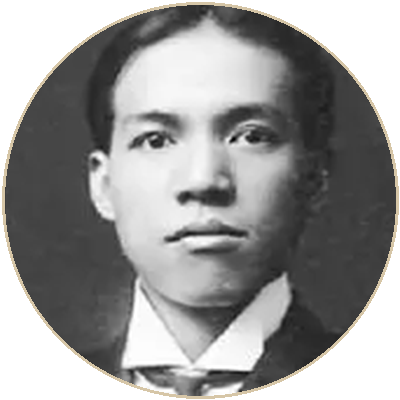
Liang Qichao, the 'Master of the Ice-Drinking Studio,' was modern China's most versatile intellectual. A prodigy who passed examinations at eleven, he became Kang Youwei's disciple and led the reform movement through his revolutionary prose. After exile in Japan, he developed the 'New Citizen' theory. Later he served as minister and became one of Tsinghua's Four Great Mentors. He died in 1929 at fifty-six.
Liang's life spanned the late Qing and Republican eras, engaging with China's most significant transformations. Here are the key episodes.
Studies at Wanmu Caotang (1890): At seventeen, Liang met Kang Youwei, who critiqued traditional scholarship so powerfully it hit 'like cold water down his back.' He abandoned old learning and devoted himself to reform.
Editing the Current Affairs Journal (1896): His accessible, passionate prose pioneered newspaper commentary, making the journal the reform movement's most important platform.
Exile and the New Citizen Journal: During fourteen years in Japan, he systematically introduced Western thought to Chinese readers and debated the revolutionaries, profoundly shaping modern Chinese intellectual life.
Tsinghua's Four Great Mentors (1925): He joined the National Research Institute, shifting from politics to scholarship, teaching Chinese historiography and training a generation of scholars.
少年智则国智,少年富则国富,少年强则国强。
"If the youth are wise, the nation is wise; if the youth are wealthy, the nation is wealthy; if the youth are strong, the nation is strong." — From 'On the Youth of China,' a passionate call for the younger generation to awaken and rebuild the nation.
美哉我少年中国,与天不老!壮哉我中国少年,与国无疆!
"How beautiful is our young China, aging not with Heaven! How magnificent are our Chinese youth, boundless as the nation!" — The soaring conclusion of 'On the Youth of China,' expressing infinite hope for the future.
法者,天下之公器也;变者,天下之公理也。
"Law is the common instrument of all under Heaven; change is the universal principle." — Liang's argument for institutional reform as a matter of natural law, not mere expediency.
饮冰十年,难凉热血。
"Ten years of drinking ice cannot cool the hot blood." — From his literary name 'Ice-Drinking Studio,' expressing his unquenchable passion for the nation despite years of hardship and exile.
「新民」是梁启超最核心的政治思想。他认为,中国的根本问题不在于制度,而在于国民素质。要建立现代国家,首先必须培养具有公德意识、自由精神、自治能力和权利观念的「新民」。这一思想对五四新文化运动产生了直接而深远的影响。
Liang's most central idea: China's problem lay not in institutions but in citizen quality. Building a modern nation requires cultivating citizens with public virtue, freedom, and self-governance — directly influencing the May Fourth Movement.
梁启超是中国「新史学」的奠基人。他批判传统史学只关注帝王将相的家谱式记述,主张历史应当研究整个民族的进化过程,关注社会、经济、文化等各个方面。他引入了进化论的历史观,将中国历史纳入世界历史的视野之中,开创了中国现代史学的新纪元。
Liang founded modern Chinese historiography, criticizing the old focus on emperors and generals. He argued for studying the entire nation's evolution within a global context.
梁启超一生倡导变法维新,但他的改革思想经历了从渐进改良到革命再到回归改良的复杂演变。他始终认为,中国需要在保持文化传统的基础上,有步骤地引入现代政治制度和思想观念,实现和平有序的社会转型。
Liang's reform thought evolved complexly — from gradual reform to revolution and back. He consistently sought systematic modernization while preserving cultural tradition.
梁启超不仅是一位思想家,更是一位伟大的文体革新者。他创造的「新民体」融合了古文的典雅和白话的通俗,运用大量的排比、比喻和抒情手法,使文章既有思想深度又有感染力。这种新文体打破了传统古文的束缚,为五四白话文运动奠定了基础。
Liang's 'New Citizen Style' blended classical elegance with vernacular accessibility, breaking traditional prose bonds and laying the foundation for the May Fourth vernacular movement.
A comprehensive compilation of Liang's lifetime writings — approximately fourteen million characters across politics, philosophy, history, literature, and education.
"《新民说》是梁启超最重要的政治理论著作,系统阐述了他关于国民性改造的主张。他从公德、私德、自由、自治、权利、义务等方面,描绘了理想「新民」的画像,对五四新文化运动产生了直接的影响。" data-en="On the New Citizen is Liang's most important political treatise, systematically presenting his vision of national character transformation. From public virtue, private morality, freedom, self-governance, rights, and duties, he painted a portrait of the ideal 'new citizen' that directly influenced the May Fourth Movement.">Liang's most important political treatise, painting a portrait of the ideal 'new citizen' with public virtue, freedom, and self-governance — directly influencing the May Fourth Movement.
"《少年中国说》是梁启超最脍炙人口的散文。文章以激昂的笔调,将中国比喻为一个充满希望的少年,呼唤年轻一代奋发图强,重建国家。这篇文章至今仍是中国中学语文课本的必选篇目。" data-en="On the Youth of China is Liang's most beloved essay. In passionate prose, he compared China to a hopeful youth, calling on the younger generation to rise and rebuild the nation. It remains a required text in Chinese secondary school curricula today.">Liang's most beloved essay, comparing China to a hopeful youth and calling on the younger generation to rebuild the nation. Still required reading in Chinese schools today.
"这部著作系统梳理了从明末清初到晚清的学术思想演变,涉及顾炎武、黄宗羲、王夫之、戴震、章学诚等重要学者。它是运用新史学方法研究中国学术史的典范之作,至今仍是该领域的必读经典。" data-en="This work systematically traces intellectual evolution from the late Ming through the Qing dynasty, covering Gu Yanwu, Huang Zongxi, Wang Fuzhi, Dai Zhen, Zhang Xuecheng, and other major scholars. It remains a model of new historiography applied to Chinese intellectual history and an essential classic in the field.">A systematic study of intellectual evolution from late Ming through Qing, covering major scholars. A model of new historiography and an essential classic in the field.
Liang's 'New Citizen' theory asks what kind of citizens a modern nation needs — public virtue, independent thinking, rights and duties balanced. His model of intellectual engagement — accessible writing with academic rigor — remains rare. His call to youth in 'On the Youth of China' still resonates as a call for awakening and responsibility.