The Enlightenment Translator
严复
Yan Fu
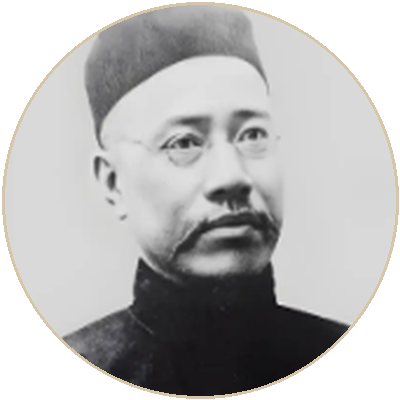
The Enlightenment Translator
严复
Yan Fu, the 'Master of Tianyan,' was modern China's most influential translator. After studying at the Royal Naval College in Greenwich, he translated Huxley's Evolution and Ethics — 'survival of the fittest' became the era's slogan. He also translated Adam Smith, Mill, and Spencer, introducing Western economics, politics, and logic. His translation theory of 'faithfulness, expressiveness, elegance' remains foundational. He died in 1921.
Yan Fu's life was inseparably linked to China's journey of learning from the West. Here are the key episodes.
Studying in England (1877): At the Royal Naval College in Greenwich, Yan gained profound understanding of Western science, politics, and liberal thought — becoming one of the first Chinese to truly grasp Western civilization's essence.
Translating Evolution and Ethics (1898): Not a literal translation but a 're-creation' with commentary. 'Survival of the fittest' struck like thunder, influencing Liang Qichao, Lu Xun, and Hu Shi.
Translating Eight Great Works: Adam Smith, Mill, Spencer, Montesquieu — eight Western classics covering virtually every major field, making Yan the gateway to Western learning for a generation.
Faithfulness, Expressiveness, Elegance: Yan's three translation standards — faithfulness to the original, clarity of expression, elegance of style — remain the foundational theory of Chinese translation after over a century.
物竞天择,适者生存。
"Things compete, Heaven selects; the fittest survive." — Yan's famous rendering of Darwinian evolution, which became the defining slogan of an entire era of Chinese thought.
译事三难:信、达、雅。
"Translation has three difficulties: faithfulness, expressiveness, and elegance." — The opening of Yan's revolutionary translation theory, which has guided Chinese translators for over a century.
鼓民力,开民智,新民德。
"Strengthen the people's vitality, open the people's wisdom, renew the people's virtue." — Yan's three-pronged program for national renewal, emphasizing that true reform must address body, mind, and spirit.
自由一言,真中国历古圣贤之所深畏,而从未尝立以为教者也。
"The word 'freedom' is truly what the ancient sages of China deeply feared and never established as a teaching." — Yan's frank observation that freedom was a concept alien to traditional Chinese thought, making its introduction all the more necessary.
严复翻译的《天演论》不仅仅是一部科学著作的译本,更是一部融入了他对中国命运深刻思考的「再创作」。他用进化论的框架来解释国家兴亡、民族竞争的规律,警告中国人:在弱肉强食的世界中,不变法图强就会被淘汰。这一思想深刻影响了整整一代中国知识分子。" data-en="Yan's translation of Evolution and Ethics was not merely a scientific translation but a 're-creation' infused with deep reflection on China's fate. He used the framework of evolution to explain the laws of national rise and fall, warning that without reform and self-strengthening, China would be eliminated in a world of survival of the fittest. This profoundly influenced an entire generation.">Not merely a translation but a 're-creation' using evolutionary theory to warn China: reform or perish. 'Survival of the fittest' became a national wake-up call.
信达雅是严复提出的翻译三原则,也是中国翻译理论的奠基之作。「信」要求忠实传达原文意义,「达」要求译文通顺流畅,「雅」要求文字优美典雅。三者缺一不可,但当不能兼顾时,严复主张「信」为第一要义。这一理论至今仍是翻译学的基本框架。" data-en="Faithfulness, expressiveness, and elegance are Yan's three translation principles and the foundation of Chinese translation theory. Faithfulness demands accurate transmission of meaning; expressiveness demands fluent readability; elegance demands beautiful style. All three are essential, though when they conflict, faithfulness comes first. This remains the basic framework of translation studies.">The foundation of Chinese translation theory. Faithfulness to meaning, expressiveness in readability, elegance in style — with faithfulness as the supreme principle.
严复是最早系统向中国介绍西方自由和民主思想的知识分子之一。他翻译穆勒的《论自由》(译为《群己权界论》),精确地将自由的概念界定为个人与群体之间的权利边界。他认为,自由不是放纵,而是有规则的权利保障;民主不是混乱,而是有序的政治参与。" data-en="Yan was among the first to systematically introduce Western ideas of freedom and democracy to China. His translation of Mill's On Liberty precisely defined freedom as the boundary of rights between individual and group. He argued that freedom is not license but rights within rules; democracy is not chaos but orderly political participation.">Among the first to introduce freedom and democracy to China, precisely defining liberty as the boundary of rights between individual and group — freedom within rules, not license.
严复认为,中国积弱的根本原因在于民智未开。他主张通过教育和学术翻译来启蒙国民,使他们具备科学思维、逻辑推理和独立判断的能力。他特别强调逻辑学(名学)的重要性,认为中国人缺乏逻辑思维训练是导致学术和政治落后的重要原因。" data-en="Yan believed China's weakness stemmed from an unenlightened populace. He advocated education and scholarly translation to enlighten citizens, equipping them with scientific thinking, logical reasoning, and independent judgment. He especially emphasized logic (名学), believing the lack of logical training was a key cause of Chinese academic and political backwardness.">China's weakness stemmed from an unenlightened populace. He advocated education and emphasized logic training as key to national progress.
Yan's translation and adaptation of Huxley, enriched with commentary linking evolution to Chinese reality. 'Survival of the fittest' swept the nation.
One of the earliest Chinese translations of Adam Smith, introducing classical economics to Chinese readers for the first time.
"严复将穆勒的《论自由》译为《群己权界论》,意为「群体与个人之间的权利边界」。这个译名本身就体现了严复对自由概念的深刻理解——自由不是无限制的个人权利,而是个人与社会之间权利的合理划分。" data-en="Yan translated Mill's On Liberty as '群己权界论' (On the Boundary of Rights Between Group and Self). The title itself reflects Yan's profound understanding: freedom is not unlimited individual right but a rational division of rights between individual and society.">Yan's title — 'On the Boundary of Rights Between Group and Self' — itself captures his insight: freedom is a rational division between individual and society.
"严复将穆勒的逻辑学著作译为《名学》,借用中国古代名家的概念来对应西方的逻辑学。他认为逻辑思维的缺失是中国学术落后的重要原因,因此将逻辑学的引入视为启蒙的关键一步。" data-en="Yan translated Mill's logic text as '名学' (Study of Names), using the ancient Chinese concept of the School of Names to correspond to Western logic. He saw the absence of logical thinking as a key cause of Chinese academic backwardness, making the introduction of logic a crucial step in enlightenment.">Translated as '名学' (Study of Names), using ancient Chinese philosophy to introduce Western logic — which Yan saw as crucial to China's enlightenment.
Yan's 'faithfulness, expressiveness, elegance' remains the standard of Chinese translation. His emphasis on logic and critical thinking is more relevant than ever. His life proves the power of ideas — one translation can transform an era's spirit, one concept can awaken a nation.