Master Xiangshan
陆九渊
Lu Jiuyuan
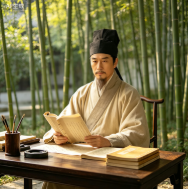
Master Xiangshan
陆九渊
The Goose Lake Debate (鹅湖之会): In 1175, Lu Jiuyuan and his brother met Zhu Xi at Goose Lake Temple for what became the most famous philosophical debate in Chinese history. Lu Jiuyuan argued that the mind itself is principle (心即理) and that moral knowledge is innate. Zhu Xi argued that principle must be discovered through the investigation of external things (格物致知). This debate defined two paths in Neo-Confucian philosophy that would diverge for centuries.
At thirteen, Lu Jiuyuan wrote this astonishing declaration, which became the motto of his philosophy. He believed that the mind is not a container of knowledge but the very substance of reality — to understand the mind is to understand the cosmos.">"The Universe is My Mind" (宇宙便是吾心): At thirteen, Lu Jiuyuan wrote this astonishing declaration, which became the motto of his philosophy. He believed that the mind is not a container of knowledge but the very substance of reality — to understand the mind is to understand the cosmos.
Teaching on Xiangshan (象山讲学): Lu Jiuyuan taught at Xiangshan (Elephant Mountain) in Jiangxi, where he attracted hundreds of students. His teaching style was direct and inspiring — he appealed to students' innate moral sense rather than asking them to study texts exhaustively.
The Six Classics Debate (六经注我): Lu Jiuyuan famously declared: "The Six Classics annotate me; I do not annotate the Six Classics." This revolutionary claim meant that the classics are not external authorities but expressions of truths already present in the human mind.
宇宙便是吾心,吾心即是宇宙。
"The universe is my mind; my mind is the universe." — The identity of mind and cosmos.
心即理也。
"The mind is principle." — The foundational claim of the philosophy of mind.
六经注我,我注六经。
"The Six Classics annotate me; I do not annotate the Six Classics." — Knowledge is innate, not imposed from without.
先立乎其大者。
"First establish what is great." — The priority of moral commitment over mere learning.
收拾精神,自作主宰。
"Gather your spirit and be your own master." — Self-reliance as the foundation of the moral life.
The central claim of Lu Jiuyuan's philosophy. The mind is not a passive receiver of knowledge but the very source of moral principle. To understand the mind is to understand the cosmos.
Before all else, one must make a fundamental moral commitment. This "establishing the great" is not an intellectual exercise but a decision of the whole person.
True philosophy is simple and direct. Lu Jiuyuan criticized Zhu Xi's approach as overly complex and indirect — "fragmented" (支离). His own method was to point directly to the mind.
The goal of cultivation is not to acquire new knowledge but to recover the innate moral knowledge that is already present in the mind. This process is one of "illumination" rather than "construction."
"Complete Works of Master Xiangshan" — Collected letters, essays, and recorded conversations.
"Recorded Sayings" — Transcriptions of his lectures and discussions with students.
Lu Jiuyuan's philosophy of mind offers a powerful alternative to purely empirical approaches to knowledge. His claim that the mind is the source of principle resonates with modern discussions about the role of the observer in quantum physics and the constructive nature of perception. His emphasis on simplicity and directness challenges the over-specialization of modern knowledge. And his call to "gather your spirit and be your own master" speaks to anyone seeking autonomy and authenticity in an age of external pressures.