The Integrity Master
刘宗周
Liu Zongzhou
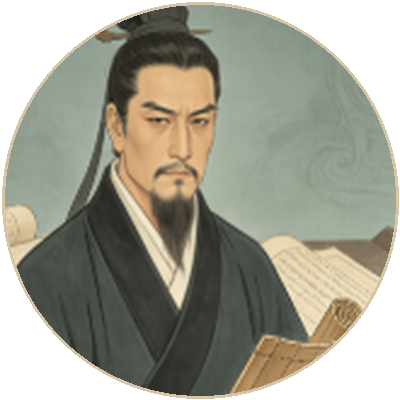
The Integrity Master
刘宗周
Liu Zongzhou, honored as 'Master Jishan,' was the last great Neo-Confucian of the late Ming. Orphaned before birth, he rose through the examinations and entered official life, only to be dismissed three times for his outspoken integrity. After the Qing conquest, he fasted to death rather than surrender — embodying the 'vigilance in solitude' and 'sincerity of will' he preached. His philosophy synthesized Cheng-Zhu and Wang Yangming traditions into the distinctive Jishan school.
The events of Liu Zongzhou's life are recorded in the History of Ming and the Ming Confucian Case Studies. Here are the most significant episodes.
Impeaching Wei Zhongxian: While all officials cowered before the eunuch dictator, Liu submitted a memorial denouncing him. Dismissed to commoner status, he declared: 'This is what my Way demands.'
Three Dismissals, Three Recalls: Dismissed three times for candor, recalled three times for integrity. The Chongzhen emperor admired his loyalty but could not bear his bluntness.
Lecturing at Zhengren Academy: He founded the Zhengren Academy in Shaoxing, focusing on moral practice rather than examination preparation. His most famous disciple was Huang Zongxi.
Fasting to Death (1645): After Hangzhou fell, he refused surrender and fasted. 'All we can do is uphold righteousness and await death.' He died after twenty-three days at age sixty-eight.
学问之道无他,求其放心而已矣。
"The Way of learning has nothing else but seeking the lost heart." — Liu Zongzhou on the fundamental task of moral cultivation: recovering one's original sincerity.
慎独之外,别无功夫。
"Beyond vigilance in solitude, there is no other practice." — The essence of Liu's teaching: all moral effort converges on the moment when one is alone with one's thoughts.
意为心之主宰。
"Will (yi) is the master of the heart-mind." — Liu's distinctive philosophical thesis that the 'will' — not consciousness or feeling — is the governing faculty of the mind.
诚者,天之道也;诚之者,人之道也。
"Sincerity is the Way of Heaven; becoming sincere is the Way of humans." — Drawing on the Doctrine of the Mean, Liu made sincerity the cornerstone of ethical life.
The central practice of Liu's philosophy. Not merely being careful when alone, but maintaining moral awareness at the instant a thought first stirs — before good and evil separate.
The key to Liu's practical philosophy. The core of the Great Learning lies not in investigating things but in making the will sincere — allowing no self-deception when thoughts arise.
Liu's most original thesis: 'will (yi) is the master of the heart-mind.' Not ordinary intention, but the governing principle — differing from both Zhu Xi and Wang Yangming.
Liu argued 'principle is simply the principle of qi,' refusing to separate them. He held qi as fundamental reality, approaching Zhang Zai's tradition while incorporating mind-cultivation.
One of Liu's most important works, systematically presenting his teaching on vigilance and sincerity. It details the path from ordinary person to sage — a highly practical moral guide.
A comprehensive collection of his philosophical treatises, memorials, letters, and recorded sayings — the most important primary source for studying his thought.
Liu's philosophical notebook in concise entries, covering reflections on principle and qi, heart-mind and nature, and practical cultivation.
Liu's 'vigilance in solitude' reminds us that true morality lies in inner self-awareness, not external rules. His 'sincerity of will' demands absolute honesty about our motives. His life — dying for principle — shows that integrity in the face of injustice is society's last line of defense.