The New Confucian Pioneer
熊十力
Xiong Shili
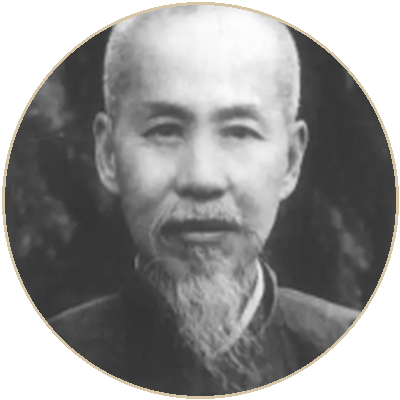
The New Confucian Pioneer
熊十力
Xiong Shili's life was full of dramatic turns — from revolutionary soldier to philosophical master.
The 1911 Revolution: At twenty-six, Xiong participated in the Wuchang Uprising. This experience convinced him that political revolution must be grounded in intellectual revolution.
From Politics to Scholarship: After witnessing post-revolutionary chaos, he abandoned politics and studied Consciousness-Only philosophy under Ouyang Jingwu at the Nanjing Inner Studies Academy.
Creating New Consciousness-Only (1932): His magnum opus critically transformed Buddhist Consciousness-Only theory, fusing it with the creative philosophy of the Book of Changes and proposing the 'non-duality of substance and function.'
Bonds with Disciples: His passionate teaching style and genuine care nurtured the second generation of New Confucianism, including Mou Zongsan, Tang Junyi, and Xu Fuguan.
Suffering in Later Years: During the Cultural Revolution, his home was ransacked and manuscripts destroyed. He protested through hunger strikes and died on May 23, 1968, marking the end of an era.
体用不二,即体即用。
"Substance and function are not two — substance is function, function is substance." — The foundational principle of Xiong's ontology, dissolving the dualism between the absolute and the phenomenal world.
翕辟成变。
"Contraction and opening together create change." — Xiong's dynamic cosmology, where reality is a ceaseless process of gathering (翕) and radiating (辟), never static.
吾学贵在见体。
"The essence of my learning lies in apprehending the substance." — Xiong's conviction that philosophy must reach beyond phenomena to the underlying reality.
哲学之穷理,至乎其极,则必归于证。
"When philosophical inquiry reaches its ultimate limit, it must necessarily arrive at verification through direct experience." — Xiong's insistence that true philosophy is not mere speculation but lived realization.
The central thesis of Xiong's philosophy: the ultimate substance (ti) and the phenomenal world (yong) are not two separate realities but two aspects of one reality. This overcomes both Buddhist dismissal of phenomena as illusion and Western substance-appearance dualism.
Drawing on the Book of Changes, Xiong proposed that the universe is driven by two complementary forces — xi (contraction) and bi (opening). Their interaction drives the ceaseless generation of all things. This is a process philosophy emphasizing reality as fundamentally dynamic.
熊十力批判性地改造了佛教唯识宗的理论。唯识宗认为「万法唯识」,一切现象都是意识的变现。熊十力不同意这种观点,他认为意识不是虚幻的变现,而是本体的自我展现。他将唯识学与儒家的生生之德相结合,强调意识本身就是宇宙创造力的体现,从而赋予了唯识论以儒家的积极进取精神。
Xiong critically transformed Buddhist Consciousness-Only theory. Rather than seeing phenomena as illusory projections of mind, he argued that consciousness is the self-expression of the ultimate substance, infusing the theory with Confucian affirmation of reality and creative dynamism.
熊十力的本体论以「生生」为核心。他认为宇宙的本体不是静态的、抽象的实体,而是永恒运动、不断创造的生命力量。这一观点深受《易经》「天地之大德曰生」的影响。本体即是生命,生命即是创造,创造即是变化——这就是宇宙的本质。这一思想为中国哲学注入了强烈的生命意识和创造精神。" data-en="Xiong's ontology centers on 'creative life' (shengsheng). He held that the ultimate substance of the universe is not a static, abstract entity but an eternally moving, ceaselessly creative life force — deeply influenced by the Book of Changes' declaration that 'the great virtue of heaven and earth is life-generating.' Substance is life, life is creation, creation is change — this is the essence of the universe.">Centered on 'creative life' (shengsheng). The ultimate substance is not a static entity but an eternally creative life force, deeply influenced by the Book of Changes. Substance is life, life is creation, creation is change.
Xiong's magnum opus and one of modern China's most important philosophical works. It fuses Buddhist Consciousness-Only theory with the creative philosophy of the Book of Changes, proposing the non-duality of substance and function.
Letters and dialogues with friends and disciples, covering wide-ranging discussions of Buddhism, Confucianism, and Western philosophy. Reveals Xiong's vast erudition and passionate personality.
A late work tracing the original spirit of Confucianism. Xiong argued that true Confucianism is not rigid ritualism but a dynamic philosophy with 'Great Unity' as its ideal and 'creative life' as its substance.
Xiong's thought remains profoundly relevant. His 'non-duality of substance and function' offers Chinese wisdom for overcoming Western philosophical dualisms. His process ontology anticipates Whitehead. His approach to tradition — creative transformation rather than blind conservatism or wholesale rejection — models how to relate traditional culture to modernization. His insistence that philosophy concerns life practice, not empty theorizing, corrects the contemporary disconnect between knowledge and action.