The Philosophical Systematizer
冯友兰
Feng Youlan
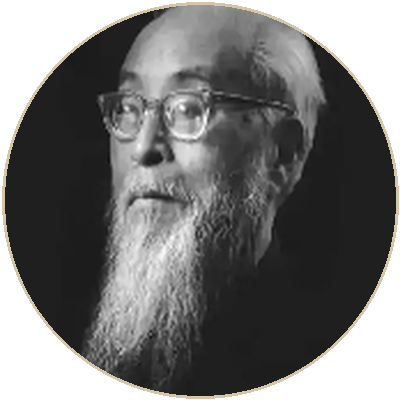
The Philosophical Systematizer
冯友兰
Feng Youlan's life spanned nearly a century of China's transformation.
Studying at Columbia: Under John Dewey, Feng was exposed to cutting-edge Western philosophy while deepening his appreciation for Chinese thought. He later recalled: 'In America, I discovered China.'
Writing the History of Chinese Philosophy (1931): His two-volume work divided Chinese thought into the 'Age of the Masters' and 'Age of Classical Studies,' remaining essential reading today.
The Six Books of Zhengyuan: During WWII, Feng completed six philosophical works. The core, New Rational Philosophy, reinterpreted Neo-Confucianism through New Realism.
Southwest Associated University: For eight years in wartime Kunming, Feng maintained Chinese scholarship under extreme hardship, embodying the spirit of 'fortitude and perseverance.'
Late Reflection and Rewriting: In his eighties, he candidly reflected on his political mistakes and completed a seven-volume New History of Chinese Philosophy before his death.
哲学,就是对于人生的有系统的反思。
"Philosophy is systematic reflection on life." — Feng's concise definition of philosophy, emphasizing its roots in lived human experience.
人对于宇宙的理解越深,他对于宇宙所作的判断,价值越高。
"The deeper one's understanding of the universe, the higher the value of one's judgments about it." — On the relationship between comprehension and wisdom.
接着讲与照着讲。
"'Continuing the tradition' versus 'repeating the tradition.' — Feng's famous distinction: true scholarship continues and develops tradition creatively, rather than merely repeating it verbatim."
为天地立心,为生民立命,为往圣继绝学,为万世开太平。
"Establish the heart of heaven and earth, secure the destiny of the people, continue the lost teachings of past sages, inaugurate eternal peace." — The famous Four Sentences of Zhang Zai, which Feng frequently cited as the mission of Chinese philosophy.
A modern reconstruction of Song Neo-Confucianism using Western logical analysis. 'Principle' (li) becomes abstract universal; 'material force' (qi) becomes concrete particular. This elevates traditional Neo-Confucianism into a rigorous modern system.
The Natural Realm (instinct), Utilitarian Realm (self-interest), Moral Realm (serving others), and Celestial Realm (unity with cosmos). Philosophy's task is to help people ascend to the highest realm.
冯友兰区分了两种对待传统的态度:「照着讲」是原封不动地重复前人的话,而「接着讲」则是在前人基础上继续发展,赋予传统以新的意义。冯友兰主张「接着讲」——他认为中国哲学的传统不是博物馆里的化石,而是活着的智慧,需要每一代人用自己的方式去继承和发展。这一方法论对中国哲学的现代转化具有深远的指导意义。
Feng distinguished 'repeating tradition' from 'continuing tradition' — building upon the past to develop new meaning. Chinese philosophy is living wisdom that each generation must develop in its own way.
Feng's most celebrated work and a milestone of modern scholarship. Translated into many languages, it remains the standard reference for Chinese philosophy studies worldwide.
Six works presenting Feng's complete system: metaphysics, the four realms, the spirit of Chinese philosophy, and philosophical methodology.
Feng's late magnum opus — a comprehensive revision of his earlier History, representing the culmination of his lifelong scholarly thinking.
Feng's methodology for studying Chinese philosophy with modern methods remains standard. His Four Realms theory reminds us life involves spiritual elevation beyond material pursuits. His cross-cultural philosophical approach pioneered Chinese-Western dialogue. His life — both achievements and mistakes — offers lessons about intellectual responsibility during social upheaval.