The National Learning Master
章太炎
Zhang Taiyan
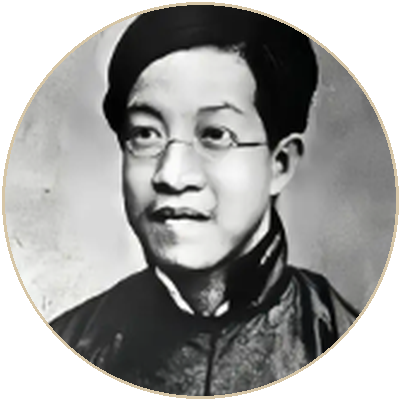
The National Learning Master
章太炎
Zhang Taiyan, honored as 'Master Taiyan,' was modern China's greatest classical scholar turned revolutionary. Trained under the great classicist Yu Yue, he shifted from reform to revolution after the Su Bao Case of 1903. In prison, he studied Buddhism deeply. In Japan, he edited the revolutionary journal Min Bao and taught national learning to students including Lu Xun and Qian Xuantong. He died in 1936.
Zhang's life spanned the late Qing and Republic, engaging in revolution and scholarship. Here are the key episodes.
The Su Bao Case (1903): Zhang's fierce anti-Qing articles led to his arrest. In court, he eloquently denounced Qing corruption. Sentenced to three years, the case made him a revolutionary hero.
Buddhist Studies in Prison: Three years studying Yogacara Buddhism transformed his worldview, enabling him to reinterpret Zhuangzi and pre-Qin philosophy from a radically new perspective.
Lecturing in Tokyo (1906–1911): His lectures trained Huang Kan, Qian Xuantong, Lu Xun, and Zhou Zuoren — forming the famous 'Zhang School' of modern Chinese scholarship.
Storming the Presidential Palace (1914): Zhang publicly denounced Yuan Shikai and was placed under house arrest for three years. He hunger-struck and continued writing — an unyielding spirit.
国学不亡,民族不灭。
"As long as national learning is not extinguished, the nation is not destroyed." — Zhang's conviction that cultural heritage is the foundation of national survival.
凡学问者,以实事求是为归。
"All scholarship must seek truth from facts." — Zhang's insistence on empirical rigor in classical studies, opposing empty speculation.
以佛解庄,庄义始明。
"By interpreting Zhuangzi through Buddhism, Zhuangzi's meaning first becomes clear." — Zhang's methodological breakthrough that revolutionized the study of Zhuangzi.
经国莫如保种,保种莫如卫学。
"To govern the state, nothing surpasses preserving the race; to preserve the race, nothing surpasses defending learning." — Zhang's equation of cultural learning with national survival in the face of imperialism.
章太炎是近代「国学」概念的主要奠基者之一。他认为,中国的学术传统(包括经学、史学、诸子学、小学等)是民族精神的根基,必须在与西学的对话中重新激活。他反对全盘西化,主张在深入研究传统的基础上进行创造性转化。他的国学研究不是复古,而是以现代方法重新发现传统的价值。" data-en="Zhang was a principal founder of the modern concept of 'national learning' (guoxue). He believed China's scholarly traditions — classics, history, philosophers, and philology — were the roots of national spirit, which must be reactivated through dialogue with Western learning. He opposed total Westernization, advocating creative transformation based on deep traditional research — not revivalism but rediscovery through modern methods.">A principal founder of modern 'national learning.' He opposed total Westernization, advocating creative transformation through deep traditional research — not revivalism but rediscovery through modern methods.
章太炎最具原创性的学术贡献是以唯识宗佛教哲学来重新解读庄子。在《齐物论释》中,他运用唯识学的概念和方法,重新诠释了庄子的齐物论思想,揭示了庄子哲学中深邃的认识论和本体论意涵。这一方法论的突破,不仅使庄子研究进入了全新的境界,也为中国哲学研究开辟了一条中西比较的新路径。" data-en="Zhang's most original scholarly contribution was reinterpreting Zhuangzi through Yogacara Buddhism. In his Erta Commentary on the Qi Wu Lun, he used Yogacara concepts to reinterpret Zhuangzi's 'On the Equality of Things,' revealing profound epistemological and ontological dimensions. This methodological breakthrough opened new frontiers in Zhuangzi studies and pioneered a comparative approach in Chinese philosophy.">Zhang's most original contribution: using Yogacara Buddhism to reinterpret Zhuangzi's 'On the Equality of Things,' revealing profound epistemological and ontological dimensions and pioneering comparative Chinese philosophy.
章太炎的独特之处在于他将革命行动和学术研究融为一体。他不是书斋里的学者,也不是没有学问根底的革命家。他以深厚的经学和小学功底为革命提供文化合法性,又以革命精神激活传统学术的生命力。这种「学以致用,以学救国」的精神,是他留给后世最宝贵的遗产。" data-en="Zhang's uniqueness lay in uniting revolutionary action with scholarly research. He was neither an ivory-tower scholar nor an unlearned revolutionary. His deep classical learning provided cultural legitimacy for revolution, while his revolutionary spirit activated traditional scholarship's vitality. This spirit of 'learning for application, learning to save the nation' is his most precious legacy.">His uniqueness: uniting revolution with scholarship. Deep classical learning provided legitimacy for revolution; revolutionary spirit activated tradition's vitality. 'Learning to save the nation' is his most precious legacy.
章太炎是中国近代最杰出的语言文字学家。他精通《说文解字》,对古音学、训诂学、文字学都有深入研究。他认为,小学(语言文字学)是理解一切古典文献的基础,不通小学就无法真正读懂经史子集。他的《文始》《新方言》等著作,是近代语言学的里程碑。" data-en="Zhang was modern China's most outstanding philologist. Master of the Shuowen Jiezi, he made deep contributions to phonology, semantics, and graphemics. He held that philology was the foundation for understanding all classical texts — without it, one cannot truly read the classics, histories, philosophers, and anthologies. His Wen Shi and New Dialect are milestones of modern linguistics.">Modern China's most outstanding philologist. He held that philology was the foundation for understanding all classical texts — without it, no true reading of the classics is possible.
Zhang's most important collection of political and scholarly essays, first published in 1900. A unique fusion of revolutionary thought and scholarly research.
"《国故论衡》是章太炎的学术代表作,分为小学、文学、诸子学三部分,系统论述了中国语言文字学、文学理论和先秦诸子哲学。这部著作以全新的视角重新诠释了中国传统学术,被誉为近代国学研究的里程碑。" data-en="Discourses on National Heritage is Zhang's masterwork, divided into three parts: philology, literature, and pre-Qin philosophers. It systematically treats Chinese language studies, literary theory, and ancient philosophy from a fresh perspective, hailed as a milestone of modern national learning.">Zhang's masterwork in three parts — philology, literature, and pre-Qin philosophers — hailed as a milestone of modern national learning.
"《齐物论释》是章太炎最具原创性的哲学著作。他运用唯识宗佛教的概念和方法重新诠释庄子的《齐物论》,揭示了庄子哲学中深邃的认识论意涵。这部著作不仅是庄子研究的突破性成果,也是中国比较哲学的先驱之作。" data-en="The Erta Commentary on the Qi Wu Lun is Zhang's most original philosophical work, using Yogacara Buddhist concepts to reinterpret Zhuangzi's 'On the Equality of Things.' It reveals profound epistemological dimensions in Zhuangzi and stands as a pioneer work of comparative Chinese philosophy.">Zhang's most original philosophical work: using Yogacara Buddhism to reinterpret Zhuangzi's 'On the Equality of Things' — a pioneer of comparative Chinese philosophy.
Zhang defended national learning from deep confidence, not blind xenophobia. His interdisciplinary methods — Buddhism meeting Zhuangzi, philology unlocking the classics — remain a model. He proved revolution and cultural heritage need each other: true revolutionaries need cultural roots, true tradition needs revolutionary spirit.