The Statecraft Patriot
陈亮
Chen Liang
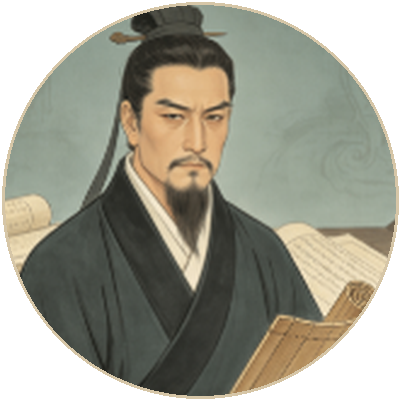
The Statecraft Patriot
陈亮
Chen Liang's life was filled with turmoil and passion, revealing a thinker of courage and conviction.
Five Essays on National Restoration: The young Chen Liang submitted strategic proposals to Emperor Xiaozong, analyzing the military situation and proposing concrete plans to resist Jin and recover the north. Though not adopted, they showed his strategic brilliance.
The Wang-Ba Yi-Li Debate: Chen Liang argued against Zhu Xi that the kingly way and hegemonic way, righteousness and profit, could work together — citing the Han and Tang dynasties as proof. This famous debate continued for years through correspondence.
Three Imprisonments: Imprisoned three times for criticizing the court, he was once accused of treason and nearly executed. Rescued by friends, these ordeals only strengthened his resolve.
Zhuangyuan at Last (1190): At nearly fifty, he finally became top scholar. But fate was cruel — he died shortly after, unable to fulfill his political ambitions.
Friendship with Xin Qiji: Close friends with the famous poet, they shared the aspiration to recover the north. Xin Qiji wrote his celebrated poem 'Breaking Through the Enemy Lines' for Chen Liang.
义利双行,王霸并用。
"Righteousness and profit walk together; the kingly way and the hegemonic way are used in tandem." — The core of Chen Liang's challenge to orthodox Neo-Confucian moral philosophy.
推倒一世之智勇,开拓万古之心胸。
"Overthrow the wisdom and courage of a single age; open up the heart and mind for all eternity." — A declaration of Chen Liang's ambition to transcend the limitations of his era.
人才以用而见其能否,安坐而能者不足恃也。
"Talent is proven through use; those who can only sit peacefully cannot be relied upon." — Chen Liang's insistence on testing ability through action, not theory alone.
天下大势之所趋,天地鬼神不能易也。
"The great trend of the world's affairs — neither heaven, earth, spirits, nor gods can change it." — Chen Liang on the irresistible forces of historical momentum.
The value of learning lies in practical results, not pure moral cultivation or abstract speculation. True Confucians should achieve governance through action, not retreat into empty discourse.
陈亮反对朱熹将义与利截然对立的观点。他认为义和利不是非此即彼的关系,而是可以并行不悖的。在现实政治中,追求国家富强(利)与坚守道德原则(义)并不矛盾。他以汉唐盛世为例,指出这些时代的成功正是「义利双行」的结果。这一观点挑战了当时理学界的主流看法,引发了深刻的学术反思。
Righteousness and profit are not mutually exclusive. Pursuing national prosperity and upholding moral principles can work together — as the great Han and Tang dynasties proved. This challenged Neo-Confucian orthodoxy.
陈亮在「王霸之辩」中提出了与朱熹截然不同的观点。朱熹推崇纯粹的「王道」(以德服人),贬抑「霸道」(以力服人)。陈亮则认为,在现实政治中,纯粹的王道往往是不够的,有时必须借助霸道的力量来实现正义的目标。他以历史上的明君为例,指出他们的成功往往是王道和霸道兼用的结果。
The pure kingly way is often insufficient in real politics. Historical rulers succeeded by combining virtue with strategic force. This pragmatic view challenged Zhu Xi's idealism.
陈亮强调治国理政必须因时制宜、因地制宜,不能死守古人的教条。他认为每个时代都有其特殊的问题和挑战,圣人的智慧在于能够根据实际情况灵活应对,而不是机械地遵循固定的道德准则。这种注重实效、反对教条的思想,使陈亮的政治哲学具有鲜明的现实主义色彩。
Governance must adapt to circumstances, not rigidly follow ancient dogmas. The sage's wisdom is flexible response to actual conditions — giving Chen Liang's philosophy a distinctly realist character.
His collected political essays, letters, and poetry. The powerful political essays reveal his sense of responsibility, while the correspondence with Zhu Xi is the primary source for the Wang-Ba debate.
《酌古论》是陈亮的史论著作,通过对历代帝王将相的评析,阐发他的政治和军事思想。他不是简单地褒贬历史人物,而是从历史中汲取治国理政的经验教训,体现了他「以史为鉴」的学术方法和经世致用的学术精神。" data-en="Deliberating on Antiquity is Chen Liang's work of historical criticism, analyzing emperors and generals of past dynasties to expound his political and military thought. Rather than simply praising or condemning historical figures, he drew lessons from history for governance, embodying his method of 'using history as a mirror' and his spirit of practical learning.">A work of historical criticism analyzing past rulers and generals to draw governance lessons — embodying his method of 'using history as a mirror' for practical statecraft.
Chen Liang's thought speaks powerfully to our times. His pragmatic spirit opposes empty theorizing in favor of real results. His patriotism inspires every generation. His courage to challenge authority models independent thinking. His view that righteousness and profit can coexist offers a balanced approach to business ethics and social development.