The Pragmatic Sage
叶适
Ye Shi
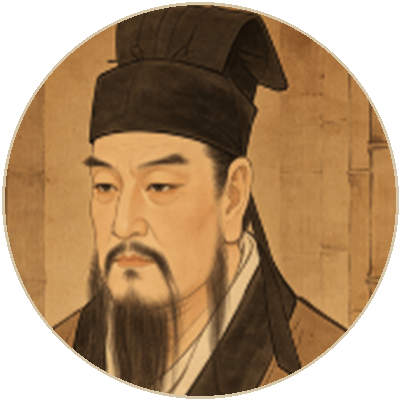
The Pragmatic Sage
叶适
Ye Shi's life spanned a critical period of Southern Song decline, reflecting a thinker's deep engagement with his times.
Inheriting the Yongjia Lineage: He studied under Jixuan and Chen Fuliang, who shifted the Yongjia school toward practical learning. Building on their foundation, Ye Shi elevated it to new heights.
Policy Memorials: He submitted rigorous memorials on anti-Jin strategy, fiscal reform, and bureaucratic improvement — proposing concrete military strategies that embodied his practical approach.
Northern Expedition and Dismissal: He participated in the Kaixi Northern Expedition's planning, but was dismissed after its failure. This ordeal strengthened his conviction that empty theorizing caused the disaster.
Later Years of Writing: After dismissal, he retired to Wenzhou and wrote his major works — core texts for studying the Yongjia school and Southern Song intellectual history.
Criticizing Neo-Confucian Emptiness: He criticized Zhu Xi and Lu Jiuyuan for devoting too much to abstract mind-nature discourse while neglecting real problems — insisting moral cultivation must combine with practical governance.
道原于一而成于两,中庸所以贵于中也。
"The Way originates in unity and is completed in duality; this is why the Doctrine of the Mean values equilibrium." — Ye Shi's understanding of the Way as arising from the dynamic interplay of opposites.
物之所在,道则在焉。
"Where things are, there the Way is." — The essence of Ye Shi's 'the Way is in things' doctrine, grounding the abstract in the concrete.
学而不思则罔,思而不学则殆。此言学与思相须也。
"'Learning without thought is labor lost; thought without learning is perilous.' This means learning and thought are mutually dependent." — Ye Shi on the inseparability of study and reflection.
无验于事者,其言不合;无证于物者,其理不实。
"What has not been tested against affairs — its claims do not hold. What has not been verified against things — its principles are not real." — Ye Shi's empiricist criterion for evaluating knowledge.
古今异宜,圣贤之事不可尽法。
"Ancient and modern times have different requirements; the deeds of sages and worthies cannot all be followed as models." — Ye Shi on the need to adapt principles to changing circumstances.
「道在物中」是叶适最核心的哲学命题。他认为道不是像朱熹所说的那样,是先于万物而存在的抽象「天理」,而是存在于具体的万事万物之中。要认识道,就必须研究具体的物——观察自然现象、分析社会问题、处理实际事务。离开了物,就无所谓道。这一观点具有鲜明的唯物主义倾向,为后来的实学发展奠定了哲学基础。
The Way is not an abstract principle existing before all things — it is found within concrete things. To understand the Way, study specific things. Apart from things, there is no Way. This materialist view laid the foundation for later practical learning.
叶适继承了永嘉学派重视「功利」的传统,但他对「功利」的理解并非简单的物质利益追求。他认为真正的「功利」是指对国家和人民有实际利益的学问和政策。学者应当关注国家的富强、人民的福祉,而不是沉溺于抽象的道德说教。这种功利之学,实质上是一种以天下苍生为念的经世之学。
True utility means learning and policies that benefit the state and people — not mere material gain. Scholars should focus on national prosperity and public welfare, not abstract moral preaching.
叶适对当时理学界空谈心性的风气进行了尖锐的批评。他认为朱熹和陆九渊虽然在具体观点上有分歧,但两人都犯了同一个错误——将过多的精力放在抽象的心性讨论上,忽视了对现实问题的关注。他主张学者应当「务实」而非「务虚」,将注意力从玄妙的哲学思辨转向切实的政治和社会问题。
Both Zhu Xi and Lu Jiuyuan made the same mistake — too much abstract mind-nature discourse, too little attention to real problems. Scholars should be practical, not abstract.
叶适强调历史是不断变化的,治国理政的方法也必须随之变化。他反对教条地遵循古代圣贤的做法,认为「古今异宜」——古代和现代有不同的情况,圣人的做法不能机械照搬。真正的智慧在于能够根据当下的实际情况,灵活地运用原则,找到最合适的治理之道。
History constantly changes; governance must adapt. Ancient methods cannot be mechanically copied. True wisdom is flexible application of principles to current circumstances.
Ye Shi's masterwork in fifty volumes — systematically evaluating classics from pre-Qin through Song, criticizing Neo-Confucian emptiness while creatively reinterpreting ancient texts.
《水心文集》收录了叶适的政论、书信、序跋、墓志铭等各类文章。其中的政论文章展现了他对现实政治的深刻洞察,书信则记录了他与同时代学者的学术交流。这部文集是研究叶适思想和南宋中后期学术文化的重要资料。" data-en="The Collected Works of Shuixin contains Ye Shi's political essays, letters, prefaces, and epitaphs. His political essays reveal deep insight into contemporary politics, while his letters record scholarly exchanges with contemporaries. This collection is an essential resource for studying Ye Shi's thought and mid-to-late Southern Song intellectual culture.">A collection of political essays, letters, and prefaces — essential for studying Ye Shi's thought and mid-to-late Southern Song intellectual culture.
Ye Shi's thought speaks to modern times. His 'Way is in things' philosophy supports empirical science and evidence-based methods. His anti-dogmatism inspires reform and innovation. His pragmatic scholarship aligns with demands for applied research and real-world results. His public spirit encourages intellectuals to engage with society and contribute to progress.