The Cosmic Architect
邹衍
Zou Yan
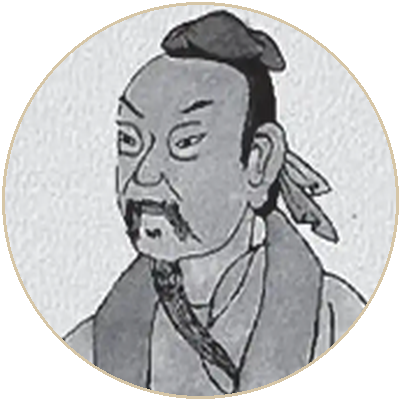
The Cosmic Architect
邹衍
Though records of Zou Yan's life are fragmentary, these episodes reveal his extraordinary stature as thinker and itinerant persuader.
Studies at the Jixia Academy: Zou Yan entered Qi's great intellectual center, initially studying Confucianism before absorbing influences from Daoism and other schools, ultimately founding his own synthesis of Yin-Yang and Five Phases theory.
Diplomatic Tours: Zou Yan was one of the era's most successful itinerant persuaders, receiving honors that surpassed even Mencius. Kings personally greeted him, swept roads before him, and built palaces for him — testimony to the power of his cosmological vision.
The Great Nine Continents Theory: Zou Yan argued that China was merely one of eighty-one great regions, shattering the parochial view of China as the world's center and presenting a cosmology of staggering scope.
Playing the Pitch Pipes: Legend has it Zou Yan demonstrated the Five Phases' correspondence with nature by playing specific pitch pipes to stimulate crop growth — reflecting his ambition to unify music, climate, and cosmology into one system.
五德从所不胜,虞土、夏木、殷金、周火。
"The Five Phases succeed each other in an invincible cycle: Yu is Earth, Xia is Wood, Shang is Metal, Zhou is Fire." — Zou Yan's theory that each dynasty is governed by one of the Five Phases, which determines its rise and fall.
中国名曰赤县神州。赤县神州内自有九州,禹之序九州是也。不得为州数。中国外如赤县神州者九,乃所谓九州也。
"What we call China is called the Red County, Divine Land. Within the Red County there are nine provinces — those ordered by Yu — but these do not count as the total. Outside China there are eight more regions like the Red County, making nine in all." — From Zou Yan's Great Nine Continents theory, a radical expansion of geographical consciousness.
先验小物,推而大之,至于无垠。
"First verify with small things, then extend the reasoning to the vast, reaching to the infinite." — Zou Yan's empirical method: beginning with the observable and reasoning outward to cosmic scales.
天地剖判以来,五德转移,治各有宜。
"Since the separation of heaven and earth, the Five Phases have cycled in succession, and each form of governance has its appropriate season." — The core principle of the Five Phases succession theory applied to political history.
Zou Yan's most influential theory: dynastic transitions follow the Five Phases conquest cycle (Wood→Earth, Metal→Wood, Fire→Metal, Water→Fire, Earth→Water). Each dynasty embodies one phase, providing cosmic legitimation for political change.
Zou Yan argued China was merely one of nine great continents, with similar regions nested layer upon layer to the edge of heaven and earth — shattering the parochial view of China as the world's center.
Zou Yan elevated Yin-Yang from simple observation to a complete cosmological system. The interplay of these dual forces drives the seasons, the growth of all things, and the rise and fall of dynasties.
'First verify with small things, then extend to the vast, reaching to the infinite.' Zou Yan combined empirical observation with analogical reasoning — a methodology remarkably advanced for its time.
Zou Yan's principal work in forty-nine chapters, covering Yin-Yang, Five Phases, astronomy, and geography. Lost except for scattered fragments preserved in later texts.
Fifty-six chapters devoted to the Five Phases Succession theory. After unifying China, Qin Shi Huang applied this theory to declare Qin as Water phase, leading to sweeping reforms.
Zou Yan's intellectual legacy is deeply embedded in Chinese culture. His Yin-Yang and Five Phases system was an early model of systems thinking. His Great Nine Continents theory shattered parochial worldviews. His integration of philosophy with political practice shaped dynastic institutions. From traditional medicine to feng shui to the Chinese calendar, his ideas permeate daily life.