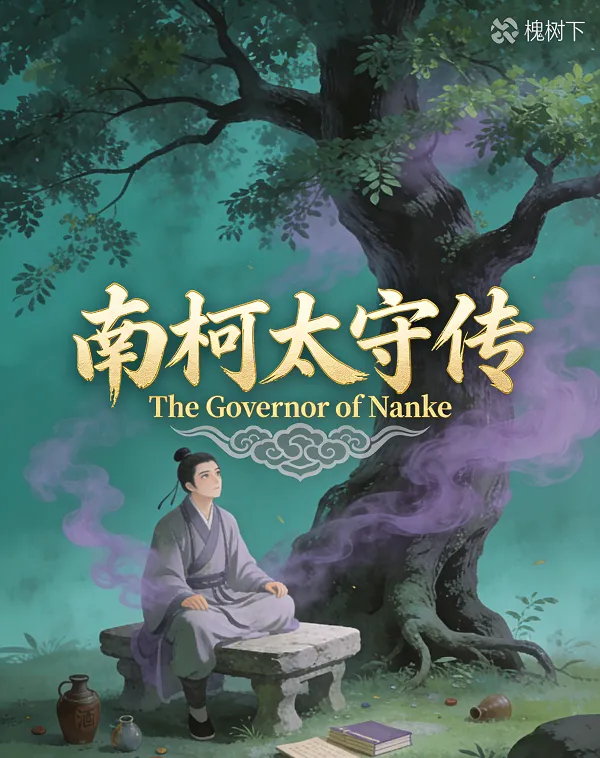
东平淳于棼淳于棼故事主人公,一个嗜酒任侠的武将,被免职后闲居在家。他的名字"棼"意为纷乱,暗示了整个故事"迷乱如梦"的主题。,吴楚游侠之士。嗜酒使气,不守细行。曾以武艺补淮南军裨将,因使酒忤帅,斥逐落魄,纵诞饮酒为事。
所居宅南有大古槐槐槐树在中国文化中有特殊地位,被视为神树,与梦境和鬼神相通。"槐安国"即由此得名——整个奇幻王国就在一棵老槐树的蚁穴之中。一株,枝干修密,清阴数亩。淳于生日与群豪大饮其下。贞元七年九月,因沉醉致疾。时二友人于坐扶生归家,卧于堂东庑之下。
二友谓生曰:「子其寝矣!余饮马濯足,俟子小愈而去。」生解巾就枕,昏然忽忽,仿佛若梦。见二紫衣紫衣紫色官服,唐代三品以上官员的服色。使者穿紫衣来请,暗示槐安国不是普通的蚁穴,而是一个等级森严、与人间社会同构的"镜像王国"。使者跪拜生曰:「槐安国王遣小臣致命奉邀。」
Chunyu Fen of Dongping was a wandering knight-errant of the Wu and Chu regions. Fond of drink and quick to temper, he paid little heed to propriety. His martial skill had earned him a minor commission in the Huainan army, but after offending his commander while drunk, he was dismissed and fell into dissolute ways, spending his days in reckless drinking.
South of his dwelling stood a great ancient locust tree槐 huái / locust treeThe locust tree holds special status in Chinese culture as a sacred tree connected to dreams and spirits. "The Kingdom of Locust Peace" derives its name from this — the entire fantasy realm exists within an old locust tree's ant nest., its branches dense and spreading, its shade covering several acres. Chunyu spent his days drinking with companions beneath it. In the ninth month of the seventh year of Zhenyuan, he fell ill from excessive intoxication. Two friends helped him home and laid him beneath the eastern corridor.
His friends said: "Sleep now! We shall water the horses and wash our feet, and leave when you are somewhat recovered." Chunyu removed his cap and lay upon the pillow, drowsy and faint, as though entering a dream. He saw two purple-robed紫衣 zǐ yīPurple official robes — the garb of third-rank officials and above in the Tang dynasty. The envoys' purple attire implies the Locust Kingdom is no ordinary ant nest but a "mirror realm" as hierarchically structured as the human world. envoys kneeling before him: "The King of the Locust Kingdom has sent humble servants to invite you."
Wandering knight-errant — a chivalrous figure without fixed office, roaming the land. Chunyu Fen's identity is crucial: not a mere scholar but a martial man with ambition, rejected by the system — making his dream-fueled rise to power all the more convincing.
生随二使上车,指古槐穴而去。使者即驱入穴中。生心甚异之,不敢致问。忽见山川风候,草木道路,与人世甚殊。前行数十里,有郛郭城堞。车舆人物,不绝于路。
生左右传车者传呼甚严,行者亦争辟于左右。又入大城,朱门重楼,楼上有金书,题曰「大槐安国」。执门者拜伏出入。有一骑传呼曰:「王以驸马远降,令且息东华馆。」
生进门升堂,穷极珍异。酒殽罗列,宾从缤纷。有女号金枝公主金枝公主槐安国公主,"金枝"暗示皇族高贵血统。淳于棼娶公主、封太守、掌兵权,实现了古代文人最极致的功名幻想——然后这一切在梦醒时全部化为乌有。,年可十四五,俨若神仙。
Chunyu followed the two envoys into a carriage, which headed directly for the hollow of the ancient locust tree. The envoys drove straight into the cavity. Chunyu was greatly astonished but dared not ask. Suddenly he beheld mountains, rivers, and weather, plants and roads, all vastly different from the mortal world. After traveling several dozen li, there appeared walled suburbs and battlements. Carriages and people filled the roads unceasingly.
The attendants beside his carriage called out imperiously; passersby scrambled to clear the way. They entered a great city with vermillion gates and tiered towers, bearing golden characters that read "Great Kingdom of Locust Peace." Gatekeepers prostrated themselves at each arrival. A mounted herald announced: "As the King's son-in-law arrives from afar, he is to rest in the East Magnolia Pavilion."
Chunyu entered the gate and ascended the hall, which was furnished with treasures beyond description. Food and wine were spread in abundance, and guests bustled about. A maiden known as the Golden Branch Princess金枝公主 Jīnzhī GōngzhǔThe Locust Kingdom's princess; "Golden Branch" implies royal noble blood. Chunyu Fen marries a princess, receives a governorship, commands troops — fulfilling the ultimate fantasy of an ambitious scholar. Then all vanishes upon waking., about fourteen or fifteen years old, appeared as fair as an immortal.
生感念嗟叹,求归甚切。王命遂行。至门外,见所乘车甚劣,左右亲使无一人,甚叹异。生上车,行可数里,复出大穴。见本里闾巷,不改往日。
潸然自悲,不觉流涕。二使者引生下车,入其门,升自阶,己身卧于堂东庑之下。生甚惊畏,不敢前近。二使因大呼生之姓名数声,生遂发寤如初。
见家僮拥篲篲扫帚。"拥篲"即拿着扫帚,是打扫庭院的动作。梦中经历二十年荣华,醒来发现家僮不过在扫地,时间只过了一瞬——这种巨大的时间落差是全篇最震撼的戏剧效果。于庭,二客濯足于榻,斜日未隐于西垣,余樽尚湛于东牖。梦中倏忽,若度一世矣。
Chunyu, overcome with emotion and sighing, begged earnestly to return. The King granted his request. Outside the gate, he saw that his carriage was shabby, and not a single attendant was at his side — he marveled greatly at the change. He boarded the carriage and traveled several li before emerging from the great hollow. He recognized his own neighborhood, unchanged from before.
Tears fell unbidden at the bittersweet sight. The two envoys helped him down, led him through his gate, up the steps — and there lay his own body, sleeping beneath the eastern corridor. Frightened and awed, he dared not approach. The envoys called his name loudly several times, and he awoke as if from the very beginning.
He saw a servant sweeping篲 huìA broom. "Holding a broom" — the act of sweeping a courtyard. After experiencing twenty years of glory in the dream, waking to find a servant merely sweeping — only an instant has passed — creates the most shocking dramatic effect in the entire tale. the courtyard, his two friends washing their feet by the couch, the slanting sun not yet hidden behind the western wall, and the remnant wine still glistening in the eastern window. In the dream, a lifetime had passed in a fleeting moment.
文学价值
《南柯太守传》是中国"人生如梦"叙事的巅峰之作。李公佐以"蚁穴"为核心意象,将整个功名富贵体系解构为一场荒诞的幻梦——淳于棼在蚁穴中经历的荣华富贵,不过是蝼蚁世界的权力游戏。这一构思的深刻之处在于:它不只是说"梦是假的",而是说"你醒着的时候追求的那些东西,和蚂蚁搬运食物有什么区别?"
结尾的时间对比("余樽尚湛于东牖")是中国文学中最具哲学力量的场景之一。二十年的帝王将相,在现实中不过一杯酒未凉的时间。
文化语境
唐代科举制度下,文人将毕生精力投入功名追求,"及第"意味着一切,"落第"意味着万劫不复。李公佐以蚁穴之喻质疑这种狂热:如果连人间的帝王将相都不过是蝼蚁,那科举功名又算什么?这一思想与佛教的"空"观和道家的"齐物"论深度呼应。
Literary Merit
"Governor of the Southern Tributary" is the pinnacle of Chinese "life as dream" narratives. Li Gongzuo uses the "ant nest" as the core image, deconstructing the entire system of fame and fortune as a grotesque illusion. Chunyu Fen's glory within the ant nest is merely the power game of an insect world. The genius lies not in saying "dreams are false," but in asking: "How different is what you pursue while awake from ants carrying food?"
The temporal contrast at the end ("the remnant wine still glistening in the eastern window") is one of the most philosophically powerful scenes in Chinese literature. Twenty years of emperors and generals — and in reality, a single cup of wine has not yet cooled.
Cultural Context
Under the Tang examination system, scholars devoted their lives to the pursuit of official success — "passing" meant everything, "failing" meant damnation. Li Gongzuo questions this fanaticism through the ant-nest metaphor: if even earthly emperors and generals are but ants, what is an examination success? This thinking resonates deeply with Buddhist "emptiness" and Daoist "equalization of things."
"南柯"原指大槐树南面的枝干——淳于棼梦中被封为"南柯郡太守",即蚂蚁在槐树南枝上筑巢形成的"王国"。后来"南柯一梦"成为汉语中使用频率最高的成语之一,比喻人生虚幻、富贵无常。与"黄粱一梦"并称为中国两大"梦典",但"南柯"更侧重对权力的解构,"黄粱"更侧重对人生的感悟。
"Southern Tributary" originally refers to the south branch of the great locust tree — Chunyu Fen was appointed "Governor of the Southern Tributary," a "kingdom" formed by ants nesting on the tree's south branch. "A Dream of the Southern Tributary" became one of the most frequently used Chinese idioms, meaning life is illusory and fortune impermanent. Paired with "A Dream of Golden Millet" as China's two great "dream allusions" — but "Southern Tributary" focuses more on deconstructing power, while "Golden Millet" focuses more on life's transience.
以蚂蚁的社会结构比喻人类社会,是中外文学中常见的思想实验。李公佐的独特之处在于:他不是简单地说"人如蝼蚁",而是让主人公亲身体验蚂蚁社会的完整运作——从政治联姻到军事征伐,从封疆大吏到恩宠衰落——然后再告诉他"你只是蚂蚁"。这种沉浸式体验后的骤然揭示,比任何说教都更有冲击力。
Using ant social structure to metaphorize human society is a thought experiment found across world literature. Li Gongzuo's innovation: he doesn't simply say "humans are like ants" — he has the protagonist experience the ant society's complete operations firsthand — from political marriages to military campaigns, from territorial governor to fallen favorite — then reveals "you were merely an ant." This immersive experience followed by sudden revelation is more powerful than any sermon.
Idiom — "A Dream of the Southern Tributary" became one of the most widely used Chinese idioms, alongside "A Dream of Golden Millet."
Ming Dynasty — Dramatist Tang Xianzu adapted it as "The Dream of the Southern Tributary," one of his "Four Dreams of Linchuan," developing the ant world into a complete political allegory.