隋炀帝隋炀帝隋朝第二位皇帝杨广(569-618),以奢靡暴虐著称。故事发生在隋末天下大乱之际,各路英雄趁势而起,为"风尘三侠"的出现提供了历史舞台。之幸江都也,命司空杨素杨素隋朝重臣,以权倾朝野著称。红拂女即为杨素府中歌妓,她的"夜奔"行为在当时是极大的冒险——歌妓私逃,一旦被捉,死罪难逃。守西京。素骄贵,又以时乱,天下之权重望崇者,莫我若也,奢贵自奉,礼异人臣。
每公卿入言,宾客上谒,未尝不踞床而见,令美人捧出,侍婢罗列,颇僭于上。末年益甚。
卫公李靖李靖唐初名将(571-649),后封卫国公。此处为青年李靖,尚未发迹,以布衣之身上书杨素。历史上的李靖后来成为大唐开国功臣,与故事中的落魄书生形成鲜明对比。以布衣上谒,献奇策。素踞见之。靖前揖曰:「天下方乱,英雄竞起。公为帝室重臣,须以收罗豪杰为心,不宜踞见宾客。」素敛容而起,谢靖,与语大悦。
When Emperor Yang隋炀帝 Suí YángdìThe second Sui emperor, Yang Guang (569-618), notorious for extravagance and cruelty. The story is set during the collapse of the Sui dynasty, when heroes rose to seize power — providing the historical stage for the "Three Heroes of the Dust." of the Sui traveled to Jiangdu, he ordered his Minister of Works Yang Su杨素 Yáng SùA powerful Sui minister. Red Whisk was a singing girl in Yang Su's household. Her "night flight" was an extraordinary gamble — a singing girl who fled her master faced death if caught. to guard the Western Capital. Yang Su was arrogant and self-important, and with the empire in chaos, he believed no one else possessed such weight of power and prestige. He maintained a lifestyle of extreme luxury, his conduct exceeding what was proper for a minister.
Whenever officials came to confer or guests came to pay respects, he invariably received them seated on his couch, attended by beautiful women and rows of maids — a style uncomfortably close to imperial ceremony. In his later years this grew ever more extreme.
The Duke of Wei, Li Jing李靖 Lǐ JìngA great Tang general (571-649), later ennobled as Duke of Wei. Here he is a young man not yet risen, presenting himself to Yang Su as a commoner. The historical Li Jing later became a founding hero of the Tang — a stark contrast to the impoverished scholar of the tale., came as a commoner to seek an audience and offer brilliant strategies. Yang Su received him seated. Li Jing stepped forward, bowed, and said: "The empire is in turmoil, and heroes are rising everywhere. As a minister of the imperial house, you should be gathering bold men to your side — it is not fitting to receive guests while reclining." Yang Su's expression changed; he rose, apologized, and spoke with Li Jing at length, greatly pleased.
Receiving guests while sprawling — sitting with legs extended on a couch when meeting visitors. In ancient times this was extremely rude (proper etiquette demanded kneeling); Yang Su used it to display his power. Li Jing's bold criticism reveals his courage and foreshadows Red Whisk's later "insight in recognizing talent."
当公之骋辩也,一妓有殊色,执红拂红拂红色拂尘。拂尘是道家法器,也是贵族日常用具。红拂女因此得名,她的执拂形象后来成为"慧眼识英雄"的经典符号。,立于前,独目靖。靖既去,而执拂者临轩指吏曰:「问去者处士第几?住何处?」靖具以对。妓诵而去。
靖归逆旅。其夜五更初,忽闻叩门而声低者,靖起问焉。乃紫衣戴帽人,杖揭一囊。靖问谁。曰:「妾,杨家之执红拂妓也。」靖遽延入。脱衣去帽,乃十八九佳丽人也。素面画衣而拜。靖惊答拜。
曰:「妾侍杨司空,阅天下之人多矣,未有如公者。丝萝非独生,愿托乔木,故来奔耳。」
During Li Jing's animated discourse, one singing girl of extraordinary beauty held a red whisk红拂 hóng fúA red horsehair whisk. The whisk was both a Daoist ritual implement and a noble household accessory. Red Whisk became her name, and her image with the whisk later became a classic symbol of "discerning a hero with wise eyes." and stood before him, her gaze fixed on Li Jing alone. After Li Jing had departed, the whisk-bearer leaned toward the window, pointed at an attendant, and asked: "Inquire what rank that departing scholar holds and where he lodges." Li Jing answered fully. The girl committed it to memory and left.
Li Jing returned to his lodgings. At the fifth watch that night, he heard a soft knock at the door. He rose to answer. There stood a figure in purple robes and cap, leaning on a staff with a bag hanging from it. Li Jing asked who it was. "I am the red-whisk girl from Minister Yang's household," came the reply. Li Jing hastily invited her in. She removed her robes and cap, revealing a beautiful girl of eighteen or nineteen. With a plain face and painted garments, she bowed. Li Jing returned the bow in surprise.
She said: "I have served Minister Yang and seen many men of the realm, but none like you. The dodder vine cannot grow alone — it must cling to a mighty tree. That is why I have come to you."
Dodder vine — silk vine and dodder are parasitic climbing plants, used in classical poetry to metaphorize a woman's dependence on her husband. Red Whisk uses this comparison to express both romantic attraction and her need for a hero worthy of clinging to.
行次灵石旅舍,既设床,炉中烹肉且熟。张氏以发长委地,立梳床前。靖方刷马。忽有一人,中形,赤髯赤髯红色的络腮胡。虬髯客因此得名——"虬"指卷曲,"髯"指络腮胡。红色胡须暗示其非汉族血统,也增添了其异人色彩。如虬,乘蹇驴而来。投革囊于炉前,取枕欹卧,看张氏梳头。
靖怒甚,未决,犹刷马。张氏熟视其面,一手握发,一手映身摇示靖,令勿怒。急急梳头毕,敛衽前问其姓。卧客答曰:「姓张。」对曰:「妾亦姓张,合是妹。」遽拜之。
问第几。曰:「第三。」问妹第几。曰:「最长。」遂喜曰:「今夕幸逢一妹。」张氏遥呼曰:「李郎且来见三兄。」靖骤拜之。
They stopped at an inn at Lingshi. Having set up the bed, they put meat on the stove to cook. Lady Zhang, whose hair fell to the ground when unbound, stood combing it before the bed. Li Jing was grooming the horses. Suddenly a man appeared — of medium build, with a red beard赤髯 chì ránRed whiskers. The Bearded Stranger takes his name from this — "qiú" means curly, "rán" means beard. The red beard hints at non-H ancestry and adds to his otherworldly aura. curling like dragons. He rode a lame donkey, threw a leather bag by the stove, grabbed a pillow, and reclined to watch Lady Zhang comb her hair.
Li Jing was furious but held his anger, continuing to groom the horses. Lady Zhang studied the stranger's face carefully. With one hand holding her hair and the other hidden behind her, she signaled to Li Jing not to lose his temper. She finished combing hastily, straightened her garments, and asked the stranger's surname. The reclining guest answered: "My surname is Zhang." She said: "My surname is also Zhang — then you must be my elder brother." She bowed immediately.
She asked his rank among siblings. He said: "Third." She asked her own rank. "The eldest," she replied. He said joyfully: "How fortunate tonight to meet my first sister!" Lady Zhang called out from afar: "Li Lang, come meet our third brother!" Li Jing hurried over and bowed.
文学价值
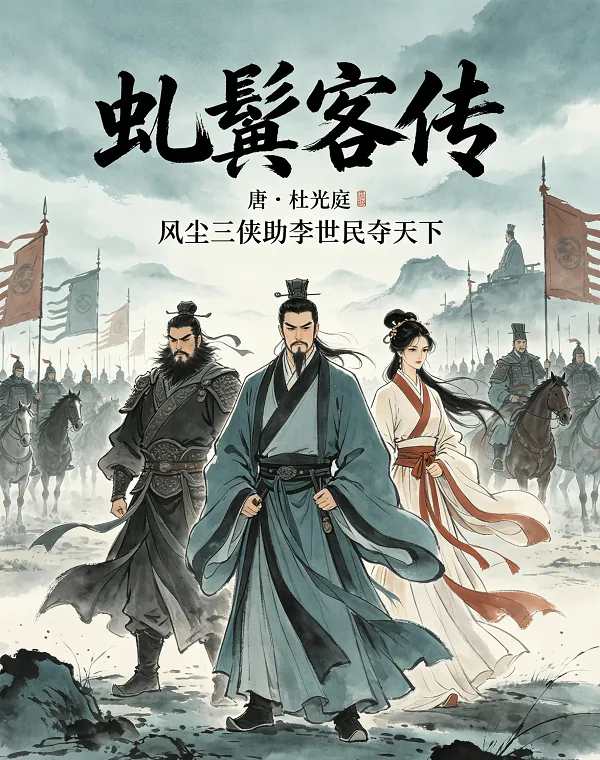
《虬髯客传》是唐传奇中最具史诗气质的作品。杜光庭以"风尘三侠"(红拂女、李靖、虬髯客)为核心,编织了一个关于野心、识见与放弃的故事。虬髯客原有意争夺天下,但见到李世民后自叹不如,将全部家财赠予李靖夫妇后远走海外——这一"让天下"的格局在古代文学中极为罕见。
红拂女的"夜奔"是全篇最动人的段落之一。她仅凭一面之缘就判断李靖是可托之人,果断抛弃锦衣玉食的生活,这种识见和魄力在古代女性形象中独树一帜。
文化语境
故事的历史背景是隋末唐初——中国历史上改朝换代最剧烈的时期之一。杜光庭是唐末五代道士,借前朝故事暗喻时局:天命有归,非人力所能争。虬髯客的"让天下"既是对李唐正统的肯定,也是道教"知天命、顺天道"思想的文学表达。
Literary Merit
"The Bearded Stranger" possesses the most epic quality among Tang tales. Du Guangting weaves ambition, insight, and renunciation around his "Three Heroes of the Dust" — Red Whisk, Li Jing, and the Bearded Stranger. The Bearded Stranger originally aspired to seize the empire, but upon seeing Li Shimin, acknowledged his own inferiority and gave all his wealth to the Li couple before departing overseas. This "yielding of the realm" is extraordinarily rare in classical Chinese literature.
Red Whisk's "night flight" is one of the most moving passages in the entire piece. Based on a single encounter, she judged Li Jing worthy of trust and boldly abandoned her life of luxury — a combination of discernment and courage unique among ancient Chinese female characters.
Cultural Context
The story is set during the Sui-Tang transition — one of the most dramatic dynastic changes in Chinese history. Du Guangting was a Daoist priest of the late Tang and Five Dynasties, using a tale of the previous dynasty to comment on his own era: heaven's mandate has its destination; no mortal power can contest it. The Bearded Stranger's "yielding" affirms Li Tang's legitimacy while expressing the Daoist principle of "knowing heaven's mandate and following the Way."
"风尘"原指旅途风沙,引申为纷乱的世道。三位侠客在乱世中相遇相知,各展其能:红拂以慧眼识英雄,李靖以才略安天下,虬髯客以气度让江山。"风尘三侠"后来成为中国文化中"知遇之恩"的经典意象,在戏曲、小说、绘画中反复出现。
"Dust" originally refers to windblown sand on the road, extended to mean a turbulent world. Three heroes meet and bond in chaotic times, each displaying unique gifts: Red Whisk with her discerning eye, Li Jing with his talent for governance, the Bearded Stranger with his magnanimity in yielding the realm. "Three Heroes of the Dust" became a classic image of "appreciative fellowship" in Chinese culture, recurring in drama, fiction, and painting.
"夜奔"是古代女性追求爱情的极端行为,意味着放弃安全、赌上性命。红拂的夜奔不同于一般的"私奔"——她不是因为被爱情冲昏头脑,而是经过冷静判断后的理性选择。这一形象打破了古代文学中女性"被动等待"的叙事定式,成为中国文学史上最具主体性的女性形象之一。
"Night flight" was an extreme act for ancient women pursuing love — it meant abandoning safety and staking one's life. Red Whisk's flight differs from ordinary elopements: she was not carried away by passion but made a rational, calculated choice. This character broke the narrative convention of women "passively waiting" in classical literature, becoming one of the most agentive female figures in Chinese literary history.
Ming Dynasty — Zhang Fengyi adapted it as "The Tale of Red Whisk," becoming a classic Kunqu opera repertoire piece.
1990s — Multiple TV dramas featuring Red Whisk and Li Jing, making the Three Heroes a popular screen adaptation subject.