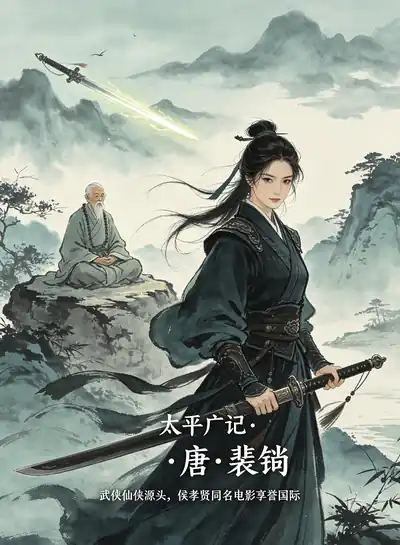
魏博大将聂锋聂锋魏博节度使麾下将领。魏博是唐代"河朔三镇"之一,藩镇割据时期最具实力的军事集团之一,为故事提供了真实的历史背景。之女名隐娘。方十岁,有尼尼文中老尼身份神秘,兼具佛教修行者与武林高手的双重身份,是中国文学中"世外高人"原型的早期形态。乞食于锋舍,见隐娘,悦之,云:「问押衙乞取此女教。」锋大怒,叱尼。尼曰:「任押衙藏于铁柜中,亦须偷去矣。」
及夜,果失隐娘所之。锋大惊骇,令人搜寻,曾无影响。每向父母思念啼泣而已。
后五年,尼送隐娘归。告锋曰:「教已成矣,子却领取。」尼欻亦不见。一家悲喜,问其所学。
Xianxia Story:The daughter of General Nie Feng聂锋 Niè FēngA military commander under the Weibo regional military governor. Weibo was one of the "Three Hebei Commands" — among the most powerful military factions during the Tang dynasty's era of provincial separatism, providing authentic historical context., commander of Weibo, was named Yinniang. When she was just ten, a nun尼 ní / Buddhist nunThe old nun in the story holds the dual identity of Buddhist practitioner and martial arts master — an early archetype of the "extraordinary figure beyond the world" in Chinese literature. came begging for food at the Nie household. Seeing Yinniang, she was delighted and said: "I ask the general to give me this girl to teach." Nie Feng was furious and rebuked her. The nun said: "Even if you hide her in an iron chest, I shall steal her away."
That night, Yinniang vanished without a trace. Nie Feng was terrified and ordered a thorough search, but nothing was found. Yinniang's parents could only weep and think of her.
Five years later, the nun returned Yinniang to her family. She told Nie Feng: "My teaching is complete; take back your child." Then the nun too vanished in an instant. The family wept and rejoiced, and asked what she had learned.
Weibo — a Tang dynasty military command headquartered in Wei Prefecture (modern Hebei Daming), the most powerful of the Three Hebei Commands. That even a general's daughter can be "stolen" suggests that mortal power is helpless before supernatural forces.
女曰:「初但读经念咒,余无他也。」锋不信,隐诘。隐娘曰:「真说又恐不信,如何?」锋曰:「但真说之。」
曰:「隐娘初被尼挈去,不知行几里。及明,至大石穴中,嵌空数十丈,寂无居人,猿猱极多,松萝益邃。已有二女,亦各十岁。皆聪明婉丽,不食,能于峭壁上飞走,若捷猱登木,无有蹶失。尼与我药一粒,兼令长执宝剑宝剑此处宝剑非普通兵器,而是具有灵性的法器。隐娘的剑越来越小,从二尺到数寸,最终藏于脑后,体现了"以神御剑"的修炼境界。一口,长二尺许,锋利吹毛,令专断猿猱,刺鸷鸟,百无一失。
一年后,刺猿猱百无一失。后刺虎豹,皆决其首而归。三年后能使飞鹰,刺之无不中。剑渐减至五寸,飞走遇之,不知其来也。至四年,留二女守穴,挈我于都市,不知何处也。指其人,一一数其过,曰:『为我刺其首,无使知觉。定其胆,若飞鸟之容易也。』」
The girl said: "At first I only read sutras and chanted mantras; there was nothing else." Nie Feng did not believe her and pressed for details. Yinniang said: "If I tell the truth, you may not believe me. What then?" Her father said: "Just tell me truly."
She said: "When the nun first took me away, I do not know how far we traveled. At dawn we arrived at a great stone cave, hollowed out dozens of zhang deep, silent and uninhabited, swarming with apes, with pine and lichen growing ever thicker. Two other girls were already there, each about ten years old, both clever and graceful. They ate nothing and could run along sheer cliffs like nimble apes through trees, never stumbling. The nun gave me a single pill and bade me always carry a fine sword宝剑 bǎo jiànNot an ordinary weapon but a spiritually charged ritual implement. Yinniang's sword grows progressively smaller — from two feet to mere inches, finally hidden behind her head — embodying the cultivation state of "commanding the sword through spirit.", about two feet long, sharp enough to sever a hair in the wind. She ordered me to practice cutting down apes and piercing birds of prey — never once missing."
"After a year, I could strike apes without a single miss. Later I pierced tigers and leopards, always severing their heads. In the third year I could strike flying hawks. My sword gradually shrank to five inches — creatures in flight never sensed its coming. By the fourth year, the nun left the two girls to guard the cave and took me to a great city — I know not which. She pointed at people one by one, enumerating their sins, saying: 'Strike off their heads for me. Let none perceive. Steel your courage, as easy as striking a bird from the sky.'"
Flying Sword — the highest realm of Chinese sword cultivation, where the blade can fly from the hand to take a target's head. This concept became a core element of martial arts and xianxia literature, from this tale to Jin Yong's "sword control techniques," forming a clear literary lineage.
「至元和间,魏帅与陈许节度使刘昌裔不协,使隐娘贼其首。隐娘辞帅之许。刘能神算,已知其来。召衙将,令来日早至城北,候一丈夫、一女子各跨白黑卫卫指驴。唐代文人骑驴之风盛行,驴比马便宜温顺,是穷书生和隐士的常用坐骑。隐娘骑驴而非骑马,暗示其超脱世俗的隐士身份。至,但拜之,曰:『吾欲相见,故远相迎也。』」
衙将受约束,遇之。隐娘夫妻曰:「刘仆射果神人。不然者,何以动召也。愿见刘公。」刘劳之。隐娘夫妻谢曰:「得罪仆射,合万死。」刘曰:「不然,各亲其主,人之常事。魏今与许何异?请当留此,勿相疑也。」隐娘谢曰:「仆射左右无人,愿舍彼而就此,服公神明也。」
知魏帅之不及刘。刘问其所须。曰:「每日只要钱二百文足矣。」乃依所请。忽不见二卫卫(驴)隐娘的驴突然消失,增添了其超自然色彩。在中国志怪传统中,仙人/异人的坐骑往往具有灵性,能随主人心意出现或隐没。所之。后潜收之,不能隐形。
"During the Yuanhe era, the military governor of Weibo fell out with Liu Changyin, the military governor of Chen and Xu, and dispatched Yinniang to assassinate him. She took leave of the governor and traveled to Xu. Liu was gifted with divine foresight and already knew of her coming. He summoned a subordinate officer and ordered him to go early the next morning to the north of the city, where he would find a man and a woman each riding a white and black donkey卫 wèiRefers to a donkey. Tang literati favored riding donkeys — cheaper and gentler than horses, they were the preferred mounts of poor scholars and hermits. Yinniang's donkey rather than horse suggests her transcendent, reclusive identity.. The officer was to bow to them and say: 'My master wishes to meet you; that is why I have come to welcome you from afar.'"
The officer followed his orders and encountered them. Yinniang and her husband said: "Governor Liu is truly a divine man. Otherwise, how could he have summoned us? We are willing to see him." Liu welcomed them warmly. Yinniang and her husband apologized: "We have offended you and deserve ten thousand deaths." Liu said: "Not so. Each serves his own master — this is only natural. How does Wei differ from Xu? I ask only that you stay here; do not suspect me of ulterior motives." Yinniang thanked him: "Your Excellency has no one at your side. We would rather leave our former post and serve here, in deference to your divine wisdom."
She saw that the governor of Wei was no match for Liu. Liu asked what she needed. She said: "Two hundred coins a day is sufficient." He granted her request. Suddenly the two donkeys卫(驴)wèi / donkeyThe sudden disappearance of Yinniang's donkeys adds to her supernatural aura. In Chinese supernatural tradition, immortals' mounts often possess spiritual power and can appear or vanish at will. vanished without a trace.
文学价值
《聂隐娘》是中国武侠文学的源头之作,裴铏以极简的笔法塑造了中国文学史上第一位真正的"女侠"形象。与后世武侠小说中女侠多为爱情附属品不同,聂隐娘拥有完全独立的人格:她选择效忠对象、自主婚姻、最终主动归隐,每一步都出自自己的判断。
故事中剑术修炼的递进描写(从砍猿猱到刺飞鸟,剑从二尺缩到五寸)构成了中国"修炼体系"叙事的原型,后世从修仙小说到武侠小说中的"升级打怪"模式,均可追溯至此。
文化语境
唐代藩镇割据为刺客故事提供了肥沃的土壤。各节度使之间互相倾轧,暗杀成为政治博弈的常见手段。裴铏将这一现实与道教修炼、佛教尼姑形象融合,创造了一个超越政治立场的"自由刺客"形象——她不属于任何阵营,只服从自己的道义判断。
Literary Merit
"Nie Yinniang" is the foundational text of Chinese martial arts literature. Pei Xing, with minimalist prose, created the first true "female knight-errant" in Chinese literary history. Unlike later martial arts fiction where female warriors often serve as romantic accessories, Yinniang possesses complete independence: she chooses whom to serve, whom to marry, and ultimately withdraws from the world on her own terms.
The progressive description of sword training (from cutting apes to piercing birds in flight, the sword shrinking from two feet to five inches) established the prototype of Chinese "cultivation system" narratives. The "level-up" pattern found in later xianxia and wuxia fiction traces directly to this tale.
Cultural Context
Tang dynasty provincial militarism provided fertile ground for assassin tales. Military governors conspired against one another, and assassination was a common political tool. Pei Xing fused this reality with Daoist cultivation and Buddhist nun imagery, creating a "free assassin" who transcends political allegiance — belonging to no faction, answering only to her own moral judgment.
飞剑是中国道教剑术修炼的最高成就。修炼者通过长期的"存想"(冥想修炼)与精气神的凝聚,使剑具备灵性,可脱离手掌飞出斩敌。裴铏在《聂隐娘》中首次将飞剑写入文学,创造了"以剑代人、以意驭剑"的武学范式。这一概念后来深刻影响了从唐传奇到金庸、古龙的整条武侠文学脉络。
The flying sword is the supreme achievement of Daoist sword cultivation. Through prolonged meditation and concentration of vital energy, the sword gains spiritual nature and can fly from the practitioner's hand to strike enemies. Pei Xing was the first to write the flying sword into literature, establishing the martial paradigm of "the sword as the person's extension, guided by will alone." This concept profoundly influenced the entire wuxia literary tradition from Tang tales through Jin Yong and Gu Long.
唐代中后期,朝廷为抵御外患而设立节度使制度,节度使逐渐掌握地方军政财权,形成事实上的独立王国。河朔三镇(魏博、成德、卢龙)最为强大。藩镇之间互相兼并暗杀,成为唐代政治的常态。聂隐娘的故事正是这一乱世背景的文学映照——刺客不是邪恶的代名词,而是政治博弈中的一枚棋子。
In mid-to-late Tang, the court established military governors to counter external threats. These governors gradually accumulated military, political, and fiscal power, becoming de facto independent kingdoms. The Three Hebei Commands (Weibo, Chengde, Longzhuang) were the strongest. Assassination and annexation between military governorates became political routine. Yinniang's story is a literary reflection of this turbulent era — the assassin is not a synonym for evil but a pawn in political maneuvering.
The Assassin — Dir. Hou Hsiao-hsien, starring Shu Qi and Chang Chen. A minimalist aesthetic recreation of Tang dynasty atmosphere, winning Best Director at Cannes. Widely regarded as the highest achievement in adapting Tang tales to cinema.
2021 — Animated adaptation selected for multiple international animation festivals, reinterpreting the classic tale through ink-wash painting aesthetics.