The Numerological Sage
邵雍
Shao Yong
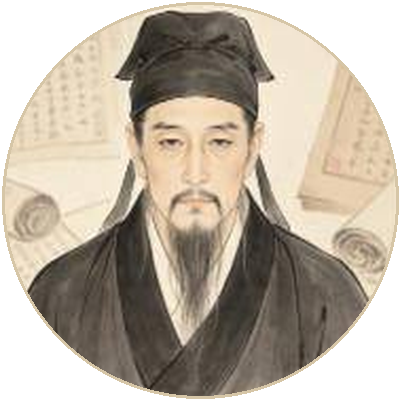
The Numerological Sage
邵雍
The events of Shao Yong's life are recorded in the History of Song and other classical texts.
百源苦读:邵雍年轻时在苏门山百源上筑室苦读,过着极为清苦的生活。据记载,他冬天不生炉火,夏天不用扇子,日以继夜地沉浸在学问之中。他在这里打下了扎实的学术基础,尤其对象数易学产生了浓厚的兴趣。这段苦读经历塑造了他一生的学术品格——淡泊名利,专注于对天地之理的探索。
Years of Intense Study at Baiyuan: As a young man, Shao Yong built a study at Baiyuan on Sumsen Mountain and lived an austere life of intense scholarship. He reportedly had no fires in winter and no fans in summer, studying day and night. Here he laid a solid academic foundation, developing his passionate interest in numerological Yi studies. These years of hardship shaped his lifelong scholarly character — indifferent to fame and fortune, devoted to exploring the principles of heaven and earth.
洛阳安居:邵雍游历多年后,最终在洛阳定居。他的好友富弼、司马光、吕公著等人集资为他购买了一座宅院。邵雍将居所命名为「安乐窝」,过着简朴而充实的生活。他在洛阳居住了三十余年,与当地士绅百姓建立了深厚的友谊。他的温和谦逊和博学多才使他成为洛阳最受尊敬的人物之一。
Settling in Luoyang: After years of wandering, Shao Yong settled in Luoyang. His close friends Fu Bi, Sima Guang, and Lü Gongzhu pooled funds to buy him a house. He named it the 'Nest of Peace and Joy' and lived there for over thirty years, forming deep friendships with scholars and commoners alike. His gentleness, humility, and vast learning made him one of Luoyang's most beloved figures.
推断世事:邵雍以精通象数之学著称,据说能够通过观察自然现象来推断世事的变化。有一次,他在洛阳天津桥上听到杜鹃的叫声,便预言说:「洛阳向来没有杜鹃,现在南方的鸟飞到了北方,这预示着南方的政治势力将进入朝廷。」不久之后,王安石果然从南方被召入朝廷推行变法。这个故事虽然可能有后人附会的成分,但反映了邵雍在民间文化中被赋予的神秘形象。
Predicting Events: Shao Yong was renowned for his ability to interpret natural phenomena. One famous story recounts that while on the Tianjin Bridge in Luoyang, he heard a cuckoo — a bird not normally seen so far north — and predicted: 'Luoyang has never had cuckoos before. Southern birds flying north means southern political forces will enter the court.' Soon after, Wang Anshi was indeed summoned from the south to implement his reforms. While this story may contain later embellishment, it reflects Shao Yong's mystique in popular culture.
拒不出仕:邵雍一生多次拒绝朝廷的征召。宋神宗时期,朝廷曾多次邀请他出任官职,但他都婉言谢绝。他认为自己的使命不在于政治事务,而在于学术研究和道德修养。他对友人说:「若要做官,须是宰相。若做不得宰相,不如不做。」这句话并非出于狂妄,而是表达了他对学问的坚持——要做就做最好的,否则不如专注于自己擅长的领域。
Refusing Office: Shao Yong repeatedly refused imperial appointments. During Emperor Shenzong's reign, the court invited him several times to serve, but he politely declined each time. He believed his mission lay not in politics but in scholarship and moral cultivation. He told friends: 'If one is to be an official, one must be a prime minister. If one cannot be prime minister, it is better not to serve at all.' This was not arrogance but a commitment to excellence — do your best or focus on what you do best.
以物观物,性也;以我观物,情也。
"To contemplate things from the perspective of things themselves is nature; to contemplate things from the perspective of the self is emotion." — Shao Yong's epistemological ideal: objectivity requires transcending the subjective ego.
先天之学,心法也。
"The learning of the Pre-Heaven is the method of the heart-mind." — Shao Yong on his pre-heaven cosmology, linking the mathematical structure of the universe to the workings of consciousness.
一分为二,二分为四,四分为八,八分为十六,十六分为三十二。
"One divides into two, two into four, four into eight, eight into sixteen, sixteen into thirty-two." — Shao Yong's description of the binary progression underlying his hexagram arrangement, anticipating the binary number system.
学不际天人,不足以谓之学。
"If learning does not encompass heaven and humanity, it is not worthy of being called learning." — Shao Yong's definition of true scholarship as encompassing the cosmic and human dimensions.
观物之乐,非观物也,观其理也。
"The joy of contemplating things is not in contemplating things themselves, but in contemplating their principles." — Shao Yong on the deeper purpose of observation: to perceive the underlying patterns of reality.
邵雍的学术贡献主要体现在他对易学的创新性研究上。与程颐以义理解《易》不同,邵雍走的是象数派的路线——他试图通过数字和图式来揭示宇宙的根本结构。他创立了「先天易学」体系,将六十四卦按照特定的数学规律排列,形成一个严密的宇宙模型。在这个模型中,每一卦都对应着宇宙中特定的事物和现象,整个卦序则反映了宇宙从生成到运行的完整过程。
Shao Yong's scholarly contribution centered on his innovative Yi studies. Unlike Cheng Yi's philosophical approach, Shao Yong followed the numerological tradition — attempting to reveal the fundamental structure of the cosmos through numbers and diagrams. He created the 'Pre-Heaven Yi Learning' system, arranging the sixty-four hexagrams according to specific mathematical patterns to form a rigorous cosmological model. In this model, each hexagram corresponds to particular things and phenomena in the cosmos, while the complete sequence reflects the universe's full process from generation to operation.
邵雍的先天学是他最具原创性的思想贡献。他认为宇宙存在两种基本状态:「先天」和「后天」。先天是宇宙的本然状态,是天地未分之前的混沌整体;后天是宇宙的显现状态,是天地已分之后的万物纷呈。邵雍通过他独创的「先天图」——包括先天八卦次序图、先天六十四卦圆图等——试图描绘宇宙从先天到后天的演化过程。这些图式不仅具有哲学意义,也包含了深刻的数学洞见,后世学者发现其中蕴含着二进制数列的雏形。
Shao Yong's Pre-Heaven Learning is his most original philosophical contribution. He held that the cosmos has two fundamental states: 'Pre-Heaven' and 'Post-Heaven.' Pre-Heaven is the cosmos's primordial state — the undifferentiated wholeness before heaven and earth separated; Post-Heaven is the cosmos's manifest state — the myriad things after heaven and earth divided. Through his original 'Pre-Heaven Diagrams' — including the Pre-Heaven Eight Trigrams Sequence and the Pre-Heaven Sixty-Four Hexagrams Circle — he attempted to depict the cosmos's evolution from Pre-Heaven to Post-Heaven. These diagrams carry not only philosophical significance but also profound mathematical insight — later scholars discovered they contain the embryo of the binary number system.
邵雍的认识论以「观物」为核心。他区分了两种观物的方式:「以物观物」和「以我观物」。「以物观物」是从事物本身的角度来观察事物,超越了个人的主观偏见,达到客观的认知;「以我观物」则是从个人的角度来观察事物,容易受到情感和欲望的干扰。邵雍认为,圣人之所以能够洞察万物之理,正是因为他们能够做到「以物观物」——将自己的心与天地万物融为一体,从而获得对宇宙真理的客观认识。
Shao Yong's epistemology centers on 'contemplating things' (观物). He distinguished two modes of observation: 'contemplating things from the perspective of things' and 'contemplating things from the perspective of the self.' The former transcends personal bias to achieve objective knowledge; the latter is colored by emotion and desire. Shao Yong held that sages could penetrate the principles of all things precisely because they achieved the former — merging their hearts with heaven, earth, and all things, thereby attaining objective knowledge of cosmic truth.
邵雍在《皇极经世》中提出了一套宏大的宇宙周期理论。他认为宇宙的历史按照严格的数学规律运行,经历着从生成到消亡的周期性循环。他将宇宙的时间尺度分为「元、会、运、世」四个层次:一元等于十二会,一会等于三十运,一运等于十二世,一世等于三十年。按照这个计算,一元总共是129,600年,代表了宇宙一个完整的大周期。在这个框架中,人类历史只是宇宙大周期中的一个片段。
In the 'Supreme World-Ordering Principles' (皇极经世), Shao Yong proposed a grand theory of cosmic cycles. He held that cosmic history operates according to strict mathematical laws, undergoing periodic cycles from generation to dissolution. He divided cosmic time into four levels: Yuan (era), Hui (epoch), Yun (period), and Shi (generation). One Yuan equals 12 Hui, one Hui equals 30 Yun, one Yun equals 12 Shi, and one Shi equals 30 years. By this calculation, one Yuan totals 129,600 years — a complete cosmic mega-cycle. Within this framework, human history is merely one fragment of the cosmic cycle.
邵雍的人生哲学以「安乐」为核心。他将自己的居所命名为「安乐窝」,自号「安乐先生」,表达了他对淡泊宁静生活的追求。他认为,真正的快乐不来自外在的功名利禄,而来自内心的平和与对天地之理的领悟。他的诗集《伊川击壤集》中充满了对自然美景的欣赏和对简朴生活的满足。他常常与友人在洛阳的名胜之间游赏赋诗,享受着精神上的富足。这种安贫乐道的生活态度,体现了儒家「孔颜乐处」的精神传统。
Shao Yong's philosophy of life centered on 'peace and joy' (安乐). He named his dwelling the 'Nest of Peace and Joy' and called himself the 'Master of Peace and Joy,' expressing his pursuit of a serene, simple life. He believed true happiness comes not from external fame and fortune but from inner peace and comprehension of cosmic principles. His poetry collection, the Jirang Anthology of Yichuan, is filled with appreciation of natural beauty and contentment with simple living. He often toured Luoyang's scenic spots with friends, composing poetry and enjoying spiritual abundance. This contented, Dao-embodying life attitude embodies the Confucian tradition of 'the joy of Confucius and Yan Hui.'
《皇极经世》是邵雍最重要的著作,也是中国思想史上最具野心的宇宙论作品之一。全书以《易经》的卦象为基础,运用数学方法,构建了一个包罗万象的宇宙模型。这个模型涵盖了从宇宙的生成到万物的运行,从自然界的四季变化到人类社会的历史演变。邵雍试图用数字和图式来描述宇宙的一切,展现了一种独特的理性主义精神。虽然这部著作极为艰深晦涩,但它对中国易学、术数和宇宙论的发展产生了深远影响。
The 'Supreme World-Ordering Principles' is Shao Yong's most important work and one of the most ambitious cosmological works in Chinese intellectual history. Built on the hexagrams of the Book of Changes using mathematical methods, it constructs an all-encompassing cosmic model covering everything from the universe's generation to the operation of all things, from seasonal changes to human history. Shao Yong attempted to describe the entire cosmos through numbers and diagrams, displaying a unique spirit of rationalism. Though extremely difficult and obscure, this work profoundly influenced Chinese Yi studies, divination, and cosmology.">Shao Yong's masterwork — one of the most ambitious cosmological works in Chinese history. Using mathematical methods based on the Book of Changes hexagrams, it constructs an all-encompassing cosmic model from the universe's generation to human history.
《观物篇》是邵雍阐述其认识论和自然哲学的重要著作。在这部作品中,邵雍系统地论述了「以物观物」的认识方法,主张真正的认知应当超越个人的主观偏见,从事物本身的角度来理解事物。他还详细讨论了天地万物的生成变化规律,以及人与自然的关系。这部著作体现了邵雍独特的理性主义精神和对客观真理的追求。
The 'Essays on Contemplating Things' is Shao Yong's important work on epistemology and natural philosophy. It systematically expounds his method of 'contemplating things from the perspective of things,' advocating that true knowledge must transcend personal bias. It also discusses the laws of cosmic change and the relationship between humans and nature. This work embodies Shao Yong's unique rationalism and pursuit of objective truth.">Shao Yong's epistemological masterwork, expounding his method of 'contemplating things from the perspective of things' — transcending personal bias to achieve objective knowledge of cosmic truth.
《伊川击壤集》是邵雍的诗歌总集,收录了他一生创作的大量诗歌。这些诗歌题材广泛,既有对自然美景的描绘,也有对人生哲理的感悟;既有与友人的唱和之作,也有独处时的沉思之作。诗歌风格平易近人,清新自然,不事雕琢。通过这些诗歌,读者可以深入了解邵雍的内心世界和他安贫乐道的人生态度。这部诗集也是了解北宋洛阳士人文化生活的重要文献。
The 'Jirang Anthology of Yichuan' is the collected poetry of Shao Yong, containing a vast number of poems written throughout his life. The subjects are diverse — natural beauty, philosophical reflections, exchanges with friends, and solitary meditations. The style is accessible, fresh, and natural, without affected ornamentation. Through these poems, readers gain deep insight into Shao Yong's inner world and his contented, Dao-embodying life attitude. This collection is also an important document for understanding the cultural life of Northern Song Luoyang's literati.">Shao Yong's collected poetry — accessible, fresh, and natural. Covering natural beauty, philosophical reflections, and friendly exchanges, it offers deep insight into his inner world and contented life.
Shao Yong speaks to our time in multiple ways: his mathematical cosmology anticipated binary computing by six centuries; his 'contemplating things objectively' aligns with scientific method; his 'Nest of Peace and Joy' offers an alternative to consumerism; and his interdisciplinary vision reminds us that innovation lives at the intersection of fields.