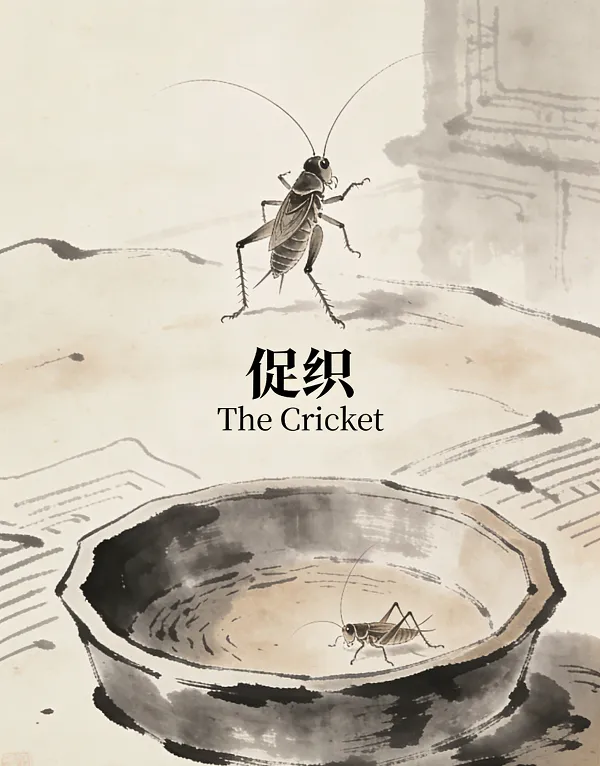
明宣德间,宫中尚促织促织蟋蟀的别名。"促织"意为"催促纺织",因蟋蟀叫声如同催促妇女纺织的声音而得名。之戏,岁征民间。此物故非西产。有华阴令欲媚上官,以一头进,试使斗,遂责令常供。
成名,为人迂讷,被猾胥报充里正。百计营谋不能脱,不终岁薄产累尽。会征促织,成忧闷欲死。妻曰:「死何裨益?不如自行搜觅,冀有万一之得。」
成乃提竹筒丝笼,于败堵丛草处,探石发穴,靡计不施。迄无济。旬余,杖至百,两股间脓血脓血化脓流血。成名因交不出蟋蟀,被官府杖打,两腿溃烂。极言底层百姓之苦。流离,不能行捉。
During the Xuande reign of the Ming dynasty, the imperial palace was devoted to cricket-fighting促织 cù zhīAn alternative name for crickets. "促织" means "urging weaving" — the cricket's song was said to sound like a call for women to spin thread., and each year crickets were demanded from the common people. A magistrate of Huayin, wishing to curry favor, presented one. When it proved victorious, the levy became permanent.
Cheng Ming, a bumbling man, was reported by a corrupt clerk and appointed village headman. No stratagem could free him; within a year his property was gone. When the cricket levy came due, he wished for death. His wife said: "What good is dying? Better go search yourself — perhaps one chance in ten thousand."
Cheng took bamboo tubes and silk cages, searching crumbling walls and thick grass, turning stones and digging holes — every method tried, nothing gained. After ten days he was beaten a hundred strokes; pus and blood脓血 nóng xuèFestering wounds. Cheng is beaten so severely by officials that his legs ulcerate. A devastating image of the common people's suffering. streamed down both legs, and he could no longer walk to search.
成有子九岁,窥父不在,窃发盆。虫跃掷径出,迅不可捉。及扑入手,已股落腹裂,斯须就毙。儿惧,啼告母。母闻之,面色灰死,大骂曰:「业根!死期至矣!翁归,自与汝覆算覆算算账、追究。!」
儿涕涕眼泪。古文中"涕"专指眼泪。此处作动词,指哭泣流泪。而出。未几成归,闻妻言,如被冰雪。怒索儿,儿渺然不知所往。既得其尸于井,因而化怒为悲,抢呼抢呼以头撞地,大声哭喊。"抢"通"撞",形容极度悲痛。欲绝。
日将暮,取儿藁葬。近抚之,气息惙然。喜置榻上,半夜复苏。但儿神气痴木,奄奄思睡。成顾蟋蟀笼虚,则气断声吞,亦不复以儿为念。
Cheng had a son of nine. While the father was away, the boy peeked into the jar. The creature leaped out in an instant — too fast to catch. By the time it was grasped, its legs were broken and its belly split; it died within moments. The boy, terrified, wept and told his mother. She went gray as ash: "Spawn of ruin! Your death hour has come! When your father returns, he'll settle accounts覆算 fù suànTo reckon, to settle scores. with you!"
The boy wept涕 tìTears. In classical Chinese, "涕" means tears specifically. Here used as a verb: to weep. and fled. Soon Cheng returned. Hearing his wife's words, he felt drenched in ice and snow. He searched for his son in fury, but the boy had vanished. Finding the body in the well, his rage turned to grief — he threw himself down抢呼 qiāng hūTo beat one's head against the ground while wailing — a gesture of extreme anguish. and howled.
At dusk, they prepared to bury the boy in straw. But reaching out, they found his breath still faint. They laid him on the bed; by midnight he stirred. Yet the boy's spirit was vacant; he lay in a stupor. Cheng glanced at the empty cricket jar — his breath caught — and could think of nothing else.
忽闻门外虫鸣。惊起觇视,虫宛然尚在。喜而捕之,一鸣辄跃去。覆之以掌,虚若无物;手裁举,则又超忽超忽突然远去、一闪即逝。而跃。急趁之,折过墙隅,迷其所往。
徘徊四顾,见虫伏壁上。审谛之,短小,黑赤色,顿非前物。成以其小,劣之。惟彷徨瞻顾瞻顾四下张望。,寻所逐者。壁上小虫,忽跃落襟袖间。视之,形若土狗,梅花翅,方首长胫。喜,收之。
村中少年好事者,驯养一虫,自名「蟹壳青蟹壳青蟋蟀名,因其色如蟹壳之青。与成名的小蟋蟀形成鲜明对比。」。日与子弟角,无不胜。径造庐访成。视成所蓄,掩口胡卢胡卢喉间发出的闷笑声。而笑。因出己虫,纳比笼中。成视之,庞然修伟,自增惭怍,不敢与较。
Suddenly he heard a cricket chirping outside. Leaping up, he saw the creature still there. He lunged — it chirped and sprang away. He covered it with his palm, but felt nothing; the moment he lifted his hand, the cricket had flashed away超忽 chāo hūTo vanish suddenly. The cricket moves with supernatural speed.. He chased it around a corner and lost it.
Pacing about, he spotted a cricket on the wall. He studied it: small, dark red — obviously not the one he had chased. Because it was tiny, he dismissed it. While he looked around瞻顾 zhān gùTo peer in all directions. for his quarry, the little cricket leaped onto his lapel. It looked like a mole cricket, with plum-blossom wings, a square head, and long shanks. Pleased, he captured it.
A young man in the village had trained a cricket called "Crab-Shell Green蟹壳青 xiè ké qīngNamed for its color. A rich youth's prize specimen.." He fought it daily and never lost. He came to Cheng's door and, seeing Cheng's prize, chuckled胡卢 hú lúA muffled laugh from the throat. behind his hand. He produced his cricket and placed it beside Cheng's. Cheng saw the enormous creature and dared not compete.
方共瞻玩,一鸡瞥来瞥来突然飞来。,径进以啄。成骇立愕呼。幸啄不中,虫跃去尺有咫。鸡健进,逐逼之。虫已在爪下矣。成仓猝莫知所救,顿足失色。旋见鸡伸颈摆扑。临视,则虫集冠上,力叮不释。成益惊喜,掇置掇置拾取后放入。笼中。
翼日进宰。宰见其小,怒呵成。成述其异。宰不信,试与他虫斗,尽靡。又试之鸡,果如成言。乃赏成,献诸抚军抚军巡抚的别称,明清省级最高长官。蟋蟀层层进献。。抚军大悦,以金笼进上,备疏其能。
既入宫中,天下所贡之虫,不可悉数。试之皆败。每闻琴瑟之声,则应节而舞。上大嘉悦,诏赐抚臣名马衣缎。抚军不忘所自,免成役。后岁余,成子精神复旧,自言:「身化促织,轻捷善斗,今始苏耳。」
由是以裘马裘马皮袍和骏马,代指富贵。因一只蟋蟀骤然富贵,极具讽刺。过世家焉。
As they watched, a rooster swooped in瞥来 piē láiTo arrive in a flash. and pecked at the cricket. Cheng cried out in alarm. Fortunately the peck missed; the cricket leaped a foot away. The rooster charged again and bore down upon it — the cricket was under its claw. Cheng stamped his feet in helpless panic. Then he saw the rooster stretch its neck and stumble. Looking closer: the cricket had latched onto the rooster's comb and would not let go. Overjoyed, Cheng scooped it up掇置 duō zhìTo pick up and place inside. into the cage.
The next day he presented it to the magistrate. The magistrate, seeing its small size, berated Cheng. Cheng described its marvels. Skeptical, the magistrate tested it against other crickets — all defeated. He tested it against a rooster, exactly as Cheng had said. He rewarded Cheng and presented it to the Provincial Governor抚军 fǔ jūnA title for the Provincial Governor (xunfu), the highest-ranking provincial official. The cricket ascends through layers of bureaucracy.. The Governor, delighted, sent it to the Emperor in a golden cage with a full account of its abilities.
In the palace, crickets from every province were tested against it — all defeated. Whenever it heard zither music, it danced in rhythm. The Emperor was overjoyed and bestowed fine horses and silk upon the Governor. The Governor, remembering his source, freed Cheng from his duties. A year later, Cheng's son regained his wits and said: "I myself became a cricket — swift and fierce. Only now have I awakened."
And so, clad in furs and riding fine horses裘马 qiú mǎSable robes and fine horses — a metonym for wealth. To become rich from a single cricket — the supreme irony., Cheng lived as a man of means.
文学价值
《促织》是《聊斋志异》中最具社会批判力的短篇。全文以"征蟋蟀"为线索,展现了一个底层家庭如何被皇家的一时玩乐碾碎——儿子坠井、妻子绝望、父亲遍体鳞伤。而最终的"大团圆"结局(蟋蟀立功、全家富贵)实际上是最深的讽刺:百姓的命运,系于一只虫子。
"魂化促织"的设定堪称神来之笔。儿子的灵魂进入了蟋蟀的身体,以虫的形态去为父亲承担苦难——这是一种令人心碎的隐喻:在专制体制下,连孩子都必须变成"工具"才能让家庭存活。
比较研究
蒲松龄在文末评论道:"天子一跬步,皆关民命,不可忽也。"这句话使全篇从一个志怪故事升华为一篇政治檄文。与杜甫"朱门酒肉臭,路有冻死骨"异曲同工,但蒲松龄借鬼神之笔,将控诉写得更为沉痛——杜甫写的是"看见"的苦难,蒲松龄写的是"看不见"的苦难:那些在权力的碾压下无声消亡的普通家庭。
Literary Merit
"The Cricket" is perhaps the most socially incisive tale in Strange Tales. The cricket levy becomes a thread that shows how an entire family is crushed by the Emperor's passing amusement — a son drowns in a well, a wife despairs, a father is beaten bloody. And the "happy ending" — the cricket wins glory, the family prospers — is the deepest irony of all: the people's fate hangs upon a single insect.
The "soul transformation" is a stroke of genius. The son's spirit enters the cricket's body, enduring hardship in insect form so his family can survive — a heartbreaking metaphor for how, under autocratic rule, even children must become "instruments" for the family to live.
Comparative Study
Pu Songling concludes: "Every step of the Emperor determines the people's fate — this must not be overlooked." This single line transforms the story from supernatural tale into political indictment. Like Du Fu's "Behind vermilion gates, meat and wine go to waste; on the road, the bones of the frozen lie," but Pu Songling, writing through the veil of the supernatural, makes his accusation even more devastating. Du Fu wrote of visible suffering; Pu Songling wrote of invisible suffering — the ordinary families silently ground to dust beneath the machinery of power.
蒲松龄在《促织》文末的评论。"跬步"即半步,形容极小的举动。此语揭示了一个深刻的政治命题:在绝对权力体制下,统治者最微不足道的个人爱好,都可能成为百姓的灭顶之灾。蒲松龄以明朝宣德年间的蟋蟀之征为题材,实际暗讽的是清代的社会现实。
Pu Songling's concluding comment in "The Cricket." "A single step" (kuǐ bù, half a stride) describes the most trivial action. The line reveals a profound political truth: under absolute power, the ruler's most insignificant personal hobby can become the common people's catastrophe. Pu Songling set his tale in the Xuande reign of the Ming dynasty, but his true target was the social reality of the Qing.
清代蒲松龄所著文言短篇小说集,共约五百篇。"聊斋"是蒲松龄的书斋名,"志异"意为记录奇闻异事。蒲松龄一生科举不第,以教书为业,利用课余时间搜集民间故事,历时数十年完成此书。全书以鬼狐仙怪的故事折射人间百态,被郭沫若誉为"写鬼写妖高人一等,刺贪刺虐入骨三分"。
A collection of approximately five hundred classical Chinese short stories by Pu Songling of the Qing dynasty. "Liao Zhai" was Pu's study; "Zhi Yi" means "records of the strange." Failing the imperial examinations all his life, Pu worked as a tutor and spent decades collecting folk tales. Through stories of ghosts, foxes, and immortals, he refracted the full spectrum of human affairs.