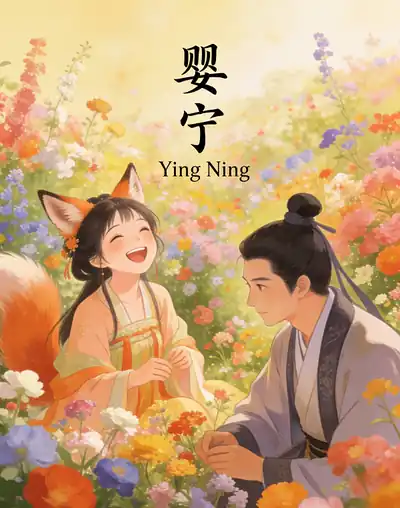
王子服,莒县人。上元出游,见一女郎,携婢,拈梅花梅花梅花是高洁的象征,在故事中反复出现,与婴宁的天真纯洁相呼应。一枝,容华绝代容华绝代容貌华美,冠绝当代。"绝代"意为当世无双。,笑容可掬。生注目不移,女顾婢曰:「个儿郎目灼灼似贼!」遗花地上,笑语自去。
生拾花怅然,神魂丧失。归而病病此处指因相思而卧病在床,即"相思病"。古人认为过度思念会损耗精气,导致疾病。,饮食俱废。母忧之,多方医治。生不肯言,但终日昏昏如醉。
Wang Zifu, a man of Ju County, went out on the Lantern Festival. He saw a young lady, attended by a maid, holding a sprig of plum blossom梅花 méi huāThe plum blossom, symbol of purity and resilience, recurs throughout the story as an emblem of Ying Ning's innocence., her beauty unmatched in any age容华绝代 róng huá jué dàiBeauty that surpasses all generations. "绝代" means without equal in the present era., her face brimming with laughter. The young man stared, unable to look away. The girl turned to her maid and said: "This fellow's eyes blaze like a thief's!" She dropped the flower on the ground and walked away laughing.
Wang picked up the flower, heartsick, his very soul departed. He returned home and fell ill病 bìngLovesickness rendered as physical illness. In Chinese tradition, excessive longing was believed to drain one's vital energy., refusing both food and drink. His mother, worried, tried every remedy. Wang would not speak of what ailed him, but lay in a stupor all day, as if drunk.
有吴生者,与生为中表中表表亲,即姑母、舅父、姨母的子女。古代"中表"关系是重要的亲属纽带。。偶至其家,诘之。生具以告。吴笑曰:「此易耳。可觅其处,当为君谋之。」
生闻之,病渐愈。吴果访得其处,归来告生曰:「南山有女,与所言符。然其家甚荒僻荒僻荒凉偏僻。此处暗示女子居所远离人烟,为后文揭示其狐女身份埋下伏笔。,恐非善类。」生不顾,固请偕往。
遂同行。入山数里,见乱山合沓,空翠爽肌。山坳中有小村落,约数十家。入村,见一门,门前皆丝柳丝柳纤细柔软的柳枝,如丝线一般。丝柳是春天的意象,此处营造出世外桃源般的氛围。,墙内桃杏尤繁,间以修竹,野鸟格磔其中。
吴扣门,有老媪出。问之,乃女子姑母。吴具以情告。媪喜曰:「吾甥女尚未字人。」延入内,呼婴宁。少时,闻门外隐隐有笑声。媪又唤之,女且笑且入,犹掩其口,笑不可遏。
A man surnamed Wu, Wang's cousin中表 zhōng biǎoA maternal cousin — the child of one's aunt, uncle, or mother's sister. An important kinship bond in traditional China., happened to visit and asked what was wrong. Wang told him everything. Wu laughed: "That's easy. Find where she lives and I'll arrange it for you."
Hearing this, Wang began to recover. Wu indeed found the girl's home and reported: "There is a girl on the south mountain who matches your description. But her home is desolate and remote荒僻 huāng pìWild and isolated. This foreshadows the revelation of her fox-spirit nature. — I fear she may not be what she seems." Wang paid no heed and insisted they go together.
They set out together. Several miles into the mountains, they found peaks folding upon one another, the air cool and green. In a mountain hollow lay a tiny village of some dozens of houses. Entering, they came to a gate hung with willow threads丝柳 sī liǔSlender willow branches, fine as silk threads — a symbol of spring, here creating an otherworldly, idyllic atmosphere., beyond the wall peach and apricot trees blossomed extravagantly, interspersed with tall bamboo, wild birds chattering among them.
Wu knocked at the gate; an old woman came out. Questioned, she proved to be the girl's aunt. Wu explained everything. The old woman was pleased: "My niece has not yet been betrothed." She invited them inside and called for Ying Ning. After a moment, they heard laughter faintly outside the gate. The old woman called again — the girl came in laughing, still covering her mouth, unable to restrain her mirth.
媪曰:「此即婴宁也。」生目之目之用目光注视她。"目"在此作动词用,表示"注视、看",古代用法。,女犹笑不已。媪曰:「大哥欲见汝久矣。」女且笑且行。媪曰:「此汝表兄,一家之人,何避嫌之有?」
生问:「妹子年几何矣?」媪未能解。生又言之。女复笑,不可仰视。媪谓生曰:「我言少教诲,此可见矣。年已十六,呆痴裁裁通"才",仅仅。此处老媪说婴宁十六岁了却还像个孩子一样天真无知。如婴儿。」生曰:「小甥一岁。」媪曰:「阿甥已十七矣,非庚午属马者耶?」生应之。
媪顾女曰:「尔表兄欲与汝为夫妇夫妇夫妻。老媪直截了当地提出婚事,婴宁却笑而不答,体现其天真无邪。,何不作妯娌妯娌兄弟之妻的互称。此处老媪用"妯娌"来暗示婚姻关系,比直接说"嫁"更为委婉。?」女又笑,顾婢曰:「我不识渠。」生曰:「妹子不认识我?」女曰:「岂不识,只是不认识表兄。」笑不可仰。
The old woman said: "This is Ying Ning." Wang gazed at her目之 mù zhīTo fix one's eyes upon her. "目" functions as a verb meaning "to look at" — an archaic usage.; she was still laughing. The old woman said: "This young gentleman has wished to see you for a long time." The girl laughed as she walked. The old woman said: "He is your cousin — one family. What need for modesty?"
Wang asked: "How old is the young lady?" The old woman did not hear clearly. Wang repeated his question. The girl laughed again, unable to look up. The old woman said to Wang: "I told you she has had little instruction — now you see it plainly. She is sixteen, yet as simple裁 cáiA variant of "才" (only, merely). The aunt says Ying Ning is sixteen yet still as innocent as a baby. as a babe." Wang said: "I am one year older." The old woman said: "Then you are seventeen — born in the year of the horse, Geng Wu?" Wang confirmed.
The old woman turned to the girl: "Your cousin wishes to be your husband夫妇 fū fùHusband and wife. The aunt proposes marriage directly; Ying Ning merely laughs, embodying perfect innocence.. Why not become sisters-in-law妯娌 zhóu lǐThe wives of brothers call each other "妯娌." The aunt uses this to hint at marriage more delicately.?" The girl laughed again and turned to her maid: "I don't know this person." Wang said: "Don't you recognize me?" She replied: "How could I not recognize you? I simply don't recognize my cousin!" And she laughed until she could not look up.
生娶婴宁归。入门,见者皆疑为仙。然女善笑,笑辄不止。邻女少妇,争承迎之。母择日将为合卺卺古代婚礼中新人各饮一瓢酒的仪式。"合卺"即今之"交杯酒",象征夫妻合为一体。,女犹笑甚,不能俯仰。母曰:「尔憨狂若此,何以为妇!」女乃忍笑而立。
然好戏谑,院中植植种植。婴宁最爱花木,在院中遍植奇花异卉,每日攀登其上,摘花簪发。满花木,日攀登其上,摘花簪发。一日,邻家子见之,神魂丧失。女不之觉。邻家子逾墙逾墙翻墙而过。邻家男子翻墙窥探婴宁,暗示其有不轨之心。窥之。女指墙底大笑。邻家子以为有约,逾墙而下。女且笑且走,邻家子追之,忽坠墙下,头破而亡。
邻家讼之官。官廉得其情,曰:「此女妖也。」然终以无心无心没有故意,不是存心的。婴宁的行为并无恶意,一切出于天真本性。释之。自是女不复笑。母曰:「向也笑,今不笑,何也?」女曰:「婢子前日遇一人,问他姓名,他笑而不答。至今想起来,好不惶愧。」
然竟不复笑,虽故逗之,亦终不笑。人皆异之。女曰:「吾不忍吾姑。」一日,忽对母泣下,具告以狐生狐生狐狸所生,即狐仙之女。婴宁最终向婆婆坦白了自己的真实身份。。母亦泣。自此终身不复笑。
Wang took Ying Ning home. Upon entering, everyone who saw her suspected she was an immortal. But the girl loved to laugh — she laughed without cease. Neighbor women and young wives competed to attend her. When the mother-in-law chose a day for the wedding ceremony卺 jǐnThe gourd-cup ritual of ancient weddings, where bride and groom each drank from a halved gourd — the origin of the modern "cross-cup wine.", Ying Ning was laughing so hard she could not bow. Her mother-in-law said: "If you are this wild and silly, how can you be a wife?" Ying Ning restrained her laughter and stood still.
Yet she loved to play. She planted植 zhíTo plant. Ying Ning fills the courtyard with flowers and climbs among them daily. the courtyard with flowers and climbed among them each day, picking blossoms to pin in her hair. One day, a neighbor's son saw her and lost his wits. Ying Ning did not notice. The young man climbed the wall逾墙 yú qiángTo scale a wall. The neighbor's voyeuristic spying implies dishonorable intentions. to spy on her. She pointed at the foot of the wall and laughed. The young man, taking this for an invitation, leapt down — and fell to his death, his skull split open.
The neighbor's family took the matter to the magistrate. The official investigated and declared: "This girl is a demon." But ultimately he released her for her lack of intent无心 wú xīnWithout malice or premeditation. Ying Ning's actions are entirely innocent.. From that day, she never laughed again. Her mother-in-law asked: "Before you laughed; now you do not. Why?" She replied: "That day I met someone. I asked his name; he laughed and would not answer. When I think of it now, I am filled with shame."
Yet she never laughed again, no matter how they tried to tease her. Everyone thought it strange. One day, she suddenly wept before her mother-in-law and confessed she was born of a fox狐生 hú shēngBorn of a fox spirit. Ying Ning finally reveals her true nature to her mother-in-law.. The old woman wept too. From then on, Ying Ning never laughed again for the rest of her life.
笑声即自由
《婴宁》是蒲松龄对"天真"最深情的礼歌。在整部《聊斋志异》中,婴宁是最独特的女性形象:她不像聂小倩那样背负冤屈,不像青凤那样精于世故,她只有一个特质——笑。不停地笑,无来由地笑,笑到令所有人困惑。
但蒲松龄的笔锋在结尾骤然一转:当婴宁进入人间社会,她的笑声从"天真"变成了"罪过"。邻家子因窥视她而死,官府判她是"妖"。社会的逻辑是:你的快乐伤害了别人,所以你必须停止快乐。于是婴宁"终身不复笑"——不是因为悲伤,而是因为被社会规训了。那颗被摘下的花,就是她死去的天真。
比较研究
婴宁的笑声令我们想起庄子笔下的"真人"——那些"不知悦生,不知恶死"的超越者。她的笑不是社交性的笑,而是存在性的笑,是未经社会化污染的本真状态。蒲松龄以此暗示:真正的自由不在庙堂,不在科举,而在一个狐女无来由的笑声之中。当笑声消失,自由也随之消亡。
Laughter as Freedom
"Ying Ning" is Pu Songling's most tender hymn to innocence. Among all the heroines of Strange Tales, Ying Ning is unique: unlike Nie Xiaoqian, she bears no grievance; unlike Green Phoenix, she knows nothing of the world. She has one quality — laughter. Constant, causeless laughter that bewilders everyone around her.
But Pu's pen turns sharply at the end: when Ying Ning enters human society, her laughter transforms from "innocence" to "crime." A neighbor's son dies while spying on her; the magistrate declares her a "demon." Society's logic is: your happiness harmed another, therefore you must stop being happy. And so Ying Ning "never laughed again for the rest of her life" — not from sorrow, but from social conditioning. The plucked flower is her dead innocence.
Comparative Study
Ying Ning's laughter recalls Zhuangzi's "True Men" — those who "do not rejoice in life, nor resent death." Her laughter is not social but existential — an authentic state uncontaminated by civilization. Pu implies that true freedom lies not in the court or the examination hall, but in a fox girl's causeless laughter. When the laughter dies, freedom dies with it.
婴宁之名,取"婴儿般安宁"之意。蒲松龄以此命名,暗示她的本真状态——如婴儿般未经世俗污染的宁静。她的笑声贯穿全文,从初见时的"笑不可遏"到最后的"终身不复笑",形成一个完整的弧线。这个弧线,本质上是一部微型的"社会化悲剧":天真如何在礼教的规训下死去。
Her name means "infant serenity" — Pu Songling's signal that she embodies a primal, uncorrupted state. Her laughter arcs through the entire story, from the opening "laughing uncontrollably" to the final "never laughed again." This arc is, at its core, a miniature tragedy of socialization: how innocence dies under the discipline of propriety.
"笑容可掬"如今是常用成语,但它的出处正是蒲松龄的这篇小说。原文描写婴宁初见王子服时"笑容可掬"——笑容满溢,仿佛可以用双手捧起。这一描写在后世广为流传,成为中国文学中描写女子笑容最经典的笔法之一。蒲松龄以极简之笔,创造了一个永恒的文学形象。
"A face brimming with laughter" is now a common Chinese idiom, but it originates in this very story. Pu describes Ying Ning's smile as so full it seems one could cup it in both hands. This image has become one of the most enduring literary descriptions of feminine joy in Chinese letters — Pu's minimalist brush creating an immortal figure.
狐仙是中国志怪文学中最核心的"非人"形象之一。与西方文学中"狐妖"的邪恶形象不同,蒲松龄笔下的狐女大多是美丽、聪慧、重情义的正面角色。婴宁是其中最纯粹的一个——她的"狐性"不是阴险狡诈,而是天性自由,不受人间礼法约束。蒲松龄以狐写人,以非人的角色来反思"人"的处境。
The fox spirit is one of the most central "non-human" figures in Chinese supernatural literature. Unlike the evil fox of Western tradition, Pu's fox women are typically beautiful, clever, and emotionally loyal. Ying Ning is the purest of them — her "fox nature" is not cunning but freedom from social constraint. Pu uses the inhuman to reflect on the human condition.
清代蒲松龄(1640—1715)所著文言短篇小说集,共四百九十一篇。"聊斋"为蒲松龄的书斋名,"志异"意为记录奇闻异事。全书以狐鬼花妖为载体,实则针砭时弊,寄托孤愤。蒲松龄一生科举不第,却以这部作品成为中国文言小说的巅峰。
A collection of 491 classical-language short stories by Pu Songling (1640–1715). "Liaozhai" (Chatting Studio) was the name of his study; "Zhiyi" means "records of the strange." Beneath its surface of fox spirits and flower demons lies biting social commentary and the author's lifelong frustration with the imperial examination system.