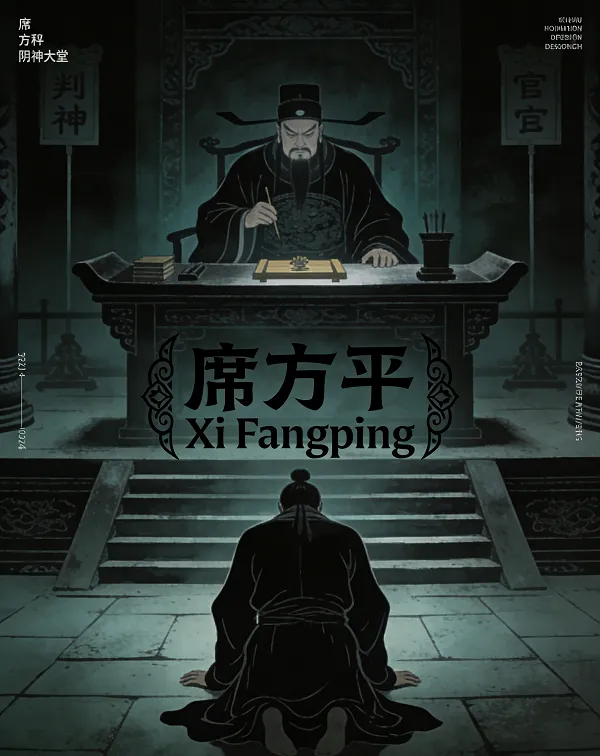
席方平,东安人。其父名廉,性戆拙戆拙憨厚笨拙、不善言辞。"戆"指憨直、不懂世故,"拙"指笨拙、不灵活。合起来形容老实巴交、容易被人欺负的性格。。里中有富室羊某,与廉有隙。羊先死;数年,廉病垂危,谓人曰:「羊某今贿冥使冥使阴间的差役,负责勾取亡魂。类似人间的衙门捕快,但在冥界执行任务。搒我矣。」俄而身赤肿,号呼遂死。
席惨怛不食,曰:「我父朴讷,今见凌于强鬼强鬼强横的鬼魂,指凭借钱财贿赂冥界官吏、横行霸道的恶鬼。,我将赴地下,代伸冤气耳。」遂不复言,时坐时立,状类痴。
盖魂已离壳。席觉出门,不知何往。但见行人络绎,问之,皆不答。俄一人来,告以城隍所在。遂往投状。
Xi Fangping was a man of Dong'an. His father, Xi Lian, was simple and blunt戆拙 gàng zhuōHonest to the point of stupidity, lacking social cunning. "戆" means artlessly frank; "拙" means clumsy. Together they describe someone too guileless for his own good.. In their village lived a wealthy man named Yang, who bore a grudge against Lian. Yang died first. Some years later, Lian fell gravely ill and said to those around him: "Yang is now bribing the messengers of the dead冥使 míng shǐUnderworld bailiffs responsible for collecting souls of the deceased — the infernal equivalent of earthly yamen runners. to flog me." Soon his body turned red and swollen, and with a cry, he died.
Xi Fangping was so stricken with grief that he would not eat. He said: "My father was honest to a fault, and now he is abused by a powerful ghost强鬼 qiáng guǐA domineering spirit — one who uses wealth to corrupt underworld officials and bully others even after death.. I shall descend beneath the earth and see that his grievance is heard." After that he spoke no more, sitting and standing aimlessly, as though in a trance.
His soul had already left his body. Xi found himself outside his door, unsure where to go. He saw travelers coming and going, and asked them the way, but none would answer. At last one man came and told him where the City God's temple stood. Xi went there to file his complaint.
席觉出门,不知何往。但见行人络绎,问之,皆不答。俄一人来,谓曰:「君欲何往?」席曰:「将赴城隍告状。」其人曰:「此去便是。」遂引之去。
至城隍处,投状。城隍以所告无据所告无据所告之事没有证据。这是官府驳回诉讼的常见理由,此处暗示城隍已受羊某贿赂,故意以"无据"为由不予受理。,不准。席愤懑无伸,冥行百里,至郡司。郡司搒席,仍批城隍覆理。
席至城隍处,城隍怒,命以火床。剥衣置铁床上,炽炭灼之。席号呼彻彻穿透、贯通。"号呼彻天"即哭喊声响彻天空,形容酷刑之惨烈。天。既下,城隍问:「尚敢再讼否?」席曰:「大冤未伸,寸心不死!若言不讼,是欺城隍也。必讼!」
Xi found himself outside his door, unsure where to go. Travelers passed in an unending stream, but when he asked the way, none would answer. At last a man came and asked: "Where does the gentleman wish to go?" Xi said: "I go to the City God to file a complaint." The man said: "It is just ahead," and led him there.
At the City God's court, Xi submitted his petition. The City God dismissed the case for lack of evidence所告无据 suǒ gào wú jù"The complaint lacks proof" — a standard formula for rejecting a lawsuit. Here it implies the City God has already been bribed by Yang and is deliberately stonewalling.. Furious and with no avenue of appeal, Xi traveled a hundred li through the netherworld to the Prefectural Judge. The Prefect had Xi flogged, then sent him back to the City God for retrial.
Xi returned to the City God, who flew into a rage and ordered a bed of fire. Xi was stripped and laid upon an iron bed with blazing coals beneath it. His screams pierced彻 chèTo penetrate, to pierce through. "号呼彻天" — his cries pierced the heavens — describes the extremity of the torture. the heavens. When he was taken down, the City God asked: "Do you still dare to litigate?" Xi replied: "My great grievance is not yet redressed — so long as an inch of my heart survives, I shall not die! If I say I will not sue, I would be deceiving the City God. I must sue!"
城隍益怒,命以铁床。席身卧其上,火光灼骨,痛不可忍。席咬牙强忍,不发一声。城隍问之,席曰:「冤深恨重恨重仇恨深重。此处的"恨"不是遗憾之意,而是冤仇、仇恨,指父亲被冤杀之仇不共戴天。,百死不辞!」城隍无奈,解赴郡司。
郡司受羊贿,亦不准状。席复上控于冥王冥王冥界之王,即阎罗王,掌管整个阴间的最高审判者。相当于人间的皇帝。。冥王立拘城隍、郡司对质。二者惧,暗使腹心关说席许以千金。席不听。
冥王讯席,怒色满面,命笞二十。席厉声曰:「受笞允当允当恰当、应当。此处席方平以反语自辩:如果我确实有罪,挨打是应当的;如果我没罪,凭什么打我?,谁教我无钱耶!」冥王怒益甚,命以火床、刀山、油鼎诸刑。
The City God's fury grew. He ordered an iron bed. Xi lay upon it as fire seared his bones, a pain beyond endurance. He clenched his teeth and bore it without a sound. When the City God questioned him, Xi said: "The grievance is deep, the hatred heavy恨重 hèn zhòngThe hatred runs deep. "恨" here means vendetta, not regret — his father was wrongfully killed, and the debt of blood cannot be forgotten.. I would die a hundred deaths without flinching!" The City God, helpless, sent him up to the Prefectural Judge.
The Prefectural Judge, also bribed by Yang, rejected the case. Xi appealed to the King of Hell冥王 míng wángThe ruler of the underworld — King Yama, the supreme judge of the netherworld, equivalent to the emperor of the dead.. The King immediately summoned the City God and Prefect to stand trial. Both were terrified and secretly sent trusted agents to offer Xi a thousand gold pieces. Xi refused to listen.
The King questioned Xi, his face dark with anger, and ordered twenty strokes of the rod. Xi cried out in a fierce voice: "The beating is deserved允当 yǔn dàngProper, fitting. Xi uses bitter irony here: if I am truly guilty, the beating is deserved — but since I am not, it only proves the judge's corruption. — for who told me to have no money!" The King's rage burned hotter, and he ordered fire beds, hills of knives, and cauldrons of oil.
席受诸刑,肤肉焦烂,痛入骨髓。冥王问之,席曰:「小人有冤未伸,虽死亦讼!」冥王问:「汝父何冤?」席曰:「富室羊某,买嘱冥使搒掠我父致死。又贿城隍、郡司,使我父冤莫能伸。今蒙大王亲鞫,若得若得如果能够。这是文言文常见的假设句式,表达了席方平对公正审判的恳切期盼。昭雪,虽赴汤蹈火,万死不辞!」
冥王遂命遍查冥籍,果得羊某行贿诸状。城隍、郡司皆受赇有据。冥王大怒,削城隍、郡司之职,重治羊某之罪。以席方平孝义可嘉,准其还阳准其还阳允许他返回阳间(复活)。冥界审案结束后,如认定生者系蒙冤入冥,可准其灵魂回到肉身复活。,增寿三纪。
席出冥府,有人指示曰:「此去见灌口二郎灌口二郎即二郎神杨戬,道教神祇,传说为司法公正之神,能洞察一切冤情。灌口在今四川都江堰,是二郎神信仰的发源地。,可诉冤。」席往见之。二郎神伟丽,席伏地泣诉。二郎令查冥籍,果如席言。
Xi endured every torment — his flesh charred and torn, pain boring into his very marrow. The King questioned him again. Xi said: "This humble man's grievance is not yet redressed. Even in death, I shall sue!" The King asked: "What wrong was done to your father?" Xi replied: "The wealthy Yang bribed the underworld bailiers to flog my father to death, then bribed the City God and the Prefect so that my father's injustice could never be heard. Now, if only若得 ruò dé"If I might but..." — a classical conditional expressing urgent supplication. Xi's language here is humble yet unbending. this King's judgment can bring the truth to light, I would walk through fire and water, die ten thousand deaths without regret!"
The King ordered a thorough search of the underworld registers. Indeed, Yang's bribes were recorded in full, and both the City God and Prefect were found guilty of corruption. The King, in great wrath, stripped them of their positions and heavily punished Yang. As for Xi Fangping, his filial devotion was deemed worthy of commendation准其还阳 zhǔn qí huán yángPermission to return to the world of the living. After an underworld trial, if a living soul is found innocent, it may be sent back to its body., and he was granted return to the living, with three cycles of added lifespan.
As Xi left the infernal court, someone pointed the way and said: "Go seek Erlang of Guankou灌口二郎 Guànkǒu ÈrlángThe god Erlang (Yang Jian), a Daoist deity of judicial fairness who can perceive all injustices. Guankou, in modern Sichuan, is the origin of Erlang worship. — there you may plead your case." Xi went before the god. Erlang was magnificent and resplendent. Xi fell to the ground and wept out his story. Erlang ordered the registers checked, and all was as Xi had said.
文学价值
《席方平》是蒲松龄最尖锐的政治寓言。表面上写冥界告状,实质上是对清代官场腐败的无情讽刺。城隍、郡司、冥王三级官僚体系的层层受贿,与人间官场如出一辙。"谁教我无钱耶"一句,是对"衙门八字开,有理无钱莫进来"这一民间谚语最辛辣的文学表达。
席方平的非凡之处在于他的"不屈"——火床、刀山、油鼎,所有酷刑都无法使他放弃。他不是不痛,而是痛也坚持。这种"明知不可为而为之"的精神,是中国古典文学中最珍贵的品质之一。
比较研究
与但丁《神曲》中的地狱之旅不同,蒲松龄的冥界并非基督教式的善恶分明之地,而是人间官僚体系的精确复刻。冥界的腐败不是因为恶灵作祟,而是因为制度性的贪腐——这正是蒲松龄超越一般志怪小说的深刻之处。他告诉读者:地狱不在地下,地狱就在人间的权力结构之中。
Literary Merit
"Xi Fangping" is Pu Songling's sharpest political allegory. On the surface it describes lawsuits in the netherworld; in truth, it is an unflinching satire of Qing dynasty official corruption. The three-tiered bureaucracy — City God, Prefect, King of Hell — each taking bribes, mirrors the earthly government perfectly. "Who told me to have no money?" is the most biting literary expression of the folk saying: "The yamen gate opens wide, but without money, justice stays outside."
Xi Fangping's extraordinary quality is his unbreakable will. Fire beds, knife mountains, cauldrons of oil — no torture can make him surrender. It is not that he feels no pain; it is that he persists despite it. This spirit of "knowing something is impossible yet doing it anyway" is among the most precious qualities in classical Chinese literature.
Comparative Study
Unlike Dante's journey through the Christian hell, Pu Songling's underworld is not a realm of moral clarity but a precise replica of earthly bureaucratic corruption. The infernal rot stems not from demons but from institutional greed — this is what elevates Pu beyond ordinary supernatural fiction. He tells us: Hell is not beneath the earth. Hell is the structure of power itself.
中国传统冥界观念中,阴间是阳间社会的镜像。城隍是县级冥界官员,郡司是地市级,冥王(阎罗王)是最高统治者。这套体系完整复刻了人间的官僚等级制度,包括受贿、推诿、刑讯逼供等官场陋习。蒲松龄正是利用这一文化共识,以"鬼话"说"人话",以"阴间"刺"阳间",完成了中国文学史上最精彩的反腐寓言之一。
In traditional Chinese cosmology, the underworld is a mirror of the living world. The City God governs at the county level, the Prefect at the regional level, and the King of Hell (Yama) rules supreme. This system replicates the full hierarchy of earthly bureaucracy — including bribery, buck-passing, and coerced confessions. Pu Songling exploits this cultural consensus, using "ghost talk" to speak "human truth," making this one of the most brilliant anti-corruption allegories in Chinese literature.
孝道是中国传统伦理的核心价值之一。《孝经》开宗明义:"身体发肤,受之父母,不敢毁伤,孝之始也。"席方平的孝行超越了一般意义上的赡养——他不惜灵魂出窍、身受极刑,也要为父伸冤。这种"以身殉孝"的行为,在中国传统文化中被视为最高层次的孝行。蒲松龄在异史氏曰中感叹:"忠孝志定,万劫不移,此烈丈夫之所为也。"
Filial piety is a core value of Chinese ethics. The Classic of Filial Piety opens: "Our bodies, hair, and skin are received from our parents — we dare not damage them. This is the beginning of filial piety." Xi Fangping's devotion goes beyond mere support — he willingly separates soul from body, endures the worst torments, to vindicate his father. This self-sacrificing filiality represents the highest form of piety in Chinese tradition. In his postscript, Pu Songling marvels: "With loyalty and filial devotion so fixed that ten thousand calamities cannot shake them — this is what a true man does."